

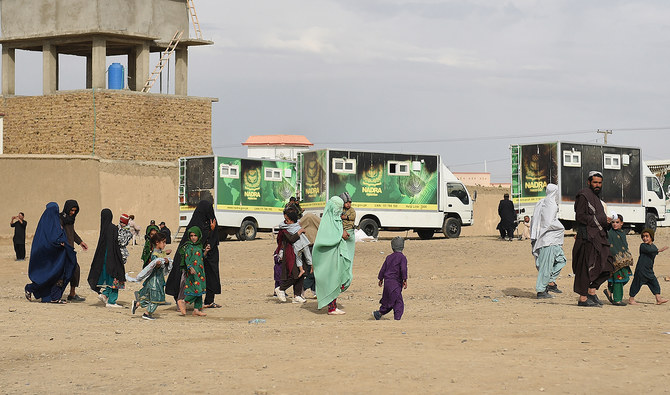

KARACHI: Pakistani police are arresting Afghan women and children in southern Sindh province as part of a government crackdown on migrants, activists said Saturday.
More than 250,000 Afghans have left Pakistan in recent weeks as the government rounded up, arrested and kicked out foreign nationals without papers. It set an Oct. 31 deadline for migrants without legal status to leave the country voluntarily.
The expulsions mostly affect Afghans, who make up the majority of foreigners living in Pakistan. Authorities maintain they are targeting all who are in the country illegally.
Human rights lawyer Moniza Kakar said police in Sindh launch midnight raids on people’s homes and detain Afghan families, including women and children.
Since Nov. 1, she and other activists have stationed themselves outside detention centers in Karachi to help Afghans. But they say they face challenges accessing the centers. They don’t have information about raid timings or deportation buses leaving the port city for Afghanistan.
“They’ve been arresting hundreds of Afghan nationals daily since the Oct. 31 deadline, sparing neither children nor women,” Kakar said.
Last December, Afghan women and children were among 1,200 people jailed in Karachi for entering the city without valid travel documents. The arrests brought criticism from around Afghanistan after images of locked-up children were circulated online.
In the latest crackdown, even Afghans with documentation face the constant threat of detention, leading many to confine themselves to their homes for fear of deportation, Kakar said. “Some families I know are struggling without food, forced to stay indoors as police officials continue arresting them, regardless of their immigration status.”
She highlighted the plight of refugee children born in Pakistan without proof of identity, even when their parents have papers. Minors are being separated from their families, she told The Associated Press.
A Pakistani child who speaks Pashto, one of Afghanistan's official languages, was detained and deported because his parents were unable to register him in the national database, according to Kakar.
The head of the Human Rights Commission of Pakistan, Hina Jilani, said Pakistan lacks a comprehensive mechanism to handle refugees, asylum-seekers and migrants without papers, despite hosting Afghans for 40 years.
She criticized the government’s “one-size-fits-all approach” and called for a needs-based assessment, especially for those who crossed the border after the Taliban seized control of Afghanistan in 2021.
Violence against Pakistani security forces and civilians has surged since the Taliban takeover. Most attacks have been claimed by the Pakistani Taliban, the Tehreek-e-Taliban Pakistan or TTP, a separate militant group but a close ally of the Afghan Taliban.
On Saturday, the TTP claimed responsibility for an attack that killed three police officers and injured another three in northwest Khyber Pakhtunkhwa province bordering Afghanistan.
Pakistan accuses the Taliban of harboring militants from groups like the TTP — allegations that the Taliban deny — and said Afghans without permanent legal status are responsible for some of the attacks.
Jilani highlighted the humanitarian aspect of dealing with Pakistan’s Afghan communities, saying they shouldn’t be solely viewed through a security lens.
The Sindh official responsible for detention and deportation centers in the province, Junaid Iqbal Khan, admitted there were “initial incidents” of mistaken identity, with documented refugees and even Pakistani nationals being taken to transit points or detention centers. But now only foreigners without proper registration or documentation are sent for deportation, Khan said.
Around 2,000 detainees have been taken to a central transit point in the past 10 days, with several buses heading to the Afghan border daily through southwest Baluchistan province.
Khan said he wasn’t involved in raids or detentions so couldn’t comment on allegations of mishandling.
Pakistan has long hosted millions of Afghans, most of whom fled during the 1979-1989 Soviet occupation. More than half a million fled Afghanistan after the Taliban takeover.


