Serbian protesters vow to prevent real estate project linked to Trump son-in-law Kushner

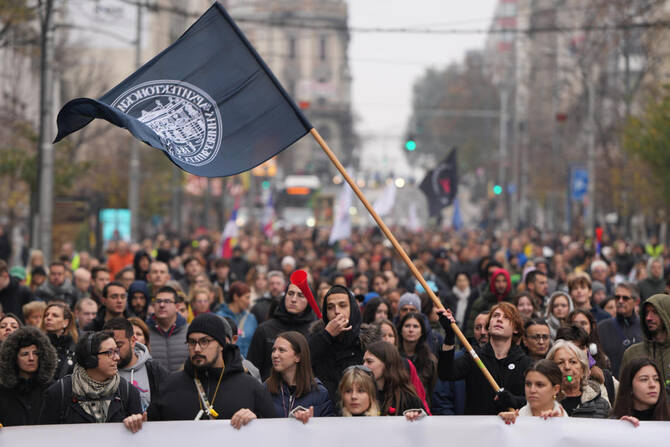
Led by university students, people attend a protest after Serbian lawmakers on Friday passed a special law clearing the way for a controversial real estate project that would be financed by an investment company linked to President Trump’s son-in-law Jared Kushner, in Belgrade, Nov. 11, 2025. (AP)
Short Url
Updated 11 November 2025
Follow

Serbian protesters vow to prevent real estate project linked to Trump son-in-law Kushner

  • Youth-led protesters drew a red line as they encircled the sprawling buildings in the capital
  • The $500-million project to build a high-rise hotel, offices and shops at the site has met fierce opposition

BELGRADE: Thousands of protesters in Serbia symbolically formed a human shield Tuesday around a bombed-out military complex, vowing to protect it from redevelopment as a luxury compound by a company linked to US President Donald Trump’s son-in-law Jared Kushner.
Youth-led protesters drew a red line as they encircled the sprawling buildings in the capital, Belgrade that were partially destroyed in a 1999 NATO bombing campaign. The site faces demolition and redevelopment under a plan backed by the populist government of President Aleksandar Vucic.
The $500-million project to build a high-rise hotel, offices and shops at the site has met fierce opposition from experts at home and abroad, as well as the Serbian public. But last week Serbian lawmakers passed a special law clearing the way for the construction despite legal hurdles.
Vucic’s pro-Trump government says the project would boost the economy and ties with the US administration, which has imposed tariffs of 35 percent on imports from Serbia. It has also sanctioned Serbia’s monopoly oil supplier, which is controlled by Russia.
However, critics say the building is an architectural monument, seen as a symbol of resistance to the US-led NATO bombing that remains widely viewed in the Balkan country as an unjust “aggression.”
Serbia’s government last year stripped the complex of protected status and signed a 99-year-lease agreement with Kushner-related Affinity Global Development in the US But the redevelopment project came into question after Serbia’s organized crime prosecutors launched an investigation into whether documents used to remove that status were forged.
The buildings are seen as prime examples of mid-20th century architecture in the former Yugoslavia. The protesters demanded that the protected heritage status for the complex be restored, and the buildings rebuilt.
“This is a warning that we will all defend these buildings together,” one of the students said. “We will be the human shield.”
The issue has become the latest flashpoint in yearlong street protests that have shaken Vucic’s firm grip on power. Protesters have accused his government of rampant corruption in state projects. The protests started after a concrete canopy collapsed at a train station in the northern city of Novi Sad after renovation, killing 16 people.
Tens of thousands of people marked the tragedy’s anniversary on Nov. 1 in Novi Sad.
Serbia was bombed in 1999 for 78 days to force then-President Slobodan Milosevic to end his crackdown on separatist ethnic Albanians in Kosovo. Anti-NATO sentiment remain strong in Serbia, and the US role in revamping the military buildings is particularly sensitive among many Serbians.
Earlier this year, the government in Albania, another Balkan country, approved a $1.6 billion plan from Kushner’s company for a project to develop a luxury resort on a communist-era fortified island on the Adriatic coast.


German spy chief warns of Russia threat to 2026 regional polls

Updated 3 sec ago
Follow

German spy chief warns of Russia threat to 2026 regional polls

  • Sinan Selen said hat Germany was especially in Moscow’s sights because it is a central logistics hub of the NATO alliance on the continent

BERLIN: Germany’s domestic spy chief warned Monday that Russia could step up sabotage, cyberattacks and disinformation campaigns next year when the EU’s top economy, a strong backer of Ukraine, holds several regional elections.
Sinan Selen, head of the BfV intelligence service, said in a Berlin speech that Germany was especially in Moscow’s sights because it is a central logistics hub of the NATO alliance on the continent.
Speaking later to AFP, Selen said about Russian disinformation campaigns that “we’ve repeatedly seen that elections play a very significant role here, and as you know we have several state elections in Germany next year.”
Russia is blamed by Western security services for a spate of drone flights, acts of sabotage, cyberattacks and online disinformation campaigns in Europe, which have escalated since its 2022 full-scale invasion of Ukraine.
“We are being attacked here and now in Europe,” Selen said in a speech marking 75 years since the founding of the BfV, the Federal Office for the Protection of the Constitution.
“In its role as a logistics hub for collective defense and support of Ukraine, Germany is more heavily targeted by Russian intelligence services than other countries,” he said.
“Above all Russia, as a hybrid actor, is undoubtedly aggressive, offensive and escalating. Its intelligence services employ a wide range of attack vectors from its toolbox.
“A clear sign of a highly dangerous escalation is the preparation and execution of sabotage attacks in Germany and other European countries, for which the Kremlin is considered the primary instigator. There is no sign of any relief in sight.”
Germany next year holds five regional elections, including in the ex-communist east, where the far-right and Moscow-friendly Alternative for Germany (AfD) party hopes to make further strong gains.
Selen, speaking about hybrid threats, said that “every sector of society can be affected, and this will be especially true in the coming year.”
The course of the Ukraine war would also strongly influence the actions of Russia, which Selen said “can scale the intensity of its sabotage operations at will.”
Selen added that “this war of aggression is more than a struggle for Ukrainian territory, it is a litmus test in the ongoing systemic conflict between authoritarianism and democracy in a multipolar and complex world.”