India, Pakistan border guards trade fire along Kashmir frontier; one Indian soldier killed

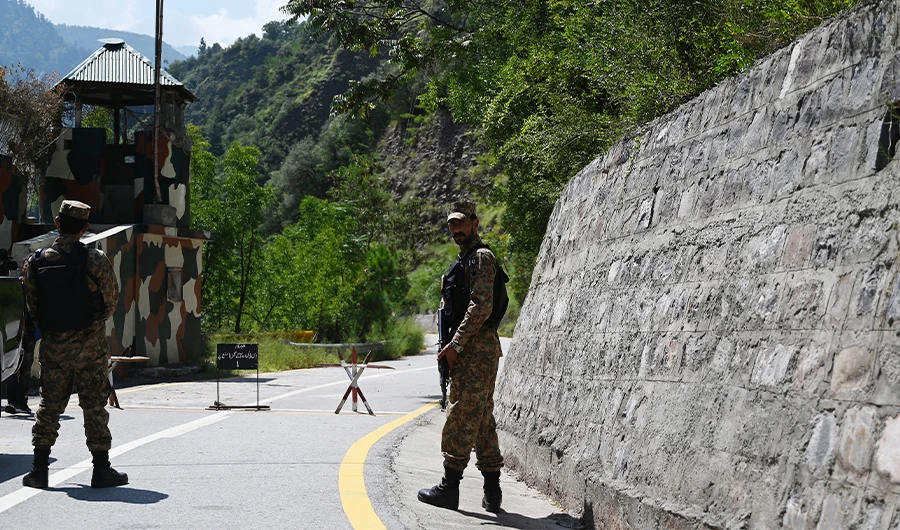
Pakistani troops patrol at the Line of Control -- the de facto border between Pakistan and India -- in Chakothi sector, in Pakistan-administered Kashmir on August 29, 2019. (AFP/File)
Short Url
Updated 09 November 2023
Follow

India, Pakistan border guards trade fire along Kashmir frontier; one Indian soldier killed

  • Both countries have fought two of their three wars since 1947 over their competing claims to the disputed region
  • In 2021, the two nations reaffirmed their 2003 cease-fire accord after months of near-daily fighting that killed scores

SRINAGAR, India: Indian and Pakistani soldiers exchanged gunfire and shelling along their highly militarized frontier in disputed Kashmir, killing an Indian border guard, officials said Thursday.
Authorities in the Indian-administered portion of Kashmir said Pakistani soldiers fired mortars and machine guns at border posts in the southern Jammu area on Wednesday night, calling it “unprovoked.”
India’s Border Security Force said in a statement that its soldiers “befittingly responded” and that one of its border guards was killed.
The fighting ended early Thursday.
There was no immediate comment from Pakistan. Each side often accuses the other of starting border skirmishes in the Himalayan region, which both claim in its entirety.
Last month, two Indian border guards and three civilians were injured in fighting along the fronter with Pakistan.
India and Pakistan have a long history of bitter relations over Kashmir. They have fought two of their three wars since 1947 over their competing claims to the region. In the Indian-administered portion of Kashmir, militants have fought against Indian rule since 1989. In 2003, the two nations agreed on a cease-fire that has largely held despite regular skirmishes.
The nuclear-armed countries’ contended frontier includes a 740-kilometer (460-mile) rugged and mountainous stretch called the Line of Control that is guarded by their armies.
Both countries also have separate paramilitary border forces guarding their somewhat defined, lower-altitude 200-kilometer (125-mile) boundary separating Indian-administered Kashmir and the Pakistani province of Punjab.
In 2021, the two nations reaffirmed their 2003 cease-fire accord after months of near-daily fighting that killed scores on both sides in Kashmir.


Pakistan, ADB sign $730 loan agreements to boost SOE reforms, energy infrastructure

Updated 25 December 2025
Follow

Pakistan, ADB sign $730 loan agreements to boost SOE reforms, energy infrastructure

  • Both sign $330 million Power Transmission Strengthening Project and $400 million SOE Transformation Program loan agreements
  • Economic Affairs Division official says Transmission Project will secure Pakistan’s energy future by strengthening national grid’s backbone

KARACHI: Pakistan and the Asian Development Bank (ADB) on Thursday signed two loan agreements totaling $730 million to boost reforms in state-owned enterprises (SOEs) and energy infrastructure in the country, the bank said.

The first of the two agreements pertains to the SOE Transformation Program worth $400 million while the second loan, worth $330 million, is for a Power Transmission Strengthening Project, the lender said. 

The agreements were signed by ADB Country Director for Pakistan Emma Fan and Pakistan’s Secretary of Economic Affairs Division Humair Karim. 

“The agreements demonstrate ADB’s enduring commitment to supporting sustainable and inclusive economic growth in Pakistan,” the ADB said. 

Pakistan’s SOEs have incurred losses worth billions of dollars over the years due to financial mismanagement and corruption. These entities, including the country’s national airline Pakistan International Airlines, which was sold to a private group this week, have relied on subsequent government bailouts over the years to operate.

The ADB approved the $400 million loan for SOE reforms on Dec. 12. It said the program seeks to improve governance and optimize the performance of Pakistan’s commercial SOEs. 

Karim highlighted that the Power Transmission Strengthening Project will enable reliable evacuation of 2,300 MW from Pakistan’s upcoming hydropower projects, relieve overloading of existing transmission lines and enhance resilience under contingency conditions, the Press Information Department (PID) said. 

“The Secretary emphasized that both initiatives are transformative in nature as the Transmission Project will secure Pakistan’s energy future by strengthening the backbone of the national grid whereas the SOE Program will enhance transparency, efficiency and sustainability of state-owned enterprises nationwide,” the PID said. 

The ADB has supported reforms by Pakistan to strengthen its public finance and social protection systems. It has also undertaken programs in the country to help with post-flood reconstruction, improve food security and social and human capital. 

To date, ADB says it has committed 764 public sector loans, grants and technical assistance totaling $43.4 billion to Pakistan.