

UAE exports set to soar 33% to $100bn in 2031: minister 

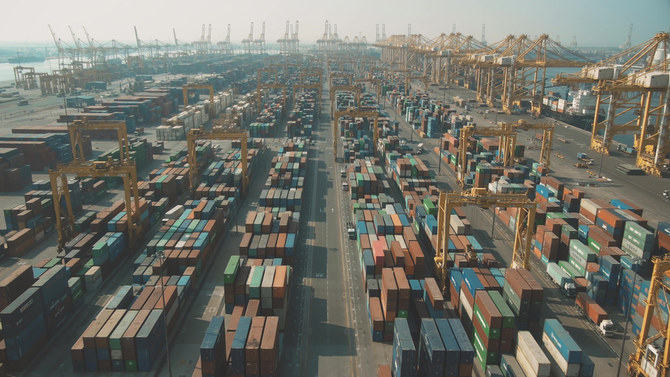
Jebel Ali container port. Shutterstock.
Short Url
Updated 08 November 2023
Follow

UAE exports set to soar 33% to $100bn in 2031: minister 

RIYADH: The UAE is set to establish comprehensive economic partnership agreements with 27 countries and economic blocs representing up to 95 percent of global trade, said a senior government official. 

Thani bin Ahmed Al-Zeyoudi, the UAE minister of state for foreign trade, said these agreements will increase the country’s gross domestic product by approximately $41.71 billion by 2031. 

He added that will also lead to an expected 33 percent growth in export volume to $100.25 billion. 

Al-Zeyoudi stated that the UAE is currently negotiating with 13 countries and economic blocs to establish free trade agreements. 

These countries include Colombia, Costa Rica, Chile, and Kenya, as well as Ukraine, Thailand, and the Eurasian Economic Union. 

It is also holding talks with Vietnam, Mercosur, Malaysia, and the Democratic Republic of the Congo. 

Al-Zeyoudi made these remarks on Nov. 7 during his presentation on foreign trade agreements at the UAE government’s annual meetings, reported the Emirates News Agency, also known as WAM. 

The minister highlighted the UAE’s prominent position in foreign trade, establishing itself as a leading international hub for non-oil business. 

He emphasized the country was leveraging its free trade agreements to diversify the economy through its increasing network of trading partners. 

Al-Zeyoudi said these partnerships aligned with the UAE’s goal to increase its non-oil foreign trade to 4 trillion dirhams ($1.09 trillion) by 2031. 

According to WAM, the UAE aims to open new markets and establish itself as a global leader in service exports while increasing the value of re-exports. 

The UAE free trade agreement, which came into force on May 1, 2022, has achieved positive results, with non-oil trade exceeding $54.8 billion in one year. 

The agreement is projected to achieve $100 billion in annual bilateral trade within five years, contributing to an increase of over 2.5 percent in the country’s GDP by 2031. 

The partnership will grow the overall trade between the two nations to $128 billion. 

Al-Zeyoudi stated that the UAE is currently negotiating with 13 countries and economic blocs to establish free trade agreements. 

According to the minister, the country’s competitiveness in nine key service sectors is a critical advantage. These sectors include information technology, education, construction services, and Islamic financial services, as well, as financial services, medical tourism and creative economy. 

The country is the fifth-largest re-exporter globally, accounting for 6.6 percent of its GDP and providing approximately 1 million jobs.  

The total value of the re-export sector is 614.6 billion dirhams, contributing 28 percent to the country’s non-oil trade in 2022. 

Al-Zeyoudi emphasized the importance of hosting and chairing the 2024 World Trade Organization Ministerial Conference. 

During this event, the UAE will lead international efforts to shape global trade dialogues, improving the efficiency of global supply chains and creating a more resilient and sustainable global trade system, thus fostering comprehensive global development. 


Saudi non-oil exports jump 21% as trade balance improves: GASTAT 

Updated 5 sec ago
Follow

Saudi non-oil exports jump 21% as trade balance improves: GASTAT 

RIYADH: Saudi Arabia’s non-oil exports, including re-exports, rose 20.7 percent year on year in November to SR32.69 billion ($8.72 billion), official data showed. 

According to preliminary figures released by the General Authority for Statistics, national non-oil exports, excluding re-exports, increased by 4.7 percent in November compared with the same month in 2024. 

The strong performance highlights progress under the Kingdom’s Vision 2030 strategy, which aims to diversify the economy and reduce its long-standing dependence on crude oil revenues. 

In its latest report, GASTAT stated: “The ratio of non-oil exports, including re-exports, to imports increased in November 2025, reaching 42.2 percent, compared with 34.9 percent in November 2024. This increase was driven by a 20.7 percent rise in non-oil exports, alongside a 0.2 percent decline in imports over the same period.”  

It added: “The value of re-exported goods increased by 53.1 percent during the same period, driven by an 81.9 percent increase in ‘machinery, electrical equipment and parts’, which accounted for 51.5 percent of total re-exports.”  

Machinery, electrical equipment and parts also led the non-oil export basket, making up 24.2 percent of outbound shipments and recording an 81.5 percent annual increase. This was followed by products of the chemical industries, which represented 20.3 percent of total non-oil exports and rose 0.5 percent year on year. 

The data adds to signs of resilience in Saudi Arabia’s non-oil economy, with S&P Global’s Purchasing Managers’ Index at 57.4 in December, well above the 50 threshold that separates expansion from contraction. 

Top non-oil destinations 

The UAE was the leading destination for Saudi non-oil exports in November, with shipments valued at SR10.48 billion. 

India ranked second at SR3.01 billion, followed by China at SR2.32 billion, Singapore at SR1.76 billion and Bahrain at SR900.7 million. 

Exports to Egypt totaled SR815.5 million during the month, while Turkiye and Jordan received goods worth SR799.1 million and SR773.3 million, respectively. 

GASTAT said ports and airports played a central role in facilitating non-oil shipments in November. 

By sea, Jeddah Islamic Seaport handled the largest volume of non-oil exports at SR3.57 billion, followed by King Fahad Industrial Seaport in Jubail at SR3.51 billion. 

Ras Al-Khair Seaport was the exit point for non-oil goods valued at SR2.66 billion, while Jubail Seaport and King Abdulaziz Seaport in Dammam handled outbound shipments worth SR2.32 billion and SR2.14 billion, respectively. 

By air, King Abdulaziz International Airport handled goods worth SR5.60 billion, while King Khalid International Airport in Riyadh processed exports valued at SR3.53 billion. 

Exports and imports 

Saudi Arabia’s total merchandise exports reached SR99.73 billion in November, representing a 10 percent increase compared with the same month in 2024. 

“Merchandise exports in November 2025 increased by 10.0 percent compared to November 2024, and oil exports increased by 5.4 percent. The percentage of oil exports in total exports declined from 70.1 percent in November 2024 to 67.2 percent in November 2025,” GASTAT added.  

China remained the Kingdom’s largest export destination, accounting for 13.5 percent of total exports, followed by the UAE at 11.7 percent and Japan at 9.9 percent. India, South Korea, the US, Egypt, Singapore, Bahrain and Poland were also among the top 10 destinations, which together accounted for 71.4 percent of total exports. 

Imports declined by 0.2 percent year on year in November to SR77.38 billion, while the merchandise trade surplus surged by 70.2 percent, the report showed. 

China was the Kingdom’s largest source of imports, accounting for 26.7 percent of inbound shipments, followed by the US at 10.2 percent and the UAE at 6.2 percent.  

“Germany, Japan, India, Italy, France, Switzerland, and Egypt were also among the top ten import sources, with total imports from these ten countries representing 68.6 percent of Saudi Arabia’s overall imports,” added GASTAT.  

King Abdulaziz Port in Dammam was the leading entry point for goods, handling 22.8 percent of imports in November. Jeddah Islamic Port followed with 22.6 percent, ahead of King Khalid International Airport in Riyadh at 17 percent and King Abdulaziz International Airport in Jeddah at 11.9 percent.