

In unprecedented move, Pakistan charges Afghan authorities with ‘facilitating’ militants

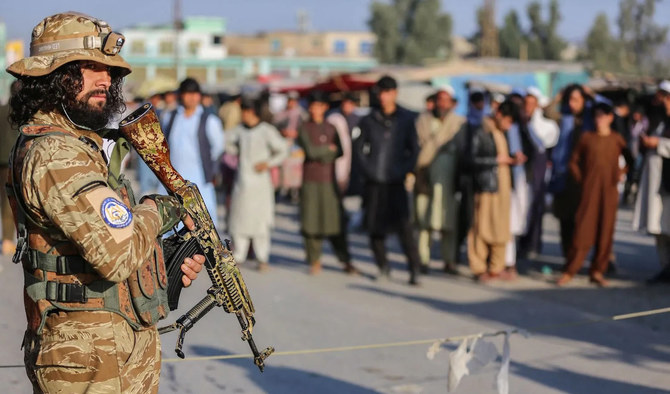
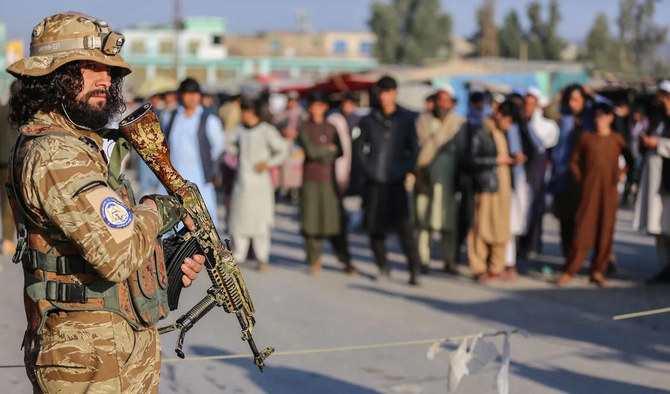
A Taliban security personnel stand guard as Afghan people wait to cross into Pakistan, near the closed Torkham gate at the Torkham border crossing between Afghanistan and Pakistan, in Nangarhar province on February 23, 2023. (AFP/File)
Short Url
Updated 08 November 2023
Follow

In unprecedented move, Pakistan charges Afghan authorities with ‘facilitating’ militants

  • Anwaar-ul-Haq Kakar says his country asked Kabul to choose between Pakistan and TTP earlier this year
  • The PM’s strongly worded statement hints at a near-collapse of cordial ties between the two countries

ISLAMABAD: In an unprecedented development, Caretaker Prime Minister Anwaar-ul-Haq Kakar on Wednesday blamed Afghanistan’s interim administration for not doing enough to address Pakistan’s security concerns by clamping down on militants operating from its territory, adding there was also some evidence of “facilitation” implicating the Taliban authorities in certain cases.

Pakistan has tried to convince the international community to constructively engage the Afghan Taliban since they swept back to power about two years ago, asking countries across the world to help ease Afghanistan’s financial constraints to prevent yet another humanitarian catastrophe in the region.

At the same time, officials in Islamabad have blamed a recent surge in militant violence in Pakistan on a proscribed network, Tehreek-e-Taliban Pakistan (TTP), whose leaders are said to be based in Afghanistan, asking the government in Kabul not to allow its soil to be used for attacks against Pakistan.

However, the Pakistani PM’s strongly worded statement is the first high-profile public display of his country’s discontent with Afghanistan, indicating a near-collapse of the previously cordial ties between the two countries.

Addressing a news conference in Islamabad, Kakar said militant violence had increased by 60 percent and suicide bombings had shot up by 500 percent since the formation of the interim Afghan administration.

“In the last two years, 2,267 innocent Pakistanis have lost their lives for which TTP terrorists are responsible who have been using the Afghan territory to launch cowardly attacks in Pakistan,” he said. “During this period, 15 Afghan nationals were found involved in suicide bombings. Apart from that, 64 Afghan citizens have also died while fighting Pakistan’s law enforcing agencies.”

The prime minister said Afghan authorities were aware of these details since his country had been sharing all this information with them since February on a fortnightly basis.
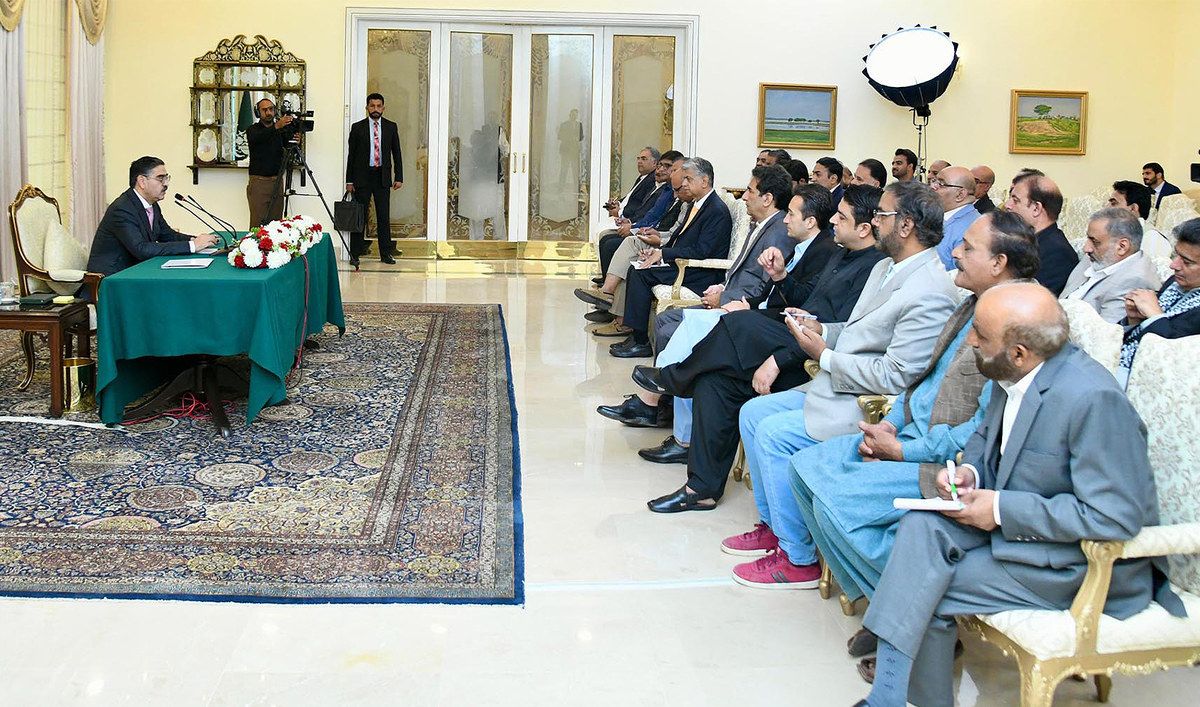


Pakistan Prime Minister Anwaar-ul-Haq (left) speaks during a press conference in Islamabad, Pakistan, on November 8, 2023. (PID)

The prime minister also made a startling revelation, saying that Pakistan gave a stark choice to officials in Kabul through a delegation led by its defense minister after a deadly suicide bombing in the country’s northwestern Khyber Pakhtunkhwa province in February that claimed more than 100 lives.

“The delegation communicated the country’s strong reservations to the Afghan authorities and clearly told them to choose between Pakistan or the TTP,” he continued.

“Despite the guarantees by the Afghan interim government, no concrete steps were taken against anti-Pakistan terrorist groups,” he added. “In fact, evidence of facilitation of terrorists emerged on certain occasions.”

The prime minister said Pakistan had decided to address its security problems on its own, many of which, he maintained, were created by illegal immigrants who had been asked by his government to leave in October.

He observed the Taliban authorities in Afghanistan had since issued misleading and hostile statements which were “regrettable.”

Kakar said the uptick in militant attacks following these assertions was “not only meaningful but also endorsed Pakistan’s suspicions.”

The prime minister’s media talk came ahead of his departure to Uzbekistan where he is scheduled to attend the 16th Economic Cooperation Organization (ECO) Summit.

Among other Central Asian nations, Afghanistan is also a member state of the regional forum.


Pakistan, China to sign multiple MoUs at major agriculture investment conference today

Updated 18 January 2026
Follow

Pakistan, China to sign multiple MoUs at major agriculture investment conference today

  • Hundreds of Chinese and Pakistani firms to attend Islamabad event
  • Conference seen as part of expanding CPEC ties into agriculture, trade

KARACHI: Islamabad and Beijing are set to sign multiple memorandums of understanding (MoUs) to boost agricultural investment and cooperation at a major conference taking place in the capital today, Monday, with hundreds of Chinese and Pakistani companies expected to participate.

The conference is being billed by Pakistan’s Ministry of National Food Security and Research as a platform for deepening bilateral agricultural ties and supporting broader economic engagement between the two countries.

“Multiple memorandums of understanding will be signed at the Pakistan–China Agricultural Conference,” the Ministry of National Food Security said in a statement. “115 Chinese and 165 Pakistani companies will participate.”

The conference reflects a growing emphasis on expanding Pakistan-China economic cooperation beyond the transport and energy foundations of the flagship China-Pakistan Economic Corridor (CPEC) into agriculture, industry and technology.

Under its first phase launched in 2015, CPEC, a core component of China’s Belt and Road Initiative, focused primarily on transportation infrastructure, energy generation and connectivity projects linking western China to the Arabian Sea via Pakistan. That phase included motorways, power plants and the development of the Gwadar Port in the country's southwest, aimed at helping Pakistan address chronic power shortages and enhance transport connectivity.

In recent years, both governments have formally moved toward a “CPEC 2.0” phase aimed at diversifying the corridor’s impact into areas such as special economic zones, innovation, digital cooperation and agriculture. Second-phase discussions have highlighted Pakistan’s goal of modernizing its agricultural sector, attracting Chinese technology and investment, and boosting export potential, with high-level talks taking place between planning officials and investors in Beijing.

Agri-sector cooperation has also seen practical collaboration, with joint initiatives examining technology transfer, export protocols and value-chain development, including partnerships in livestock, mechanization and horticulture.

Organizers say the Islamabad conference will bring together government policymakers, private sector investors, industry associations and multinational agribusiness firms from both nations. Discussions will center on investment opportunities, technology adoption, export expansion and building linkages with global buyers within the framework of Pakistan-China economic cooperation.