EU weighs advancing Ukraine’s membership bid as Russia war drags on

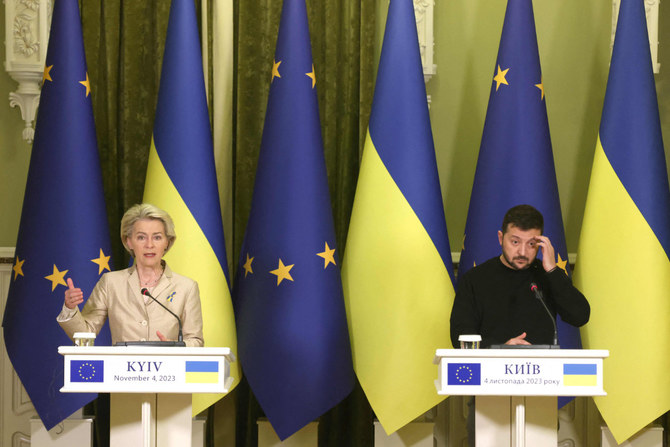
European Commission President Ursula von der Leyen (L) and Ukraine's President Volodymyr Zelensky (R) give a joint press conference following their talks in Kyiv on November 4, 2023, amid the Russian invasion of Ukraine. (AFP)
Short Url
Updated 06 November 2023
Follow

EU weighs advancing Ukraine’s membership bid as Russia war drags on

  • Ukraine hopes to start EU membership talks
  • Moldova seen possibly following suit, questions over Georgia

BRUSSELS: The European Union executive is expected to recommend taking Ukraine one step closer to becoming a member of the bloc this week, according to EU officials, a coveted prize for Kyiv as weariness creeps in nearly two years after Russia’s invasion.

European Commission President Ursula von der Leyen’s Brussels-based executive will publish a report on Wednesday assessing progress achieved toward membership by EU hopefuls. On a visit to Kyiv on Saturday, she praised Ukraine for making headway.
The report and recommendation will inform a key decision in December by a summit of the EU’s national leaders on whether to start formal membership negotiations with Kyiv.
Such talks take years before candidates meet extensive legal and economic criteria to join, and the bloc is not willing to take in a country at war.
Still, advancing Western integration is a top priority for Ukraine, where troops face battle fatigue and concerns swirl over the future of vital US military aid.
The Commission said last June that Ukraine met two out of seven conditions the EU had set to start membership talks.
“You have made excellent progress,” von der Leyen told a news conference with Ukraine’s President Volodymyr Zelensky on Saturday.
“You are fighting an existential war and at the same time deeply reforming your country,” she said in highlighting reforms to Ukraine’s justice system, reining in oligarchs and tackling money laundering.
She expressed confidence that Ukraine would soon complete the remaining steps — related to fighting corruption and safeguarding minority rights — and advance on its EU path.
Zelensky said Kyiv would deliver on the conditions, and that a positive EU decision would give fresh motivation to his society and troops. He said Ukraine eventually joining the EU would strengthen both.
“There will be no grey geo-political zones in Europe. We will secure a new basis for growth and development of Ukraine and all European countries. We will guarantee to our country and citizens real economic and social security,” he said.
His comments capped a week when Ukraine’s commander-in-chief said the war was moving toward attritional fighting and the Italian premier spoke of international fatigue with the war during a prank call that was later made public.

Moldova and Georgia
In good news for Ukraine, Germany’s foreign minister expressed confidence that the EU would advance its bid to join.
Kyiv is expected to get a green light this week “on the understanding that” it does more to tackle graft and secure minority rights, the latter issue raised by Hungarian Prime Minister Viktor Orban, who prides himself on his contacts with Moscow.
The Commission report on Wednesday will also cover other EU hopefuls, including Georgia and Moldova.
The latter got nine conditions to start membership talks, including fighting organized crime, and can get a conditional positive recommendation along with its neighbor Ukraine.
“Moldova has shown its resilience and commitment to progress its EU agenda while taking measures to mitigate the impact of Russia’s war of aggression,” said a draft of the report, which was seen by Reuters ahead of official publication.
EU officials say Georgia has not satisfied the 12 conditions it was given to win candidate country status, something Kyiv and Chisinau secured last year a few months after Russia launched its large-scale invasion of Ukraine in February.
But Tbilisi has the backing of Orban and could still move ahead on its EU path as the bloc wrestles for influence with Russia.


Reference to Trump’s impeachments is removed from the display of his Smithsonian photo portrait

Updated 9 sec ago
Follow

Reference to Trump’s impeachments is removed from the display of his Smithsonian photo portrait

  • For now, references to Presidents Andrew Johnson and Bill Clinton being impeached in 1868 and 1998, respectively, remain as part of their portrait labels, as does President Richard Nixon’s 1974 resignation as a result of the Watergate scandal

WASHINGTON: President Donald Trump’s photo portrait display at the Smithsonian’s National Portrait Gallery has had references to his two impeachments removed, the latest apparent change at the collection of museums he has accused of bias as he asserts his influence over how official presentations document US history.
The wall text, which summarized Trump’s first presidency and noted his 2024 comeback victory, was part of the museum’s “American Presidents” exhibition. The description had been placed alongside a photograph of Trump taken during his first term. Now, a different photo appears without any accompanying text block, though the text was available online. Trump was the only president whose display in the gallery, as seen Sunday, did not include any extended text.
The White House did not say whether it sought any changes. Nor did a Smithsonian statement in response to Associated Press questions. But Trump ordered in August that Smithsonian officials review all exhibits before the nation celebrates the 250th anniversary of the Declaration of Independence on July 4. The Republican administration said the effort would “ensure alignment with the president’s directive to celebrate American exceptionalism, remove divisive or partisan narratives, and restore confidence in our shared cultural institutions.”
Trump’s original “portrait label,” as the Smithsonian calls it, notes Trump’s Supreme Court nominations and his administration’s development of COVID-19 vaccines. That section concludes: “Impeached twice, on charges of abuse of power and incitement of insurrection after supporters attacked the US Capitol on January 6, 2021, he was acquitted by the Senate in both trials.”
Then the text continues: “After losing to Joe Biden in 2020, Trump mounted a historic comeback in the 2024 election. He is the only president aside from Grover Cleveland (1837– 1908) to have won a nonconsecutive second term.”
Asked about the display, White House spokesman Davis Ingle celebrated the new photograph, which shows Trump, brow furrowed, leaning over his Oval Office desk. Ingle said it ensures Trump’s “unmatched aura ... will be felt throughout the halls of the National Portrait Gallery.”
The portrait was taken by White House photographer Daniel Torok, who is credited in the display that includes medallions noting Trump is the 45th and 47th president. Similar numerical medallions appear alongside other presidents’ painted portraits that also include the more extended biographical summaries such as what had been part of Trump’s display.
Sitting presidents are represented by photographs until their official paintings are commissioned and completed.
Ingle did not answer questions about whether Trump or a White House aide, on his behalf, asked for anything related to the portrait label.
The gallery said in a statement that it had previously rotated two photographs of Trump from its collection before putting up Torok’s work.
“The museum is beginning its planned update of the America’s Presidents gallery which will undergo a larger refresh this Spring,” the gallery statement said. “For some new exhibitions and displays, the museum has been exploring quotes or tombstone labels, which provide only general information, such as the artist’s name.”
For now, references to Presidents Andrew Johnson and Bill Clinton being impeached in 1868 and 1998, respectively, remain as part of their portrait labels, as does President Richard Nixon’s 1974 resignation as a result of the Watergate scandal.
And, the gallery statement noted, “The history of Presidential impeachments continues to be represented in our museums, including the National Museum of American History.”
Trump has made clear his intentions to shape how the federal government documents US history and culture. He has offered an especially harsh assessment of how the Smithsonian and other museums have featured chattel slavery as a seminal variable in the nation’s development but also taken steps to reshape how he and his contemporary rivals are depicted.
In the months before his order for a Smithsonian review, he fired the head archivist of the National Archives and said he was firing the National Portrait Gallery’s director, Kim Sajet, as part of his overhaul. Sajet maintained the backing of the Smithsonian’s governing board, but she ultimately resigned.
At the White House, Trump has designed a notably partisan and subjective “Presidential Walk of Fame” featuring gilded photographs of himself and his predecessors — with the exception of Biden, who is represented by an autopen — along with plaques describing their presidencies.
The White House said at the time that Trump himself was a primary author of the plaques. Notably, Trump’s two plaques praise the 45th and 47th president as a historically successful figure while those under Biden’s autopen stand-in describe the 46th executive as “by far, the worst President in American History” who “brought our Nation to the brink of destruction.”