

Reference to Trump’s impeachments is removed from the display of his Smithsonian photo portrait

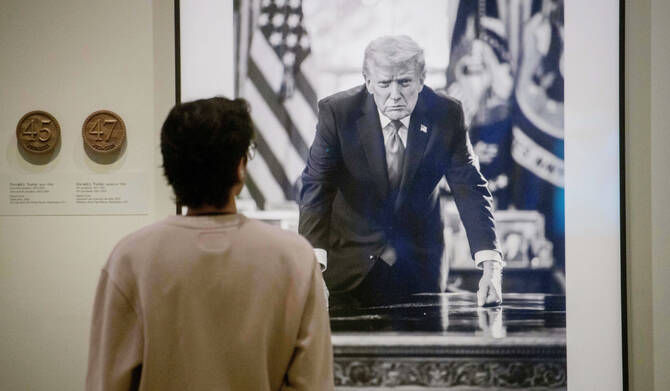
A visitor stops to look at a photograph of President Donald Trump and a short plaque next to it are on display at the Smithsonian's National Portrait Gallery's "American Presidents" exhibit on Sunday, Jan. 11, 2026 in Washington. (AP)
Short Url
Updated 12 January 2026
Follow

Reference to Trump’s impeachments is removed from the display of his Smithsonian photo portrait

  • For now, references to Presidents Andrew Johnson and Bill Clinton being impeached in 1868 and 1998, respectively, remain as part of their portrait labels, as does President Richard Nixon’s 1974 resignation as a result of the Watergate scandal

WASHINGTON: President Donald Trump’s photo portrait display at the Smithsonian’s National Portrait Gallery has had references to his two impeachments removed, the latest apparent change at the collection of museums he has accused of bias as he asserts his influence over how official presentations document US history.
The wall text, which summarized Trump’s first presidency and noted his 2024 comeback victory, was part of the museum’s “American Presidents” exhibition. The description had been placed alongside a photograph of Trump taken during his first term. Now, a different photo appears without any accompanying text block, though the text was available online. Trump was the only president whose display in the gallery, as seen Sunday, did not include any extended text.
The White House did not say whether it sought any changes. Nor did a Smithsonian statement in response to Associated Press questions. But Trump ordered in August that Smithsonian officials review all exhibits before the nation celebrates the 250th anniversary of the Declaration of Independence on July 4. The Republican administration said the effort would “ensure alignment with the president’s directive to celebrate American exceptionalism, remove divisive or partisan narratives, and restore confidence in our shared cultural institutions.”
Trump’s original “portrait label,” as the Smithsonian calls it, notes Trump’s Supreme Court nominations and his administration’s development of COVID-19 vaccines. That section concludes: “Impeached twice, on charges of abuse of power and incitement of insurrection after supporters attacked the US Capitol on January 6, 2021, he was acquitted by the Senate in both trials.”
Then the text continues: “After losing to Joe Biden in 2020, Trump mounted a historic comeback in the 2024 election. He is the only president aside from Grover Cleveland (1837– 1908) to have won a nonconsecutive second term.”
Asked about the display, White House spokesman Davis Ingle celebrated the new photograph, which shows Trump, brow furrowed, leaning over his Oval Office desk. Ingle said it ensures Trump’s “unmatched aura ... will be felt throughout the halls of the National Portrait Gallery.”
The portrait was taken by White House photographer Daniel Torok, who is credited in the display that includes medallions noting Trump is the 45th and 47th president. Similar numerical medallions appear alongside other presidents’ painted portraits that also include the more extended biographical summaries such as what had been part of Trump’s display.
Sitting presidents are represented by photographs until their official paintings are commissioned and completed.
Ingle did not answer questions about whether Trump or a White House aide, on his behalf, asked for anything related to the portrait label.
The gallery said in a statement that it had previously rotated two photographs of Trump from its collection before putting up Torok’s work.
“The museum is beginning its planned update of the America’s Presidents gallery which will undergo a larger refresh this Spring,” the gallery statement said. “For some new exhibitions and displays, the museum has been exploring quotes or tombstone labels, which provide only general information, such as the artist’s name.”
For now, references to Presidents Andrew Johnson and Bill Clinton being impeached in 1868 and 1998, respectively, remain as part of their portrait labels, as does President Richard Nixon’s 1974 resignation as a result of the Watergate scandal.
And, the gallery statement noted, “The history of Presidential impeachments continues to be represented in our museums, including the National Museum of American History.”
Trump has made clear his intentions to shape how the federal government documents US history and culture. He has offered an especially harsh assessment of how the Smithsonian and other museums have featured chattel slavery as a seminal variable in the nation’s development but also taken steps to reshape how he and his contemporary rivals are depicted.
In the months before his order for a Smithsonian review, he fired the head archivist of the National Archives and said he was firing the National Portrait Gallery’s director, Kim Sajet, as part of his overhaul. Sajet maintained the backing of the Smithsonian’s governing board, but she ultimately resigned.
At the White House, Trump has designed a notably partisan and subjective “Presidential Walk of Fame” featuring gilded photographs of himself and his predecessors — with the exception of Biden, who is represented by an autopen — along with plaques describing their presidencies.
The White House said at the time that Trump himself was a primary author of the plaques. Notably, Trump’s two plaques praise the 45th and 47th president as a historically successful figure while those under Biden’s autopen stand-in describe the 46th executive as “by far, the worst President in American History” who “brought our Nation to the brink of destruction.”


UK veterans are ‘ticking time bomb’ after Iraq war chemical exposure

Updated 59 min 52 sec ago
Follow

UK veterans are ‘ticking time bomb’ after Iraq war chemical exposure

  • Fifteen former RAF personnel were deployed to the Qarmat Ali water plant in 2003, which was contaminated with sodium dichromate
  • Veterans say they were not screened or protected, and are now living with serious health conditions

LONDON: Fifteen British servicemen who worked on a carcinogen-contaminated water treatment site during the Iraq war say they were not offered biological screening despite official guidance saying they should have been.

The former Royal Air Force members, who have suffered from ailments including cancer, tumors and nosebleeds, told Sky News they were offered no medical assistance or subsequent treatment after having been exposed to toxic sodium dichromate at the Qarmat Ali water treatment plant in 2003.

The channel said it had seen a letter from the RAF’s medical authority stating that senior officers knew of the dangers posed by the substance.

Peter Lewis, 53, was one of 88 personnel deployed to guard the site, which was deemed vital for getting Iraq’s oil industry up and running. He told Sky: “I’ve had eight or nine operations to remove cancer.

“I’ve had so many lumps taken out of my neck, one on my face. This is something I’m literally fighting every year now. It’s constant.”

Qarmat Ali, the former troops say, was covered in ripped bags of bright orange sodium dichromate.

“We were never warned what the bags of chemicals were,” Jon Caunt, another former serviceman, said. “We were breathing this stuff in.”

His former comrade Tony Watters added: “I never thought about what it was. We were told the site is safe.”

Several months after deployment to the site, however, the servicemen were joined by two workers wearing protective gear who placed signs around it reading: “Warning. Chemical hazard. Full protective equipment and chemical respirator required. Sodium dichromate exposure.”

Watters said: “When you left the site, your uniform was contaminated, your webbing was contaminated.

“You went in your sleeping bag, and that was contaminated. And you were contaminating other people with it back at camp.”

Andy Tosh, who has led the group of veterans as they sought answers from the Ministry of Defence, said: “Even with the warning signs going up … they kept us there. They knowingly kept us exposed.”

The RAF gave some of the men a leaflet on their return to the UK, warning of the dangers of the substance, but not all were told.

The letter seen by Sky acknowledging the dangers posed to the veterans made a “strong” link to “increased risk of lung and nose cancer” as well as numerous other issues. It suggested personnel sent to Qarmat Ali should have their medical records altered to mention their exposure to sodium dichromate.

“Offer biological screening. This cannot be detailed until the numbers exposed are confirmed,” the letter also said.

An inquiry into US personnel deployed to Qarmat Ali found that 830 people were “unintentionally exposed” to sodium dichromate, giving them access to support from the US Department of Veterans Affairs. This came after the death of Lt. Col. James Gentry from cancer in 2009, which the US Army determined came “in line of duty for exposure to sodium dichromate.”

There has been no such inquiry by UK authorities despite British personnel being deployed at the site for longer than their American counterparts.

Thirteen of them have suffered from cancer and similar symptoms, including one who developed a brain tumor.

Jim Garth told Sky: “My skin cancer will never go away … It’s treatable, but when the treatment is finished, it comes back, so I’ve got that for life really.”

Lewis added: “I’m actually getting to the point now where I don’t care anymore … sooner or later, it’s going to do me.”

Caunt described his former colleagues’ conditions as a “ticking time bomb.”

He added: “We do not know what’s going to happen in the future."

The MoD insists medical screening was offered to personnel at the time, despite the men stating that it was not. In 2024, several met with Labour MPs about the issue. One, John Healey, who is now the UK defence secretary, said at the time the veterans should have “answers to their important questions.”

In a statement, the MoD said: “We take very seriously the concerns raised by veterans who were deployed to guard the Qarmat Ali Water Treatment Plant in 2003.

“As soon as we were alerted to the possible exposure of Sodium Dichromate, an environmental survey was conducted to evaluate typical exposure at Qarmat Ali. Results showed that the levels at the time were significantly below UK government guidance levels.”

A 2004 letter seen by Sky News suggested, however, that the MoD knew the levels of sodium dichromate were higher.

“Anyone who requires medical treatment can receive it through the Defence Medical Services and other appropriate services,” the MoD said.

“Veterans who believe they have suffered ill health due to service can apply for no-fault compensation under the War Pensions Scheme.”

Watters called on the government to hold an investigation into what happened at Qarmat Ali.

“We are the working class, we are ex-soldiers who have put our lives on the line and you’re turning a blind eye to us,” he said.

Garth added: “We felt let down at Qarmat Ali all those years ago, and we still feel let down now.”