

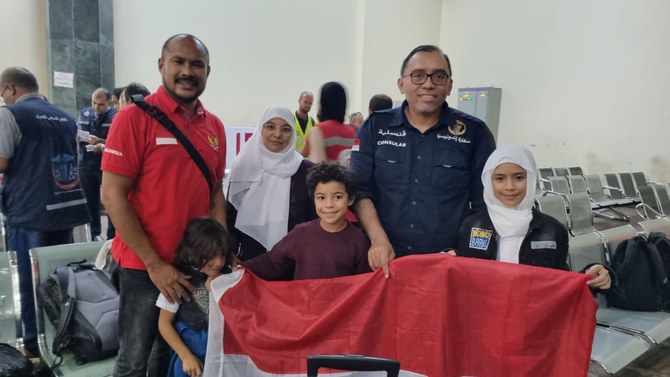
First Indonesians leave Gaza after difficulties to ensure safe passage

Indonesian citizen Abdillah Onim, his Palestinian wife and three children are received by Indonesia’s consular staff at Gaza’s Rafah crossing with Egypt on Nov. 2, 2023. (Indonesian MoFA)
Short Url
Updated 03 November 2023
Follow

First Indonesians leave Gaza after difficulties to ensure safe passage

  • 10 Indonesians were trapped in Gaza when Israeli attacks began last month
  • Indonesia’s FM says evacuation is difficult in the face of constant bombardment

Jakarta: Indonesia has evacuated four nationals from the Gaza Strip, its foreign minister said on Friday, after complex efforts to ensure safe passage for them.

Ten Indonesians have been living in the densely populated Palestinian enclave, which has been under constant fire since Oct. 7, when Israeli warplanes began their daily bombardment of residential buildings, schools and medical facilities in retaliation for an attack by the Gaza-based militant group Hamas.

More than three weeks into the deadly bombardment, which has killed more than 9,000 people, most of them women and children, and wounded tens of thousands, Israel has allowed some foreign passport holders to evacuate to Egypt through the Rafah crossing.

With no humanitarian ceasefire, however, the evacuees and those helping them reach the border, remain under constant threat from Israeli strikes.

Foreign Minister Retno Marsudi told reporters in Jakarta that so far one family, consisting of an Indonesian national, his Palestinian wife, and their three children, has managed to enter Egypt.

Evacuation, she said, was “not something easy” and it took three attempts since Wednesday for the family to reach Rafah, because “there were attacks along the way.”

The family eventually reached the border on Thursday evening and on Friday morning was taken care of by Indonesia’s consular staff in Egypt.

“What makes the evacuation process even more difficult is that communication is on and off. Sometimes the connection is there but most of the time it is not,” Marsudi said, adding that other countries have been experiencing the same difficulties.

“My explanation regarding the efforts ... is proof of the very difficult undertaking needed to create a corridor for safe evacuation.”

The cutting of phone and internet connections by Israel last week plunged Gaza into a communications blackout amid intensified aerial bombardment.

While some communication has been restored, it is regularly shut down and difficult to maintain as power supplies have run out in the besieged area.

Indonesia is now trying to evacuate a second family.

“They are three Indonesian citizens (husband and two children) and a Palestinian wife. Yesterday, on Nov. 2, they arrived at the Rafah gate, but there are still several administrative issues that are being resolved,” Marsudi said.

She added that there were another three Indonesians in Gaza — volunteers of the Indonesian NGO Medical Emergency Rescue Committee, or MER-C, which funds the Indonesia Hospital in Bait Lahia.

They remain at the hospital and have opted to stay.

“From the beginning, we have also been communicating with the three of them,” the minister said.

“They have decided to stay in Gaza. We will continue to be in touch.”


India, Arab League target $500bn in trade by 2030

Updated 01 February 2026
Follow

India, Arab League target $500bn in trade by 2030

  • It was the first such gathering of India–Arab FMs since the forum’s inauguration in 2016
  • India and Arab states agree to link their startup ecosystems, cooperate in the space sector

NEW DELHI: India and the Arab League have committed to doubling bilateral trade to $500 billion by 2030, as their top diplomats met in New Delhi for the India–Arab Foreign Ministers’ Meeting. 

The foreign ministers’ forum is the highest mechanism guiding India’s partnership with the Arab world. It was established in March 2002, with an agreement to institutionalize dialogue between India and the League of Arab States, a regional bloc of 22 Arab countries from the Middle East and North Africa.

The New Delhi meeting on Saturday was the first gathering in a decade, following the inaugural forum in Bahrain in 2016.

India’s Foreign Minister S. Jaishankar said in his opening remarks that the forum was taking place amid a transformation in the global order.

“Nowhere is this more apparent than in West Asia or the Middle East, where the landscape itself has undergone a dramatic change in the last year,” he said. “This obviously impacts all of us, and India as a proximate region. To a considerable degree, its implications are relevant for India’s relationship with Arab nations as well.”

Jaishankar and his UAE counterpart co-chaired the talks, which aimed at producing a cooperation agenda for 2026-28.

“It currently covers energy, environment, agriculture, tourism, human resource development, culture and education, amongst others,” Jaishankar said.

“India looks forward to more contemporary dimensions of cooperation being included, such as digital, space, start-ups, innovation, etc.”

According to the “executive program” released by India’s Ministry of External Affairs, the roadmap agreed by India and the League outlined their planned collaboration, which included the target “to double trade between India and LAS to US$500 billion by 2030, from the current trade of US$240 billion.”

Under the roadmap, they also agreed to link their startup ecosystems by facilitating market access, joint projects, and investment opportunities — especially health tech, fintech, agritech, and green technologies — and strengthen cooperation in space with the establishment of an India–Arab Space Cooperation Working Group, of which the first meeting is scheduled for next year.

Over the past few years, there has been a growing momentum in Indo-Arab relations focused on economic, business, trade and investment ties between the regions that have some of the world’s youngest demographics, resulting in a “commonality of circumstances, visions and goals,” according to Muddassir Quamar, associate professor at the School of International Studies, Jawaharlal Nehru University.

“The focus of the summit meeting was on capitalizing on the economic opportunities … including in the field of energy security, sustainability, renewables, food and water security, environmental security, trade, investments, entrepreneurship, start-ups, technological innovations, educational cooperation, cultural cooperation, youth engagement, etc.,” Quamar told Arab News.

“A number of critical decisions have been taken for furthering future cooperation in this regard. In terms of opportunities, there is immense potential.”