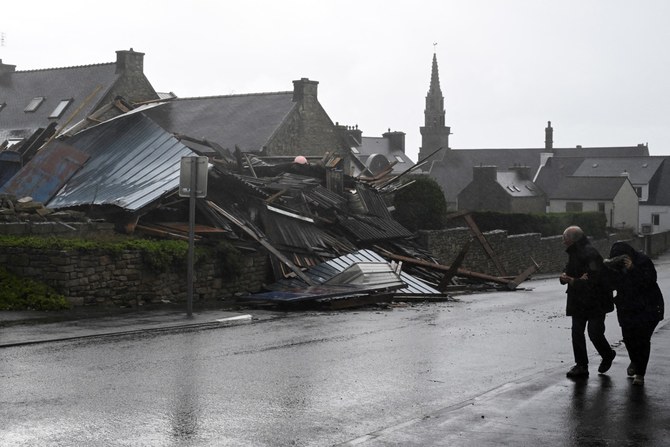
Brussels: At least 10 people were killed as Storm Ciaran battered Western Europe with record winds of up to 200 kilometers per hour, causing travel mayhem with closed ports and flight and rail disruptions.
Three people died in Tuscany, Italian authorities announced on Friday, reporting record rainfall and the declaration of a state of emergency.
Tuscany governor Eugenio Giani said the three dead included an 85-year-old man who was found drowned in his house.
“What happened tonight in Tuscany has a name: climate change,” he wrote on X, formerly known as Twitter.
Florence mayor Dario Nardella said the “situation is critical” in the city.
Trees felled by gale-force winds caused most of the deaths in Europe. In the Belgian city of Ghent, a five-year-old Ukrainian boy and a 64-year-old woman were killed by falling branches.
Falling trees had earlier killed a lorry driver in his vehicle in northern France’s Aisne region, and French authorities also reported the death of a man who fell from his balcony in the port city of Le Havre.
A man in the Dutch town of Venray, a woman in central Madrid and a person in Germany also died.
Some 1.2 million French homes lost electricity as the storm lashed the northwest coast. Almost 700,000 remained without power on Thursday evening, according to network manager Enedis.
French President Emmanuel Macron was due to visit the storm-battered region of Brittany on Friday, the Elysee presidential palace said.
The storm interrupted rail, air and maritime traffic in Belgium where the port of Antwerp was closed and flights from Brussels were disrupted.
The wind gusts in the western Brittany region were “exceptional” and “many absolute records have been broken,” national weather service Meteo-France said on X.
The prefect for the local department said gusts as high as 207 km/h (129 mph) were recorded at Pointe du Raz on the tip of the northwest coast, while the port city of Brest saw winds hit 156 km/h.
In southern England, hundreds of schools were closed as large waves powered by winds of 135 km/h crashed along the coastline.
On the Channel Island of Jersey, residents had to be evacuated to hotels overnight as gusts of up to 164 km/h damaged homes, according to local media.
More than 200 flights were canceled at Amsterdam’s Schiphol Airport, a major European hub.
Air, rail and ferry services saw cancelations and long delays across several countries.
The effects of the storm were felt as far south as Spain and Portugal, with Spanish authorities warning of waves as high as nine meters (29 feet) along the Atlantic coast.
In Spain, more than 80 flights were canceled at 11 airports.
There was disappointment for the hardy athletes of the annual Dutch “headwind cycle championships” race.
They only hold their race along the Oosterscheldekering storm surge barrier in the western Netherlands if the wind is above a gale seven on the Beaufort Scale (up to 61 km/h).
But they finally met their match with Storm Ciaran and had to postpone it.
There were “many disappointed faces,” organizer Robrecht Stoekenbroek told local agency ANP, vowing to go ahead when the storm passed.
The French weather service said storms would continue into Friday, notably in the southwest of the country and on the island of Corsica.
Rail services in western parts of the country would remain disrupted on Friday, said Transport Minister Clement Beaune.


Ten dead as Storm Ciaran batters Western Europe
https://arab.news/9dh83
Ten dead as Storm Ciaran batters Western Europe

- Florence mayor Dario Nardella said the “situation is critical” in the city
- In Spain, more than 80 flights were canceled at 11 airports



Ukraine toils to restore power and heat, Zelensky warns of new attack
- Russia has systematically attacked Ukraine’s energy system since it invaded its neighbor in 2022 and the air strikes have intensified in recent months
KYIV: Emergency crews toiled to restore heat and power to beleaguered Kyiv residents on Monday, more than three days after Russian strikes on energy targets, and President Volodymyr Zelensky warned that new air attacks could be imminent.
Officials said hundreds of apartment blocks in the capital remained without heat despite round-the-clock efforts by the crews. Humanitarian centers, dubbed “resilience points,” were open for people to keep warm and charge electronic devices.
Russia has systematically attacked Ukraine’s energy system since it invaded its neighbor in 2022 and the air strikes have intensified in recent months.
Zelensky, speaking in his nightly video address, said a program was being launched to raise wages and provide support for participants in emergency work brigades.
He issued a new warning to heed air raid alerts as night-time temperatures sank to minus 15 Celsius (5 F) or lower.
“There is intelligence information. The Russians are preparing a new massive strike,” he said.
“Drones to exhaust air defense systems and missiles. They want to take advantage of the cold. The strike may occur in the coming days. Please take care of yourselves. Protect Ukraine.”
Deputy Prime Minister Oleksiy Kuleba, writing on Telegram, said 90 percent of Kyiv’s apartment buildings have had heating restored, leaving fewer than 500 dwellings still to be connected.
Mayor Vitali Klitschko put the number with no heating at 800, most on the west bank of the Dnipro River. He said a meeting of the Kyiv city council would be convened on Thursday to debate the most pressing issues facing residents.
Prime Minister Yulia Svyrydenko, presenting the program for bonus payments, said the work conducted by emergency crews stood “at the very limit of human endurance, often involving life-threatening risks across the entire country.
“This applies to specialists who, in freezing conditions, go directly to the sites of strikes and restore supplies of heat, electricity, water and gas.”
Residents made their way to one of the humanitarian centers on the east bank of the river in the evening — two tents pitched on a small area of open ground.
They charged their devices and chatted, while outside, the din of whining generators filled the air.
“It’s dark in the apartment. I have an electric stove, so it’s impossible to heat up lunch or dinner, or make tea,” said Kateryna Zubko, 67, an engineer who has lived without power, heating and water since the latest attack.
“We support each other. Ukrainians are such resilient people, I think that this war will end someday, it can’t go on forever.”


