
NEW YORK CITY: A group of independent UN experts issued an urgent warning on Thursday in which they sounded the alarm that time is rapidly running out to prevent potential genocide and a humanitarian catastrophe in Gaza.
They painted a grim picture of the situation in the besieged Gaza Strip and expressed deep frustration with Israel’s refusal to halt its plans “to decimate” the territory.
“We remain convinced that the Palestinian people are at grave risk of genocide,” the experts said. “The time for action is now. Israel’s allies also bear responsibility and must act immediately to prevent its disastrous course of action.”
The group of seven experts included the UN’s special rapporteurs on the human rights to safe drinking water and sanitation; the right to food; the human rights of internally displaced people; and contemporary forms of racism; as well as Francesca Albanese, the special rapporteur on the situation of human rights in the Palestinian territory occupied since 1967.
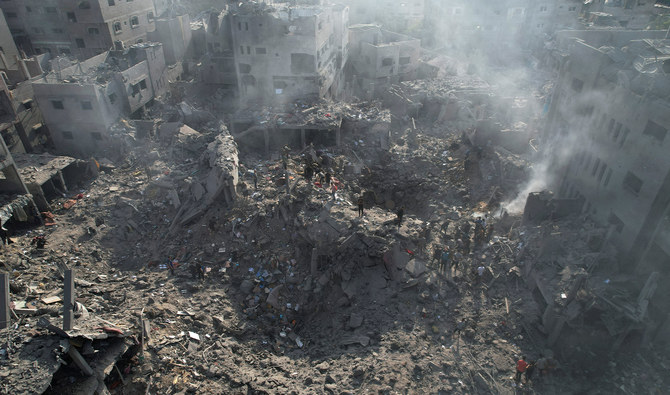
Expressing “deepening horror” about the Israeli airstrikes that have relentlessly targeted the Jabalia refugee camp in northern Gaza since Tuesday night, killing and injuring hundreds of residents, they described the attacks as “a brazen breach of international law.”
They added: “The Israeli airstrike on a residential complex in the Jabalia refugee camp is a brazen violation of international law — and a war crime. Attacking a camp sheltering civilians, including women and children, is a complete breach of the rules of proportionality and distinction between combatants and civilians.”
The experts welcomed a recent UN General Assembly resolution, passed with the support of an overwhelming majority of member states on Oct. 27, that emphasized the need to protect civilians and adhere to legal and humanitarian obligations. However, they stressed that the situation requires more than only a resolution.
“We received the resolution with hope but the need for action is now,” they said, warning that all the signs point toward a rapidly approaching critical breaking point in Gaza.
They highlighted disturbing reports of people being forced to resort to desperate measures to survive, such as desperately grabbing flour and other essentials from a UN warehouse, children forced to drink sea water because of a lack of clean water, and surgery being performed on patients, including children, without anesthesia. In addition, they said, many elderly residents of Gaza and people with disabilities have been displaced from their homes, which are now rubble, and forced to live in tents.
The situation in Gaza has reached a catastrophic tipping point, the experts warned, in which a dire need for food, water, medicine, fuel and other essential supplies is compounded by a looming health crisis, given the prolonged lack of fuel and damage to water infrastructure as a result of the constant shelling for the past three weeks, which has left the population of Gaza with little or no access to safe drinking water.
About 1.4 million people in Gaza are now internally displaced, with about 630,000 seeking refuge in 150 UN Relief and Works Agency emergency shelters. The agency has reported that 70 UN workers have died so far as a result of the Israeli bombardment of Gaza.
The UN experts also called for the immediate release of all civilians held captive since the attack by Hamas militants on Israeli towns on Oct. 7.
“All parties must comply with their obligations under international humanitarian and human rights law,” they said.
“We demand a humanitarian ceasefire to ensure that aid reaches those who need it the most. A ceasefire also means channels of communication can be opened to ensure the release of hostages.”
While expressing grave concern for the safety of UN and other humanitarian workers, as well as the hospitals and schools that are providing refuge and lifesaving medical services to the people of Gaza, the experts also raised an alarm about the safety of journalists and other media workers, and their families. They noted that internet and communication connections have been disrupted, hampering essential reporting of developments in Gaza.
“We want to remind all parties that humanitarian and medical personnel and facilities are protected under international law,” they said. “States have an obligation to ensure their safety and protection during times of war.
“As the secretary-general (of the UN, Antonio Guterres,) has repeatedly reiterated, Israel and Palestinian armed groups must bear in mind that even wars have rules.”
The experts concluded by reiterating the immense hardship and deprivation the Palestinian population of Gaza is enduring, and issuing a powerful call for Israel and its allies to agree to an immediate ceasefire, warning that swift action is imperative.
“The Palestinian people in Gaza, particularly women, children, persons with disabilities, youth, and older persons, have endured decades of hardship and deprivation,” they said.
“We are running out of time.”
Special rapporteurs are part of what is known as the special procedures of the UN Human Rights Council. They are independent experts who work on a voluntary basis, are not members of UN staff and are not paid for their work.