Pakistan’s finance ministry signals achievement of IMF economic goals to secure loan tranche

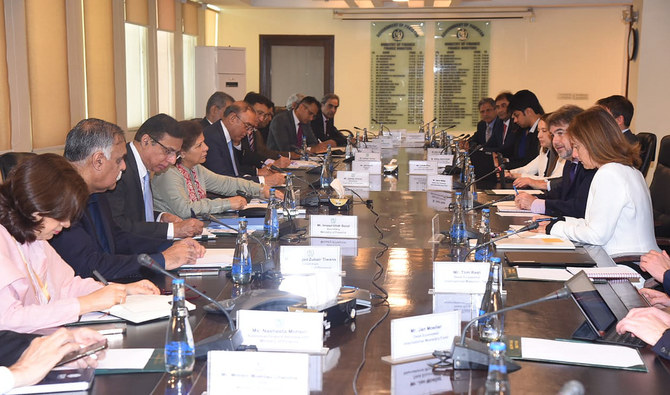
Pakistan’s Caretaker Finance Minister Dr. Shamshad Akhtar (4L) attends a meeting with an International Monetary Fund (IMF) review mission led by IMF mission official Nathan Porter (2R) at the Finance Ministry in Islamabad on November 2, 2023. (Photo courtesy: Press Information Department)
Short Url
Updated 02 November 2023
Follow

Pakistan’s finance ministry signals achievement of IMF economic goals to secure loan tranche

  • The ministry says it has exceeded tax collection targets with a tight monetary policy and market-based exchange rate
  • Economists say the IMF will focus on sustainability of fiscal discipline during the review of the $3 billion loan program

ISLAMABAD: Pakistan’s finance ministry assured an International Monetary Fund (IMF) delegation on Thursday it has met all principal economic targets required by the global lender ahead of an economic review under the $3 billion loan program that is likely to help the country secure a $710 million tranche.

The IMF review mission led by Nathan Porter visited the ministry to initiate the two-week-long evaluation process and was briefed by caretaker finance minister Dr. Shamshad Akhtar, central bank governor Jameel Ahmad and officials of Pakistan’s tax collection body on key economic indicators.

A favorable appraisal by the IMF team will pave way for the approval of a second loan tranche under the short-term loan by the Fund’s executive board in December.

Pakistan got a nine-month standby arrangement amounting to $3 billion in July to support the economic stabilization program and received the first tranche of $1.2 billion. The development took place at a time when the South Asian nation of 241 million was struggling to bridge an external financing gap to avert sovereign debt default.

“The caretaker Minister for Finance, Revenue, & Economic Affairs Dr. Shamshad Akhtar welcomed the delegation and shared progress on the Standby Arrangement (SBA),” the ministry said in a statement circulated after the meeting.

“The Minister briefed the Mission on fiscal measures being taken by the Government to improve the economic situation,” it added. “The meeting also included discussions on comprehensive reforms and measures undertaken by FBR and the Government’s strategies to address the circular debt issue.”

According to officials privy to the details of the meeting, the IMF review team was informed that tax collection and petroleum development levy had exceeded the target while the policy of market-based currency exchange rate was also being implemented.

The country has a primary surplus of over Rs400 billion as prices of utilities like gas and electricity have already been revised upward to keep a check on the ballooning of circular debt.

“Mr. Nathan Porter, IMF Mission Chief, appreciated the Government’s commitment to meeting the 1st Quarter targets, and commended the Government’s efforts and measures taken in some critical areas,” the ministry’s statement continued. “He further underscored the importance of continuation of these efforts for staying on track for economic stability of the country.”

Economists agree the government has fulfilled almost all the targets set under the IMF loan program to unlock the second tranche, though they emphasized it was important to remain cautious and ensure sustainability of the fiscal discipline.

“The government has significantly increased the gas and electricity tariffs to meet the IMF targets in the energy sector while other revenue targets have also been met through direct and indirect taxation,” Afia Malik, a senior research economist at Pakistan Institute of Development Economics (PIDE) in Islamabad, told Arab News.

“Looking at all these numbers, Pakistan should easily clear the IMF review for the next tranche,” she said.

Haroon Sharif, former economic adviser to the government, agreed majority of the prior actions for the second tranche had been met with a fiscal deficit between the range of 7 to 7.5 percent as agreed with the Fund.

“We have cut imports, development budget and subsidies to achieve the targets, and now it all looks positive for the IMF review,” he told Arab News.

Sharif cautioned the authorities had achieved majority of the targets through administrative measures, including currency exchange rate, and the IMF would like to see if these actions were sustainable over the period.

“I guess major focus of the Fund will be on sustainability of the fiscal discipline to complete the loan program,” he added.


Islamabad says surge in aircraft orders after India standoff could end IMF reliance

Updated 06 January 2026
Follow

Islamabad says surge in aircraft orders after India standoff could end IMF reliance

  • Pakistani jets came into the limelight after Islamabad claimed to have shot down six Indian aircraft during a standoff in May last year
  • Many countries have since stepped up engagement with Pakistan, while others have proposed learning from PAF’s multi-domain capabilities

ISLAMABAD: Defense Minister Khawaja Asif on Tuesday said Pakistan has witnessed a surge in aircraft orders after a four-day military standoff with India last year and, if materialized, they could end the country’s reliance on the International Monetary Fund (IMF).

The statement came hours after a high-level Bangladeshi defense delegation met Pakistan’s Air Chief Marshal Zaheer Ahmed Baber Sidhu to discuss a potential sale of JF-17 Thunder aircraft, a multi-role fighter jointly developed by China and Pakistan that has become the backbone of the Pakistan Air Force (PAF) over the past decade.

Fighter jets used by Pakistan came into the limelight after Islamabad claimed to have shot down six Indian aircraft, including French-made Rafale jets, during the military conflict with India in May last year. India acknowledged losses in the aerial combat but did not specify a number.

Many countries have since stepped up defense engagement with Pakistan, while delegations from multiple other nations have proposed learning from Pakistan Air Force’s multi-domain air warfare capabilities that successfully advanced Chinese military technology performs against Western hardware.

“Right now, the number of orders we are receiving after reaching this point is significant because our aircraft have been tested,” Defense Minister Asif told a Pakistan’s Geo News channel.

“We are receiving those orders, and it is possible that after six months we may not even need the IMF.”

Pakistan markets the Chinese co-developed JF-17 as a lower-cost multi-role fighter and has positioned itself as a supplier able to offer aircraft, training and maintenance outside Western supply chains.

“I am saying this to you with full confidence,” Asif continued. “If, after six months, all these orders materialize, we will not need the IMF.”

Pakistan has repeatedly turned to the IMF for financial assistance to stabilize its economy. These loans come with strict conditions including fiscal reforms, subsidy cuts and measures to increase revenue that Pakistan must implement to secure disbursements.

In Sept. 2024, the IMF approved a $7 billion bailout for Pakistan under its Extended Fund Facility (EFF) program and a separate $1.4 billion loan under its climate resilience fund in May 2025, aimed at strengthening the country’s economic and climate resilience.

Pakistan has long been striving to expand defense exports by leveraging its decades of counter-insurgency experience and a domestic industry that produces aircraft, armored vehicles, munitions and other equipment.

The South Asian country reached a deal worth over $4 billion to sell military equipment to the Libyan National Army, Reuters report last month, citing Pakistani officials. The deal, one of Pakistan’s largest-ever weapons sales, included the sale of 16 JF-17 fighter jets and 12 Super Mushak trainer aircraft for basic pilot training.