Air pollution sparks alarm, dims World Cup cheer in India 

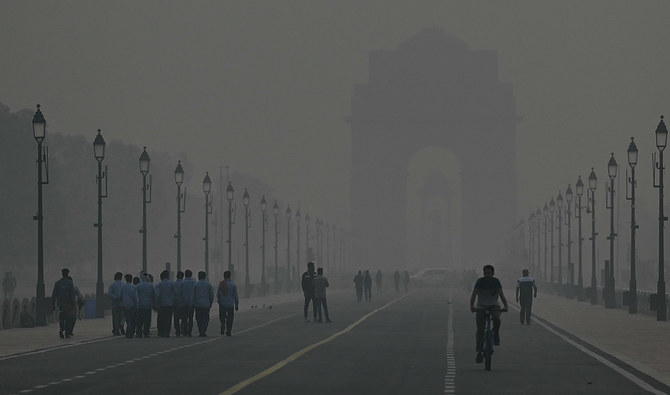
People walk in smoggy conditions at India Gate in New Delhi on October 31, 2023. (AFP/File)
Short Url
Updated 02 November 2023
Follow

Air pollution sparks alarm, dims World Cup cheer in India 

  • Toxic haze blanketing New Delhi raised fears of another public health emergency in the Indian capital
  • With AQI levels above 400, New Delhi and Pakistan’s Lahore topped eal-time list of world’s most polluted cities

NEW DELHI: Toxic haze blanketed New Delhi on Thursday, raising fears of another public health emergency in the Indian capital, as government agencies warned that pollution levels could worsen over the next few days despite efforts to reduce them. 

Air Quality Index (AQI) stood at 415 on a scale of 500 in the capital’s Anand Vihar area on Thursday, indicating “severe” levels of pollution that can affect healthy people and those with existing ailments. AQI between 0-50 is considered healthy. 

The dip in air quality in the region during the winter months is often accompanied by a spike in respiratory illnesses, spurring school and factory closings. 

The New Delhi government has announced a ban on the entry of diesel buses and said construction activities will be halted if the situation persists. 

With AQI levels above 400, New Delhi and Pakistan’s Lahore on Thursday topped a real-time list of the world’s most polluted cities compiled by Swiss group IQAir. India’s Mumbai also features among the world’s 15 most polluted cities. 

The worsening air quality has cast a shadow over the cricket World Cup as fans flock to stadiums across Indian cities. 

AQI in Mumbai hovered around the 200 mark ahead of Thursday’s match between India and Sri Lanka. The city is expected to welcome large crowds as it hosts the semifinal of the tournament on Nov. 15. 

India’s cricket board (BCCI) this week announced a ban on firework displays during the remaining matches of the tournament as a measure to combat pollution. 

Players have expressed concern about the toxic air, with England’s Joe Root complaining of breathing difficulties during a game and India’s Rohit Sharma urging change for “future generations.” 


NATO wants ‘automated’ defenses along borders with Russia: German general

Updated 24 January 2026
Follow

NATO wants ‘automated’ defenses along borders with Russia: German general

  • That zone would act as a defensive buffer before any enemy forces advanced into “a sort of hot zone,” said Lowin
  • The AI-guided system would reinforce existing NATO weapons and deployed forces, the general said

FRANKFURT: NATO is moving to boost its defenses along European borders with Russia by creating an AI-assisted “automated zone” not reliant on human ground forces, a German general said in comments published Saturday.
That zone would act as a defensive buffer before any enemy forces advanced into “a sort of hot zone” where traditional combat could happen, said General Thomas Lowin, NATO’s deputy chief of staff for operations.
He was speaking to the German Sunday newspaper Welt am Sonntag.
The automated area would have sensors to detect enemy forces and activate defenses such as drones, semi-autonomous combat vehicles, land-based robots, as well as automatic air defenses and anti-missile systems, Lowin said.
He added, however, that any decision to use lethal weapons would “always be under human responsibility.”
The sensors — located “on the ground, in space, in cyberspace and in the air” — would cover an area of several thousand kilometers (miles) and detect enemy movements or deployment of weapons, and inform “all NATO countries in real time,” he said.
The AI-guided system would reinforce existing NATO weapons and deployed forces, the general said.
The German newspaper reported that there were test programs in Poland and Romania trying out the proposed capabilities, and all of NATO should be working to make the system operational by the end of 2027.
NATO’s European members are stepping up preparedness out of concern that Russia — whose economy is on a war footing because of its conflict in Ukraine — could seek to further expand, into EU territory.
Poland is about to sign a contract for “the biggest anti-drone system in Europe,” its defense minister, Wladyslaw Kosiniak-Kamysz, told the Gazeta Wyborcza daily.
Kosiniak-Kamysz did not say how much the deal, involving “different types of weaponry,” would cost, nor which consortium would ink the contract at the end of January.
He said it was being made to respond to “an urgent operational demand.”