AMMAN: Jordan on Wednesday announced it had recalled its ambassador from Israel and told the Israeli ambassador to stay away in protest at the Israeli bombardment of Gaza, saying the attacks had killed innocents and caused a humanitarian catastrophe.
The ambassador would only return to Tel Aviv if Israel halted its war on the enclave and ended “the humanitarian crisis it has caused,” Foreign Minister Ayman Safadi said.
“This is to express Jordan’s stance that rejects and condemns the Israeli war on Gaza that kills innocents and is causing an unprecedented humanitarian catastrophe,” Safadi said in a statement carried on state media.
Safadi said the decision was also taken because Israel was depriving Palestinians of food, water and medicines after it imposed a siege on the enclave following a devastating assault by Hamas on Israel on Oct 7.
Israel’s ambassador in Jordan, who left two weeks ago amid protests, would only be allowed to return on the same conditions, the minister said.
Israel said it regretted the Jordanian government’s decision, adding it was focused on waging a war against the militant Hamas group after the bloody assault that killed hundreds of Israelis.
Jordan was stepping up diplomatic efforts to pressure Israel to end the war, which brought “dangerous risks” of conflict spreading across the region and threatening global peace, Safadi said.
The conflict has stirred long-standing fears in Jordan, home to a large population of Palestinian refugees and their descendants, that a wider conflagration would give Israel the chance to implement a transfer policy to expel Palestinians en masse from the West Bank.
Jordan, which shares a border with the West Bank, absorbed the bulk of Palestinians who fled or were driven out of their homes when Israel was created
King Abdullah on Wednesday said Israel’s “military and security solution” against Palestinians would not succeed, adding the only path to a just and comprehensive Arab-Israeli peace were negotiations leading to a two-state solution.
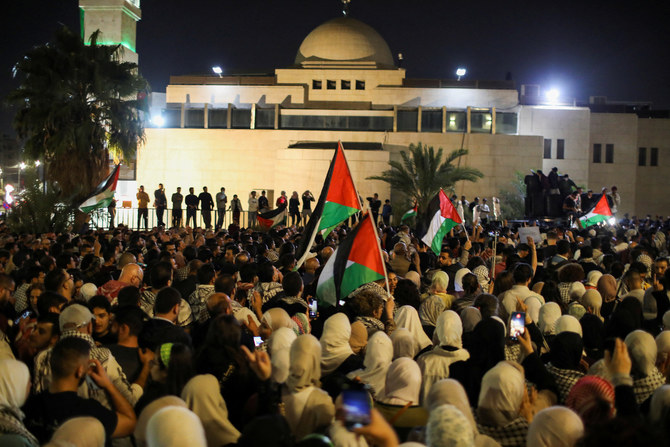
Many Jordanians, in a country where pro-Palestinian sentiment is widespread, have staged daily protests calling on the authorities to close the Israeli embassy and scrap the unpopular 1994 peace treaty between Israel and Jordan.
The Israeli embassy has long been a flashpoint of anti-Israel protests at times of turmoil in the Palestinian territories. The authorities who have stepped up security have use tear gas on several occasions to prevent angry mobs from storming the heavily guarded embassy and has arrested hundreds involved in rioting near the area.
The main Islamist opposition led by the Muslim Brotherhood have called for large demonstrations across the country next Friday in support of the militant group Hamas, which now enjoys widespread popularity among many Jordanians.


![]()

Jordan recalls envoy in Israel over Gaza bombardment
Short Url
https://arab.news/998rq
Jordan recalls envoy in Israel over Gaza bombardment
- The ambassador would only return to Tel Aviv if Israel halted its war on the enclave and ended “the humanitarian crisis it has caused,” Foreign Minister Ayman Safadi said
- Israel’s ambassador in Jordan would only be allowed to return on the same conditions


Latest updates


© 2026 SAUDI RESEARCH & PUBLISHING COMPANY, All Rights Reserved And subject to Terms of Use Agreement.