

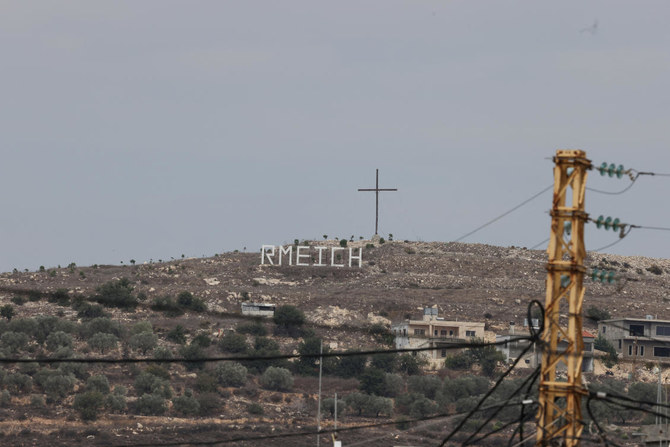

RMEICH, Lebanon: At Lebanon’s border with Israel, residents of a Christian village are hoping war can be avoided even as they prepare for the possibility of worsening hostilities between the Lebanese Shiite group Hezbollah and Israel.
Located just a couple of kilometers (miles) from the frontier, the village of Rmeich has already suffered fallout from three weeks of clashes along the border between Israel and Iran-backed Hezbollah, the dominant force in south Lebanon.
Half of its residents have fled north since shells began crashing into hills nearby. With the olive harvest disrupted, their livelihoods have also been affected by south Lebanon’s worst violence since Hezbollah and Israel went to war in 2006.
The village, along with the rest of Lebanon, is feeling the turbulence unleashed by the conflict raging some 200 km away between Israel and the Palestinian group Hamas, an ally of the heavily armed Hezbollah.
Those who remain in Rmeich appear reluctant to discuss the politics of the crisis that has brought conflict to their doorstep, trying to preserve some normalcy in the village whose 18th century church still holds a mass three times a day.
“I won’t say we’re feeling safe but the situation is stable,” the village priest Toni Elias, 40, said as a military drone buzzed overhead.
“If we don’t hear the drone, we think something odd is going on. We’re used to it everyday, 24/7,” Elias said.
Rmeich is one of around a dozen or more Christian villages near the border with Israel in predominantly Shiite Muslim south Lebanon. During the 2006 war, some 25,000 people from surrounding towns sought shelter in Rmeich.
Memories of the 2006 conflict loom large. Rmeich locals and charities have set up a makeshift hospital at a school, in case the clashes between Hezbollah and Israel — so far largely contained to areas at the border — get worse.
“We won’t use it unless there is a war and roads get closed, and inshalla (God willing) this won’t happen,” said Georges Madi, a doctor from the village.
WAR AND PEACE
The tensions are weighing on the local economy, compounding hardship for people still suffering the effects of Lebanon’s devastating financial collapse four years ago.
“If the war is prolonged, we can’t stay here. There is no work or money,” said Charbel Al Alam, 58, who makes his living from farming tobacco, historically an important industry for south Lebanon.
“In the 2006 war, tobacco plants dried out in the fields and no one was able to harvest it. No one compensated us,” he said.
While farmers had been able to gather this year’s crop, they worry whether they will be able plant next year’s. Business in Rmeich has generally come to a halt, several local said.
Unlike the surrounding areas, there is no sign of the yellow and green Hezbollah flag in Rmeich.
While avoiding any criticism of Hezbollah, Rmeich mayor Milad Al Alam said the Lebanese army should be the sole military force in Lebanon — a view voiced by Hezbollah’s opponents who say its arsenal has undermined the state.
“We wish the decision of war and peace were in our hands. If it were, the situation would have been different,” he said.
The town has no shelter or official evacuation plan for its 4,500 remaining residents if war intensifies, he added. “People were stuck in the village for 17 days in 2006,” he said.
Elias, the priest, said he was confident Rmeich would not be hit: “As long we’re here, living in the village. We don’t want war, we’re a peaceful village ... so the village remains safe if others flee to it.”


