Lebanon accuses Israel of white phosphorus attacks

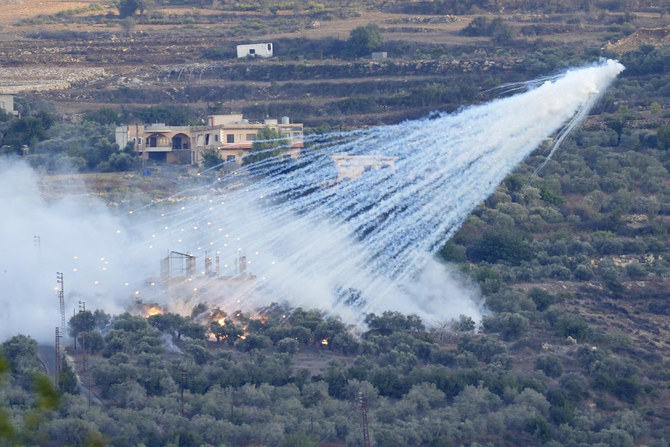
A shell that appears to be white phosphorus from Israeli artillery explodes over a house in al-Bustan, a Lebanese border village with Israel, south Lebanon, on Oct. 15, 2023. (AP)
Short Url
Updated 01 November 2023
Follow

Lebanon accuses Israel of white phosphorus attacks

  • Incendiary weapon can cause serious burns if it hits people

BEIRUT: Lebanon on Tuesday accused Israel of white phosphorus attacks that it said it would file a complaint to the UN over, with a minister alleging the incendiary weapon had burned 40,000 olive trees.
Rights groups and Lebanese officials have repeatedly accused Israel of using the weapon, which can cause serious burns if it hits people — allegations Israel had previously denied.
“I instructed the Lebanese mission to the UN to submit a new complaint to the Security Council to condemn Israel’s use of white phosphorus in repeated attacks on Lebanon,” Lebanese Foreign Minister Abdallah Bou Habib said.
In a statement, Bou Habib also accused Israel of “deliberately burning Lebanese groves and forests.”
Since Palestinian militant group Hamas launched an unprecedented attack on Israel from the Gaza Strip on October 7, Lebanon’s southern border has seen tit-for-tat exchanges between Israel and the Iran-backed Hezbollah, a Hamas ally.
The skirmishes have killed at least 62 people in Lebanon according to an AFP tally, mostly Hezbollah combatants but also four civilians, including a Reuters journalist.
Israel said eight people were killed, including soldiers and civilians.
Israeli attacks have also set olive groves and greenery ablaze in the border area, with at least one fire still raging in Lebanon’s south on Tuesday.
Agriculture Minister Abbas Al Hajj Hassan said Israeli white phosphorus strikes burnt down 40,000 olive trees in Lebanon’s south.
His ministry found in a preliminary survey that “128 fires resulted from the Israeli enemy’s phosphorus bombing of our regions,” he told AFP.
Phosphorus, a substance that catches fire on contact with the air, is used to create smokescreens to hide troop movements, illuminate the battlefield or destroy buildings by fire.
It falls under the 1983 Convention on Certain Conventional Weapons, which restricts incendiary weapons without banning their use altogether.
While the convention outlaws their use against civilians and non-military targets as well as their deployment against military targets near civilians, it does not cover deployment for smokescreening or battlefield illumination.
Earlier Tuesday, Amnesty International released an investigation saying it had “evidence of Israel’s unlawful use of white phosphorus” in south Lebanon between October 10 and 16.
“One attack on the town of Dhayra on 16 October must be investigated as a war crime because it was an indiscriminate attack that injured at least nine civilians... and was therefore unlawful,” the group added.
Human Rights Watch also accused Israel of using white phosphorus in Gaza and Lebanon earlier this month — which Israel denied.


Syrian government and SDF agree to de-escalate after Aleppo violence

Updated 37 min 40 sec ago
Follow

Syrian government and SDF agree to de-escalate after Aleppo violence

  • Turkiye views the US-backed SDF, which controls swathes of northeastern Syria, as a ⁠terrorist organization and has warned of military action if the group does not honor the agreement

DAMASCUS: Syrian government forces and the Kurdish-led Syrian Democratic Forces agreed to de-escalate on Monday evening in the northern city of Aleppo, after a wave of attacks that both sides blamed on each other left at least two civilians dead and several wounded.
Syria’s state news agency SANA, citing the defense ministry, said the army’s general command issued an order to stop targeting the SDF’s fire sources. The SDF said in a statement later that it had issued instructions to stop responding ‌to attacks ‌by Syrian government forces following de-escalation contacts.

HIGHLIGHTS

• SDF and Syrian government forces blame each other for Aleppo violence

• Turkiye threatens military action if SDF fails integration deadline

• Aleppo schools and offices closed on Tuesday following the violence

The Syrian health ministry ‌said ⁠two ​people ‌were killed and several were wounded in shelling by the SDF on residential neighborhoods in the city. The injuries included two children and two civil defense workers. The violence erupted hours after Turkish Foreign Minister Hakan Fidan said during a visit to Damascus that the SDF appeared to have no intention of honoring a commitment to integrate into the state’s armed forces by an agreed year-end deadline.
Turkiye views the US-backed SDF, which controls swathes of northeastern Syria, as a ⁠terrorist organization and has warned of military action if the group does not honor the agreement.
Integrating the SDF would ‌mend Syria’s deepest remaining fracture, but failing to do ‍so risks an armed clash that ‍could derail the country’s emergence from 14 years of war and potentially draw in Turkiye, ‍which has threatened an incursion against Kurdish fighters it views as terrorists.
Both sides have accused the other of stalling and acting in bad faith. The SDF is reluctant to give up autonomy it won as the main US ally during the war, which left it with control of Islamic ​State prisons and rich oil resources.
SANA, citing the defense ministry, reported earlier that the SDF had launched a sudden attack on security forces ⁠and the army in the Sheikh Maqsoud and Ashrafiyah neighborhoods of Aleppo, resulting in injuries.
The SDF denied this and said the attack was carried out by factions affiliated with the Syrian government. It said those factions were using tanks and artillery against residential neighborhoods in the city.
The defense ministry denied the SDF’s statements, saying the army was responding to sources of fire from Kurdish forces. “We’re hearing the sounds of artillery and mortar shells, and there is a heavy army presence in most areas of Aleppo,” an eyewitness in Aleppo told Reuters earlier on Monday. Another eyewitness said the sound of strikes had been very strong and described the situation as “terrifying.”
Aleppo’s governor announced a temporary suspension of attendance in all public and private schools ‌and universities on Tuesday, as well as government offices within the city center.