Pakistan urged to identify, protect thousands of at-risk Afghans

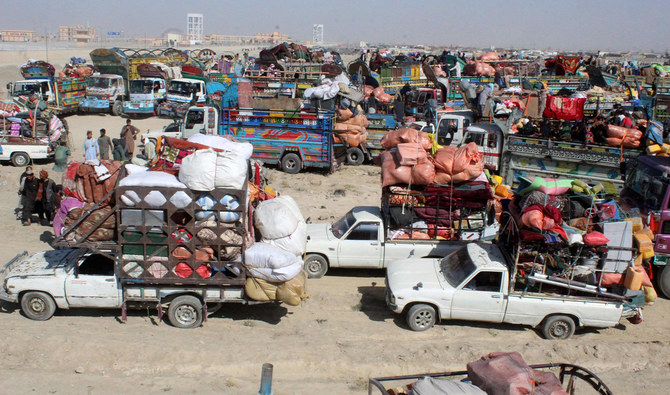
Afghan refugees arrive in trucks and cars to cross the Pakistan-Afghanistan border in Chaman on October 31, 2023. (AFP)
Short Url
Updated 31 October 2023
Follow

Pakistan urged to identify, protect thousands of at-risk Afghans

  • UNHCR asks the government to come up with comprehensive screening mechanism, offers technical assistance
  • Several embassies of NATO members want Pakistan to exempt Afghan nationals being resettled to Western countries

ISLAMABAD: Western embassies and the United Nations are urging Pakistan to incorporate into its plan to deport hundreds of thousands of undocumented migrants a way to identify and protect Afghans who face the risk of persecution at home, officials told Reuters.

Pakistan has set Nov.1 for the start of the expulsions, which could leave more than 1.7 million Afghans vulnerable in the South Asian nation, of a total of more than 4 million migrants and refugees from its neighbor.

“We are asking the government to come up with a comprehensive system and ... mechanism to manage and register people at immediate risk of persecution if forced to return,” Qaiser Khan Afridi, the spokesman for the UN refugee agency in Pakistan, told Reuters.

“Because they cannot return, they can’t go back to Afghanistan because their freedom or their life might be at risk.”

Spokespersons for Pakistan’s interior and foreign ministries did not immediately respond to a request for comment.

It was not immediately clear if Pakistan had agreed to take up the proposals by the United Nations and other embassies.

Afridi added that if Pakistan approved, his agency, the United Nations High Commission for Refugees (UNHCR), had offered to provide it the technical assistance and financial support needed for the effort.

Two official sources said several embassies of NATO members in Islamabad were lobbying Pakistan’s government at the highest levels, along with UNHCR, seeking exemption from deportation for thousands of Afghans being resettled to Western countries.

“To help protect vulnerable individuals, we have shared a list with the government of more than 25,000 Afghan individuals in the US resettlement and relocation pipelines,” a senior US official told Reuters.

The official, who spoke on condition of anonymity as the matter is sensitive, added that US authorities were working to issue letters to such individuals identifying them as being part of the resettlement efforts.

The official sources, who sought anonymity, said they continued to call for the setting up of a “protective screening mechanism” for those being deported.

That would probably involve an interview to evaluate a potential deportee’s claims about fear of persecution and decide the need for additional protection, in line with international humanitarian law, officials familiar with the proposals said.

About 600,000 Afghans have crossed into Pakistan since the Taliban took over in 2021, in addition to a large number present since the Soviet invasion of 1979.

This month, Pakistan said it would deport all foreigners without proper documents after Wednesday, and about 60,000 Afghans returned home in October, with more expected to do so.

Pakistan says Afghan nationals have been found to be involved in crimes and militancy, and are a drain on its resources.


Pakistan’s OGDC ramps up unconventional gas plans

Updated 4 sec ago
Follow

Pakistan’s OGDC ramps up unconventional gas plans

  • Pakistan has long been viewed as having potential in tight and shale gas but commercial output has yet to be proved
  • OGDC says has tripled tight-gas study area to 4,500 square km after new seismic, reservoir analysis indicates potential

ISLAMABAD: Pakistan’s state-run Oil & Gas Development Company is planning a major expansion of unconventional gas developments from early next year, aiming to boost production and reduce reliance on imported liquefied natural gas.

Pakistan has long been viewed as having potential in both tight and shale gas, which are trapped in rock and can only be released with specialized drilling, but commercial output has yet to be proved.

Managing Director Ahmed Lak told Reuters that OGDC had tripled its tight-gas study area to 4,500 square kilometers (1,737 square miles) after new seismic and reservoir analysis indicated larger potential. Phase two of a technical evaluation will finish by end-January, followed by full development plans.

The renewed push comes after US President Donald Trump said Pakistan held “massive” oil reserves in July, a statement analysts said lacked credible geological evidence, but which prompted Islamabad to underscore that it is pursuing its own efforts to unlock unconventional resources.

“We started with 85 wells, but the footprint has expanded massively,” Lak said, adding that OGDC’s next five-year plan would look “drastically different.”

Early results point to a “significant” resource across parts of Sindh and Balochistan, where multiple reservoirs show tight-gas characteristics, he said.

SHALE PILOT RAMPS UP

OGDC is also fast-tracking its shale program, shifting from a single test well to a five- to six-well plan in 2026–27, with expected flows of 3–4 million standard cubic feet per day (mmcfd) per well.

If successful, the development could scale to hundreds or even more than 1,000 wells, Lak said.

He said shale alone could eventually add 600 mmcfd to 1 billion standard cubic feet per day of incremental supply, though partners would be needed if the pilot proves viable.

The company is open to partners “on a reciprocal basis,” potentially exchanging acreage abroad for participation in Pakistan, he said.

A 2015 US Energy Information Administration study estimated Pakistan had 9.1 billion barrels of technically recoverable shale oil, the largest such resource outside China and the United States.

A 2022 assessment found parts of the Indus Basin geologically comparable to North American shale plays, though analysts say commercial viability still hinges on better geomechanical data, expanded fracking capacity and water availability.

OGDC plans to begin drilling a deep-water offshore well in the Indus Basin, known as the Deepal prospect, in the fourth quarter of 2026, Lak said. In October, Turkiye’s TPAO with PPL and its consortium partners, including OGDC, were awarded a block for offshore exploration.

A combination of weak gas demand, rising solar uptake and a rigid LNG import schedule has created a surplus of gas that forced OGDC to curb output and pushed Pakistan to divert cargoes from Italy’s ENI and seek revised terms with Qatar.