

British Medical Journal accuses Israeli forces of ‘deliberate violence’ against health workers in Palestine

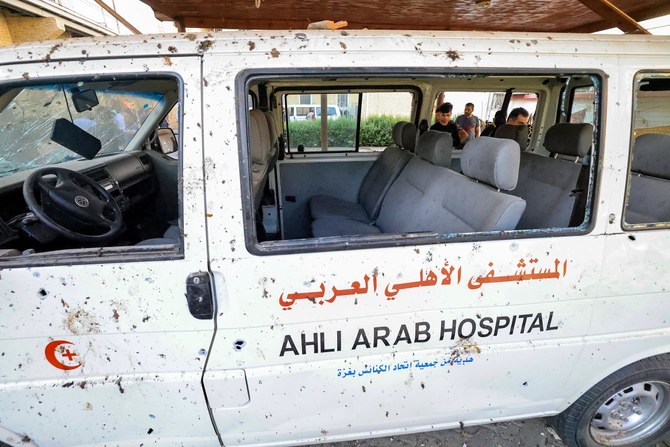
Reports of the deaths of 20 health workers in Israeli airstrikes, as well as violence against staff working for the United Nations Relief and Works Agency were also highlighted. (AFP/File)
Short Url
Updated 26 October 2023
Follow

British Medical Journal accuses Israeli forces of ‘deliberate violence’ against health workers in Palestine

  • Editorial claims attacks are part of broader pattern of Israeli violence against health workers
  • Authors call for ‘immediate deescalation’ and adherence to international law

LONDON: Six health academics from around the world have accused Israeli forces of deliberately targeting healthcare workers in Gaza and Palestine.

In an editorial published in BMJ Global Health, a British Medical Journal-owned peer-reviewed publication, the six focused on the deadly blast at Al-Ahli hospital in Gaza, describing it as “one of the most horrific attacks on a healthcare facility in our collective history,” and suggesting the devastation was caused by an airstrike.

The editorial alleged that Israeli forces intentionally target people’s limbs to cause more suffering and death in the occupied territories.

Both Israel and Hamas have denied responsibility for the hospital blast, and the cause remains unclear.

The editorial states: “These most recent, egregious healthcare-related attacks follow a long history of Israeli violence against health workers, the destruction of health infrastructure, the systematic obstruction of access to healthcare, and the implementation of settler-colonial strategies that aim to increase morbidity and mortality in occupied Palestine.”

Reports of the deaths of 20 health workers in Israeli airstrikes, as well as violence against staff working for the United Nations Relief and Works Agency were also highlighted.

The authors claimed recent healthcare-related attacks are part of a broader pattern of Israeli violence against health workers.

These strategies include the destruction of Palestinian healthcare and other essential services; “exerting full control” over water and electricity supplies; and the “deliberate targeting of limbs, leading to traumatic limb loss and disability.”

The authors called for an “immediate deescalation of the threat posed by Israel to the lives of millions of Palestinian people.”

In a follow-up to the editorial, a spokesperson for the BMJ said the journal is making changes to the article, including replacing “airstrike” with “missile strike,” and acknowledging that the origin of the missile is yet to be determined.


Lebanon’s official media scale back Hezbollah coverage after Cabinet ban

Updated 12 March 2026
Follow

Lebanon’s official media scale back Hezbollah coverage after Cabinet ban

  • Information Minister Paul Morcos instructs outlets to comply with government decision
  • Journalists, social media urged to avoid content that could provoke hate speech, incitement

BEIRUT: Lebanon has begun implementing a Cabinet decision taken earlier this month to ban Hezbollah’s security and military activities by scaling back coverage of the group on official media platforms.

The measure, which was described in political circles as a significant and bold step, came after decades during which news about the party and the speeches of its leaders were published verbatim and broadcast live through official media outlets, like the state-run National News Agency, TV station Tele Liban and Radio Lebanon.

“No one is imposing censorship,” an official source told Arab News.

“Rather, there is a commitment to the decisions of the state. It is no longer possible for a speech that attacks the Lebanese government and the state to be published through its official media outlets.”

Information Minister Paul Morcos issued a circular instructing directors of official media outlets to comply with the government’s decision to ban the broadcast of speeches or statements by Hezbollah Secretary-General Sheikh Naim Qassem and statements issued by the group’s armed wing, particularly when they contain criticism of the state.

Morcos also ordered that Hezbollah statements be handled in the same manner as those issued by other political parties, meaning they should not be published verbatim. He further instructed media outlets to avoid using the term “Islamic resistance,” except when it appears directly within Hezbollah statements.

The first manifestations of the decision were Tele Liban’s abstention from live broadcasting a speech by Qassem and a statement made on Tuesday by lawmaker Mohammed Raad, who heads the Hezbollah parliamentary bloc.

The group’s supporters described the move as an attempt “to restrict the resistance, Hezbollah and its leadership in the official media.”

Some argued on social media that preventing the use of terms like “resistance” or “holy warriors (Mujahedin)” and replacing them with expressions such as “Hezbollah” and “fighters” was “aimed at brainwashing and stripping the party of its resistance identity.”

During a Cabinet session on Thursday, Morcos raised the issue of content circulating on social media that incites murder and sectarian strife. This comes against the backdrop of the war that Hezbollah waged from Lebanon against Israel on March 2, without state approval, which led to a sharp division in Lebanese public opinion.

Morcos, who is also Cabinet spokesperson, said after the session that what was being published “exceeds the bounds of freedom of opinion, the press and expression.”

Prime Minister Nawaf Salam considered it to fall under the penal code, specifically regarding crimes that harm national unity, he said, and that “we are against strife in all its forms.”

Morcos also urged journalists, influencers and social media users to remain aware of the sensitivity of the current situation and to avoid content that could provoke strife, hate speech or incitement.

He acknowledged, however, that, according to a legal study, he has no authority over social media, even on media-related matters.

“The Ministry of Information does not exercise a guardianship role and lacks judicial police powers,” he said.

“These authorities rest with the public prosecution offices, which are overseen by the minister of justice and fall within the domain of criminal law and criminal prosecution.”

The ban was agreed during a Cabinet session on March 2, after Hezbollah launched six rockets from Lebanese territory toward northern Israel, the first such attack since the November 2024 ceasefire, prompting retaliatory strikes.

The Cabinet reaffirmed that “the decision of war and peace rests exclusively with the Lebanese state and its constitutional institutions,” and called on Hezbollah to hand over its weapons to the state while limiting its role to political activity within the legal and constitutional framework.