

KSA striving for environmentally friendly industrial operations, says Alkhorayef 

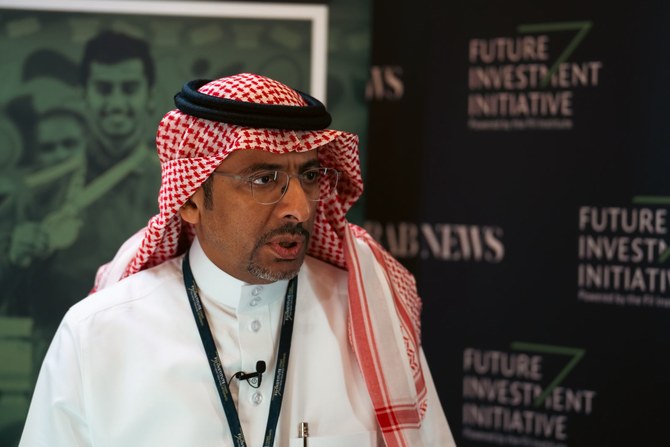
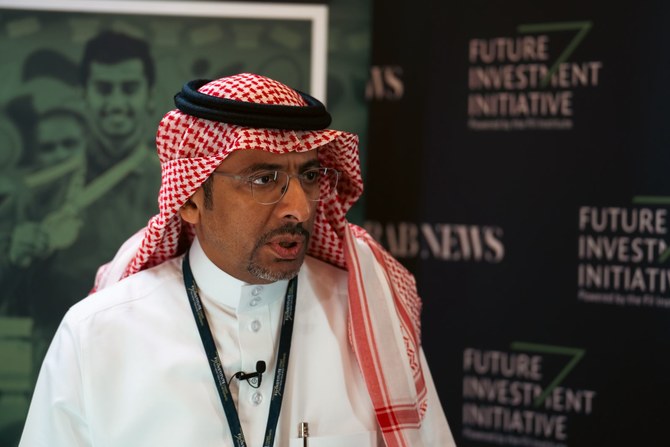
Speaking to Arab News on the sidelines of the 7th Future Investment Initiative in Riyadh, Minister of Industry and Mineral Resources Bandar Alkhorayef emphasized the importance of technological advancements to make mining operations safer. AN photo
Short Url
Updated 26 October 2023
Follow

KSA striving for environmentally friendly industrial operations, says Alkhorayef 

RIYADH: Saudi Arabia’s mining and industrial sector is “betting on technology,” aiming to achieve safer, more productive, and environmentally friendly operations, according to a senior minister. 

Speaking to Arab News on the sidelines of the 7th Future Investment Initiative in Riyadh, Minister of Industry and Mineral Resources Bandar Alkhorayef emphasized the importance of technological advancements to make mining operations safer. 

Referring to the second edition of the Future Minerals Forum organized by the ministry in January, he explained that they were actually “betting on technology” through the establishment of a “tech zone.” 

It was really exciting to see how the different solutions that are available today for mining to have more safer mines, more productive mines, and more environmentally friendly mines,” Alkhorayef said. 

He noted that the tech zone had showcased a wide array of innovative solutions that are readily available to the mining industry today. 

Additionally, the minister highlighted two essential components in the government’s strategy for sustainable resource exploration. This includes the significance of having suitable policies in place, along with substantial financial investments in geological survey projects designed to systematically explore the nation’s mineral resources. 

“First of all, policies need to be in place, and I think we are very well positioned in terms of the policies that we have put in place,” Alkhorayef said. 

He added: “Secondly, as a government, we are spending a lot of money, we have a great project to explore the country. Our geological survey entity is working very hard with different projects to explore and get data ready for investors to let them know exactly the kind of minerals that we have and where they are.” 

Furthermore, the minister outlined three critical factors that investors take into account when assessing opportunities: growth, profitability, and stability.
“I don't see anywhere globally that allows or offers the growth potential that we have in Saudi. We have a great deal of opportunities where we are keen as a government,” Alkhorayef told Arab News. 

“So, in terms of what the investor wants, I think we are trying to do our utmost to get that in place; definitely we understand the challenges globally. But I think Saudi Arabia is the place to be today,” he continued. 

As part of efforts to enhance exports and align with Vision 2030 objectives, the minister reaffirmed the country’s commitment to attracting SR1 trillion ($266 billion) in industrial investments.    

Speaking at the second edition of the “Made in Saudi” exhibition earlier this month, Alkhorayef emphasized that the majority of funds will be directed toward bolstering exports.  

The target, first introduced in early 2019, seeks to position the Kingdom as a significant industrial and global logistics hub.    


Saudi investment hits 32% of GDP, non-oil fixed capital reaches 40%, minister says

Updated 05 January 2026
Follow

Saudi investment hits 32% of GDP, non-oil fixed capital reaches 40%, minister says

RIYADH: Saudi Arabia’s investment now accounts for 32 percent of gross domestic product, with non-oil fixed capital at 40 percent, according to the minister responsible for portfolio.

Speaking during his visit to the Shoura Council, Khalid Al-Falih said that foreign direct investment is expected to grow fivefold, signaling strong Vision 2030 progress.

“Regarding cumulative performance, the Kingdom has exceeded all expectations, achieving high levels of investment,” Al-Falih said, according to a video posted on Al-Ekhbariya’s X account focused on economic matters.

The minister added: “Today, investment accounts for 32 percent of the total GDP. In terms of non-oil GDP, fixed capital represents 40 percent, compared with 41 percent in China, the highest globally.”

If we take the non-oil GDP, he said, fixed capital will make 40 percent. “China is the largest globally with 41 percent. So, we will rank second if we compare it to the non-oil economy and fourth when measured against total GDP,” Al-Falih said.

He emphasized that the Kingdom offers an investment-attractive environment, noting that when focusing on foreign direct investment rather than overall investment, Saudi Arabia ranks among the world’s highest.

The minister of investment added that FDI is expected to grow fivefold by the end of 2025, though these data require confirmation, stressing that this is “a big indicator for the success of Saudi Vision 2030.”

During his address to the session, Al-Falih emphasized that Saudi Vision 2030 prioritizes economic diversification and reducing dependence on oil, through boosting the private sector’s contribution to inclusive economic development, supporting national sectoral priorities, and driving growth in the Kingdom’s GDP.

He highlighted key initiatives enabling the private sector, including the establishment of the Ministry of Investment and the Saudi Investment Promotion Authority, the launch of the “Shareek” program, the development of the National Investment Strategy, and linking all stakeholders in the investment ecosystem.

“The Cabinet’s adoption of the National Investment Strategy, launched by Crown Prince in 2021 and implemented in 2022 as a comprehensive national framework, has played a major role in positioning investment as a driver of economic growth,” he said.

Al-Falih revealed that the ministry has identified more than 2,000 investment opportunities worth over SR1 trillion ($267 billion), noting that 346 of these opportunities have been converted into closed deals valued at over SR231 billion through the “Invest Saudi” platform.

He also highlighted the success of the regional headquarters attraction program, with licenses issued to more than 700 global companies by the end of 2025, surpassing the 2030 target of 500 companies, across diverse sectors that reinforce Saudi Arabia’s role as a regional business hub.

The minister revealed that active investment licenses have grown tenfold, rising from 6,000 in 2019 to 62,000 by the end of 2025, highlighting the role of companies in creating over one million jobs, including numerous positions for Saudi nationals.

Al-Falih noted the Kingdom’s success in attracting 20 of the world’s top 30 banks, as part of efforts to strengthen the presence of leading asset managers and international banks in support of the Saudi banking sector.

He also discussed reforms to enhance the business environment, such as the Civil Transactions Law, Companies Law, and the updated Investment Law issued in mid-2024, which contributed to Saudi Arabia moving up 15 places in the global competitiveness ranking.

The minister also announced the update of the National Investment Strategy in 2025, focusing on quality, productivity, and directing investments toward sectors with the highest economic impact, while developing financing solutions for SMEs.