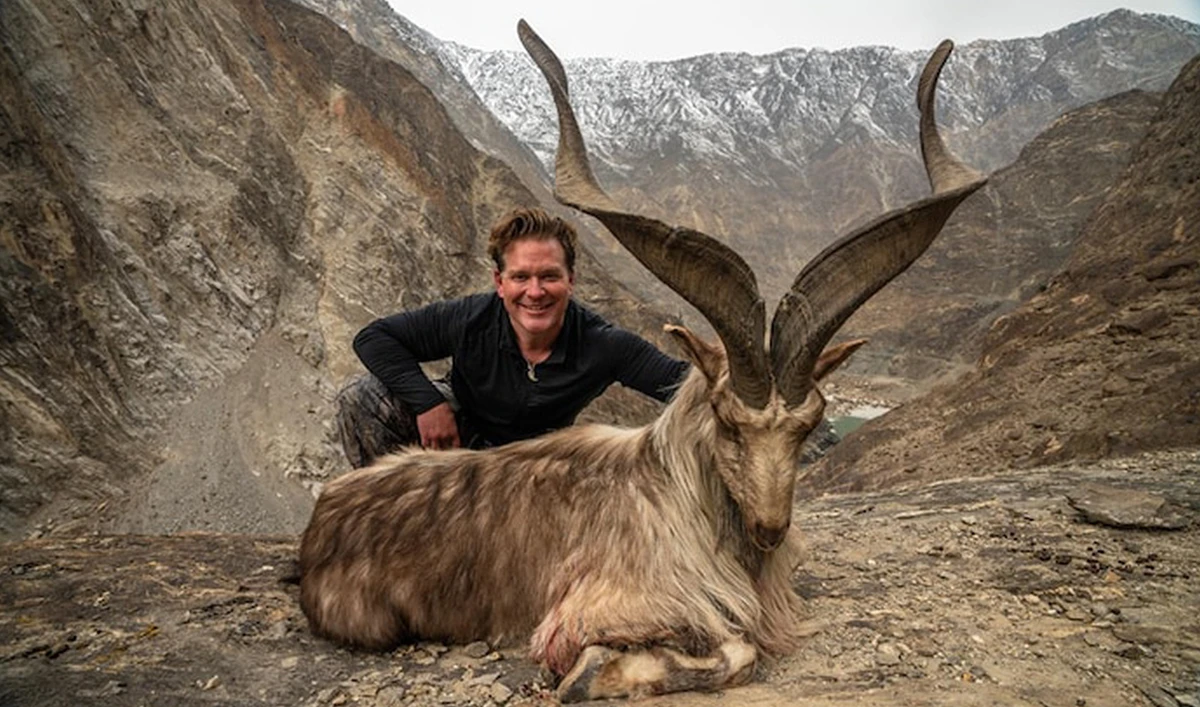
- Gilgit-Baltistan has auctioned hunting permits for 104 endangered animals, including markhors, blue sheep and ibexes
- Conservationists argue trophy hunting program in Pakistan prevents poaching and empowers local communities
KHAPLU, Gilgit-Baltistan: The Gilgit-Baltistan (GB) government’s wildlife department on Tuesday auctioned trophy hunting permits for 104 endangered animals, with the highest permit to hunt the Astor markhor fetching a record $186,000, a wildlife department official confirmed.
The enormous license fee to kill the rare markhor, a long-horned goat native to Pakistan and found in its snowy northern mountains, is one of the highest in the world. The trophy hunting program was first introduced by the region’s administration in GB’s Nagar Valley in 1990, attracting international hunters who have since been paying hundreds of thousands of dollars to target a limited number of wild animals in the area. The program was later extended to different areas of GB.
Trophy hunting is viewed worldwide as a controversial practice as it involves hunting of rare animals for sport and displaying their parts as trophies. Conservationists argue the trophy hunting program in northern Pakistan prevents poaching and empowers local communities. Markhors are usually found at heights of 8,000-11,000 feet, but during the winter months descend to between 5,000-6,000 feet, which is when the hunting season kicks off.
“We had four permits of markhors and the highest permit was auctioned today in the Kargah-Napura-Basin area [of GB] for $186,000,” Khadim Abbas, a conservator for GB’s wildlife department, told Arab News over the phone.
Officials say 80 percent of the money received from the trophy hunting program goes to local communities, who spend it on education, health and development projects. The trophy hunting season commences on November 1 and ends on April 25. For the 2023-2024 season, the GB government auctioned hunting permits for four Astor markhors, 12 blue sheep and 88 ibexes.
Abbas said the second-highest permit for hunting a markhor sold for $181,000, followed by another one worth $177,000. The conservator said eight international permits for blue sheep were also auctioned.
“The base value for the blue sheep [permit] was $9,000. However, the price for a single blue sheep [permit] has been recorded between $26,000 and $35,000,” he said.
For Pakistani hunters, the highest price a blue sheep permit fetched was Rs 1,800,000 ($6,440), he continued, adding that the highest rate for hunting an ibex fetched Rs 1,100,000 ($3,935).
Abbas confirmed that 80 percent of the amount collected through the permits would go to the local communities while the rest would be deposited in the national exchequer.
“Local communities use the money in the health and development sector,” he said. “They also provide scholarships to students and loans for needy members of the community in case of emergency or to start small businesses.”
Tariq Hussain, another wildlife department official, said last year the highest price fetched by a markhor hunting license was $165,000. He said the trophy hunting program was proving to be beneficial for GB’s locals.
“The trophy hunting program is spreading awareness among locals and they are playing their best role to control illegal hunting of wild animals in their areas,” Dr. Salar Ali, head of the Department of Environmental Science at the University of Baltistan, told Arab News.
He said before the trophy hunting program was launched by the government, locals were not aware of the benefits that endangered animals provided, adding that poaching activities were also on the rise then.
“Now, once they [locals] started to get income from this program, they are playing their role to protect these animals,” Ali said.