

Hezbollah chief meets top Palestinian leaders

1 / 2
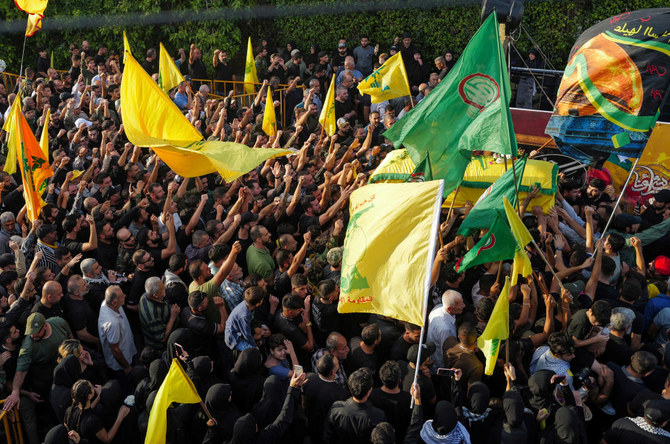
People carry the coffin of Hezbollah member Haydar Ayad, who was killed in southern Lebanon amidst tension between Israel and Hezbollah, during his funeral, in Babliyeh Lebanon, October 24, 2023. (Reuters)
2 / 2
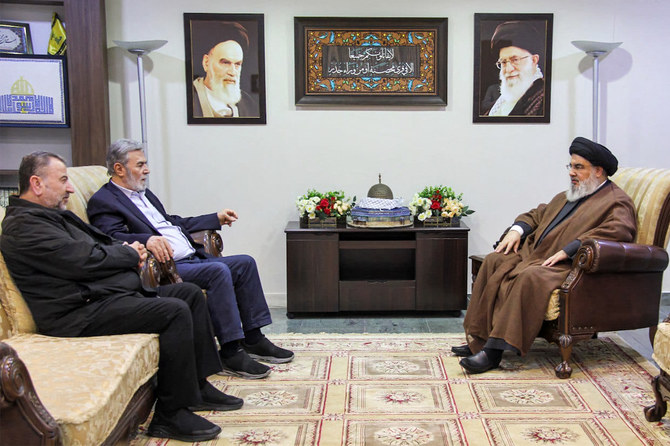
This handout picture provided by the media office of the Hezbollah Lebanese Shiite movement on October 25, 2023, shows the group's secretary-general Hassan Nasrallah (R) meeting with with the Palestinian secretary-general of the Islamic Jihad movement Ziad Nakhale (2nd-L) and the Hamas movement's deputy chief of political affairs Saleh al-Arouri (L) at an undisclosed location in Lebanon. (AFP)
Short Url
Updated 25 October 2023
Follow

Hezbollah chief meets top Palestinian leaders

BEIRUT: The head of Lebanon’s Hezbollah met with top leaders of the Palestinian militant factions Hamas and Islamic Jihad, according to a report by Hezbollah’s Al-Manar TV, saying they had assessed what their alliance must do to “achieve a real victory for the resistance” in Gaza.
The meeting grouped Hezbollah’s Sayyed Hassan Nasrallah, with Hamas deputy chief Saleh Al-Arouri, and Islamic Jihad chief Ziad Al-Nakhala, Al-Manar reported.
“The meeting ... assessed the positions taken internationally and what the Axis of Resistance must do,” a headline on Al-Manar said, referring to an alliance of Iran, Palestinian militant groups, Syria, Lebanon’s Hezbollah and other factions.

Nasrallah and the Palestinian militant leaders “agreed to keep coordinating and daily following up on developments,” the statement added.
Hezbollah and Hamas have long been part of a "joint operations room" with the Quds Force -- the foreign operations arm of Iran's Revolutionary Guards -- a source close to Hezbollah previously told AFP on condition of anonymity.
The meeting also touched upon the cross-border fire on the Lebanon-Israel border, the statement said.


 Sheik Hassan Nasrallah, leader of Hezbollah, left, chats with Khaled Mashaal, in south of Beirut, Lebanon, March 27, 2004. (AP)


GCC states ‘face reliance on Saudi Arabia for food imports’

Updated 6 sec ago
Follow

GCC states ‘face reliance on Saudi Arabia for food imports’

  • With 70 percent of food coming through Strait of Hormuz, analysts warn of inevitable shortages

Some Gulf states may have to rely on overland food deliveries from Saudi Arabia if the US-Israel-Iran war continues to disrupt shipping through the Strait of Hormuz and restrict regional airspace, analysts warned on Thursday.
The region is up to 90 percent dependent on food imports, and price surges and scarcity of some goods are expected.
“With over 70 percent of GCC foodstuffs being imported through the Strait of Hormuz, Gulf states face shortages if the war persists,” said Neil ​Quilliam of the Chatham House think tank. 
“While GCC countries have taken steps to diversify suppliers and ensure sufficient stores to withstand disruption, this can only last several months. At this point, price increases ​and longer lead times will start to hit the markets.”
Commodities analyst Ishan Bhanu said: “The biggest immediate effect will be due to the blockade of Jebel Ali in Dubai, serving about 50 million people. Qatar, Kuwait, Bahrain and Iraq effectively become landlocked and will depend on overland routes through Saudi Arabia.”
Bottlenecks are yet to show and the UAE has said its strategic reserves of vital goods cover four to six months of needs. It urged residents to report unjustified price increases through a dedicated hotline.
Supermarket staff ​throughout the Gulf said shelves remain largely stocked, though suppliers are taking longer to replenish certain products. Iran’s strikes on the Gulf since Saturday prompted panic buying in supermarkets, a dry run for what could come. 
“Perception of risk matters, and even if stocks are sufficient now, public runs on supermarkets can spook the public,” Quilliam said.