

Six killed in Russia’s missile attack on Kharkiv postal center

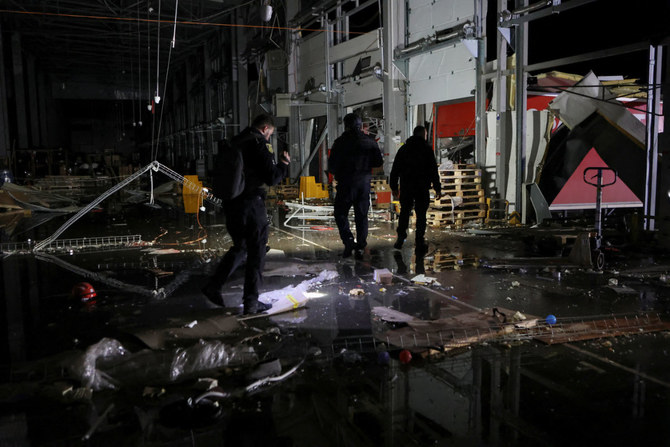
Police officers inspect a Nova Post distribution center hit by Russian missiles in the village of Korotych, outside of Kharkiv, Ukraine, on October 22, 2023. (Reuters)
Short Url
Updated 22 October 2023
Follow

Six killed in Russia’s missile attack on Kharkiv postal center

  • President Zelensky posts video on Telegram showing a building with windows blown out and construction materials strewn about
  • Moscow’s drive to capture the town of Avdiivka has encountered fierce resistance, incurring heavy losses on both personnel and weapons

KYIV: Six people have been killed and at least 14 injured in a Russian missile attack that hit a postal distribution center in the war-devastated northeastern Ukrainian city of Kharkiv, Ukrainian officials said.

“Russian missiles hit the Nova Poshta center — an ordinary civilian object,” President Volodymyr Zelensky said on the Telegram messaging app.
He posted a video showing s building with windows blown out and construction materials strewn about, with red trucks with Nova Poshta written in Ukrainian in front of it.
Oleh Synehubov, the governor of the broader Kharkiv region of which the city of Kharkiv is the administrative center, said several of the injured were in serious condition in hospital.
Those killed and injured were employees of the postal center, Synehubov said on Telegram. Police said the workers did not have time to run to the shelter, because the siren sounded a second before impact.
Reuters could not independently verify the reports. There was no immediate comment from Russia. Both sides deny targeting civilians in the war that Russia launched against its neighbor in February 2022.
Kharkiv, Ukraine’s second-largest city, was devastated in the early days of Russia’s full-scale invasion.

Resistance in Avdiivka
Further south in the east, Ukraine has been trying to stop a new push by Russian forces to gain more territory there, amid Kyiv’s slow and gruelling counteroffensive that has continued for months.
Moscow’s drive to capture the town of Avdiivka encountered fierce resistance on Saturday, Ukraine’s military said, with defenses bolstered by fortifications erected nearly a decade ago.
“The enemy is becoming more active, but is incurring heavy losses,” General Oleksandr Tarnavskyi, commander of Ukraine’s troops in the south, said on Telegram.
Russia’s Defense Ministry, in its evening report, made no mention of Avdiivka, but reported strikes on areas outside Bakhmut, a town seized by Moscow’s forces in May after months of battles. Both towns are in the eastern Donetsk region.
Avdiivka, a watchword in Ukraine for resistance, has withstood enemy attacks for months. Video footage shows buildings in ruins and streets barely distinguishable.
The town was briefly captured in 2014 by Russian-backed separatists who seized large swathes of eastern Ukraine, but was retaken by Ukrainian forces who built solid fortifications.
“We have concrete fortifications ... outside the city,” military analyst Pavel Norozhnyi told national television. “(Russian forces) need heavy artillery and anti-tank missiles to destroy every stronghold.”
The Institute for the Study of War, a US think-tank, said Russian troops had “marginally advanced” near Avdiivka.


Minnesota gears up for anti-immigration enforcement protest Friday despite dangerous cold

Updated 1 sec ago
Follow

Minnesota gears up for anti-immigration enforcement protest Friday despite dangerous cold

MINNEAPOLIS: A vast network of labor unions, progressive organizations and clergy has been urging Minnesotans to stay away from work, school and stores Friday to protest against immigration enforcement in the state.
“We really, really want I.C.E. to leave Minnesota, and they’re not going to leave Minnesota unless there’s a ton of pressure on them,” said Kate Havelin of Indivisible Twin Cities, one of the more than 100 groups that is mobilizing. “They shouldn’t be roaming any streets in our country just the way they are now.”
The Twin Cities of Minneapolis and St. Paul have seen daily protests since Renee Good was fatally shot by a US Immigration and Customs Enforcement officer during an operation on Jan. 7. Federal law enforcement officers have surged in the area for weeks and have repeatedly squared off with community members and activists who track their movements online and in streets.
On Thursday, a prominent civil rights attorney and at least two other people involved in an anti-immigration enforcement protest that disrupted a Sunday service at a Minnesota church were arrested.
Vice President JD Vance visited Minneapolis to meet with ICE officials. He said repeatedly that he believed the fraught situation in Minneapolis would improve upon better cooperation from state and local officials, and he encouraged protests to remain peaceful.
Friday’s mobilization was planned as the largest coordinated protest action to date, including a march in downtown Minneapolis despite dangerously cold temperatures that the National Weather Service forecast in the single to double digits below zero (-20 to -30 degrees Celsius).
While organizations have asked participants to prepare for the cold, Havelin compared the presence of immigration enforcement to just such winter weather warnings.
“Minnesotans understand that when we’re in a snow emergency … we all have to respond and it makes us do things differently,” she said. “And what’s happening with ICE in our community, in our state, means that we can’t respond as business as usual.”
More than a hundred small businesses in the Twin Cities, largely coffee shops and restaurants, said they would close in solidarity or donate part of their profits, organizers said.
Ethnic businesses especially have lost sales during enforcement surges as both workers and customers stay away fearing they would be detained.
But some are deciding to close anyway, preferring to take a stance in solidarity rather than the “unscheduled interruption” of having agents apprehend staff, said Luis Argueta of Unidos MN, a civil rights group.
Many schools were planning to be closed for a variety of reasons. The University of Minnesota, which has about 50,000 students enrolled, said there would be no in-person classes because of the extreme cold warning, and the St. Paul public school district said there would no classes for the same reason. Minneapolis Public Schools were also scheduled to be closed Friday “for a teacher record keeping day.”
Clergy planned to join the march as well as hold prayer services and fasting, according to a delegation of representatives of faith traditions ranging from Buddhist to Jewish, Lutheran to Muslim.
Bishop Dwayne Royster, leader of the progressive organization Faith in Action, arrived in Minnesota on Wednesday from Washington, D.C.
“We want ICE out of Minnesota,” he said. “We want them out of all the cities around the country where they’re exercising extreme overreach.”
Royster said at least 50 of his network’s faith-based organizers from around the US were joining in the protest.
About 10 faith leaders were planning to travel to Minnesota from Los Angeles while others from the same group planned a solidarity rally in California, said one of the organizers there.
“It was a very harrowing experience,” said the Rev. Jennifer Gutierrez of the large enforcement operation in Los Angeles last year. “We believe God is on the side of migrants.”