

Events leading to the exile and return of Pakistan’s Nawaz Sharif

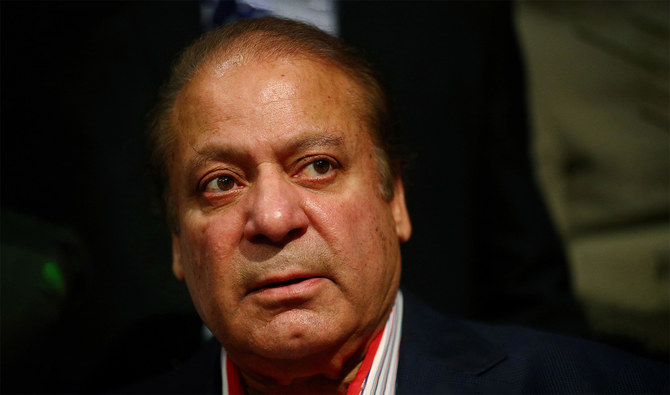
Ousted Prime Minister of Pakistan, Nawaz Sharif, speaks during a news conference at a hotel in London, Britain on July 11, 2018. (REUTERS/File)
Short Url
Updated 21 October 2023
Follow

Events leading to the exile and return of Pakistan’s Nawaz Sharif

  • Supreme Court disqualifies Sharif from PM office in 2017, declaring him dishonest for not disclosing income from a company owned by his son
  • In 2018, Supreme Court imposes lifetime ban on Sharif from taking part in politics or holding any public office in a first-of-its-kind decision

ISLAMABAD: Pakistan’s three-time prime minister, Nawaz Sharif, is due to return home on Saturday after four years of self-imposed exile in London, his lawyer and party said.

Sharif, 73, first become prime minister in 1990. He was ousted in a 1999 coup, ending a second stint as prime minister, and went into self-imposed exile until 2007.

Here is a timeline of events leading to his latest years of exile and his return.

April 2016: Millions of documents from a Panamanian law firm are leaked to the media. Some of the so-called Panama Papers show the involvement of Sharif’s family in offshore companies that hold properties in London. Sharif, who became prime minister for a third time after winning a 2013 election, denies wrongdoing but a case against him is filed in Pakistan by his main rival, cricketer-turned-politician Imran Khan.

July 28, 2017: The Supreme Court disqualifies Sharif from the prime minister’s office, declaring him dishonest for not disclosing income from a company owned by his son. Sharif, who had fallen out with the powerful military over policy differences, including ties with India, resigns from office the same day. He soon leaves for London to tend to his wife who was receiving medical treatment there.

April 13, 2018: The Supreme Court imposes a lifetime ban on Sharif from taking part in politics or holding any public office in a first-of-its-kind decision.

July 5, 2018: An anti-graft court sentences Sharif in absentia to 10 years in prison. He and his daughter, Maryam Nawaz, seen by supporters as his political heir, are convicted after failing to prove the source of income used to buy properties in London in the 1990s.

July 12, 2018: Nawaz and his daughter fly back to the city of Lahore, their hometown and political stronghold, and are arrested at the airport and sent to jail.

July 25, 2018: Sharif’s main rival, Imran Khan, wins a general election. The conservative Khan, political analysts say, is favored by the military to lead a civilian government. Both Khan and the military deny that.

Dec. 24, 2018: Sharif is convicted in another graft case and sentenced to seven years in prison and fined $25 million. He said the charges, linked to the ownership of a steel mill in Saudi Arabia, were politically motivated.

Nov. 19, 2019: Sharif flies to London after a court allows him to leave for medical treatment, on condition he returns when fit. He does not return.

April 10, 2022: Khan is ousted as prime minister in a parliamentary vote of no-confidence after differences with the military over security appointments. Sharif’s younger brother, Shehbaz Sharif, becomes prime minister.

May 9, 2023: The anti-corruption agency arrests Khan sparking violent protests by his supporters and months of tension between him and the military, compounding worries about nuclear-armed Pakistan as it grapples with record inflation.

Aug. 9, 2023: Shehbaz Sharif’s government completes its tenure and hands over power to a caretaker administration that will oversee a general election.

Sept. 21, 2023: The election commission announces it will be ready to hold a general election by the end of January 2024.

Oct. 19, 2023 — A court bars authorities from arresting Sharif upon his return and his lawyer says he intends to appeal against his convictions. His party has said he would contest a seat in the general election if his convictions are over-turned.


Fear, shock grip southwestern Pakistan day after deadly separatist attacks

Updated 5 sec ago
Follow

Fear, shock grip southwestern Pakistan day after deadly separatist attacks

  • Separatist militants carrying assault rifles stormed banks, jails, police stations and military installations, killing 31 civilians and 17 security personnel
  • Mobile Internet, train services remained suspended across Pakistan’s Balochistan on Sunday, with major roads and businesses deserted after attacks

QUETTA: Residents in the southwestern Pakistani city of Quetta were in shock and feared more violence, they said on Sunday, following deadly separatist attacks that killed nearly 200 people, including militants, security personnel and civilians, in the Balochistan province.

Authorities in Balochistan are battling one of the deadliest flare-ups in years as ethnic Baloch separatists step up assaults on security forces, civilians and infrastructure in the resource-rich province bordering Iran and Afghanistan.

Separatist militants carrying assault rifles stormed banks, jails, police stations and military installations in a string of coordinated attacks in several cities of Balochistan, including the provincial capital of Quetta, early Saturday.

Officials said the attacks killed 31 civilians and 17 security personnel, while 145 militants were killed in skirmishes and follow-up operations. The assaults were claimed by the Baloch Liberation Army (BLA) separatist group.

“The fear and anger are palpable in the city’s atmosphere following yesterday’s attacks at various locations in Quetta and other cities of Balochistan,” Zain Ali, a resident of Quetta’s Brewery Road, told Arab News on Sunday.

“We used to think that there is insurgency in Balochistan but Quetta is safe but that perception has been shattered.”

Balochistan has long been the site of a separatist insurgency that has intensified in recent years, with the BLA emerging as the most influential of separatist groups operating in the region.

The separatists, who frequently target security forces, foreigners, government officials and non-local Pakistanis, accuse the central government of stealing the region’s resources to fund development elsewhere in the country. The Pakistani government denies the allegations and says it is working for the uplift of local communities in Balochistan.

Saturday’s pre-dawn attacks by BLA targeted high-security government installations in Balochistan’s Quetta, Gwadar, Dalbandin, Pasni, Nushki, Kalat, Turbat and Mastung cities. 

Ali, who teaches at a private school and stepped out of home to buy groceries on Sunday, said he experiences an “unexplainable fear” of a sudden ambush by armed men on his way to downtown Quetta.

“If the capital is not safe, how would you expect security in rural areas of Balochistan,” Zain said. “The government has to take decisive action against these elements.”

On Sunday, mobile Internet and train services remained suspended across the province, with major roads and businesses deserted after the attacks.

Hafiz Ameer Muhammad, a security guard at a government’s run bank in Quetta’s Hazar Ganji area, recounted the horror when the militants stormed the city’s busiest business market, attacking several bank branches and torching goods and equipment.

“They came here at 10am and fired upon the gate but we didn’t let them in,” he told Arab News. “They broke the window and got inside and threatened us to hand over the weapons or face death.”

Dr. Mansoor Tareen, a dentist at Quetta’s Liaquat Bazar, said he feared more such attacks.

“Unfortunately, the government is limited to media and newspapers,” he said.

Pakistan’s military said the attacks were launched by “Indian-sponsored Fitna al Hindustan,” a reference it uses for Baloch separatist groups. India has denied any involvement.

In a statement on Saturday, the BLA said it had launched “Operation Herof 2.0,” claiming responsibility for attacks at multiple locations across Balochistan. Saturday’s assaults were similar to coordinated attacks carried out by the group in Aug. 2024, which killed dozens of people in various districts of Balochistan.

Balochistan Chief Minister Sarfraz Bugti has vowed his government would not surrender and would fight the militants until they are eliminated.

“We will fight this war for 1,000 years,” he said on Sunday. “This country is ours. This is our motherland. We will fight for it.”