

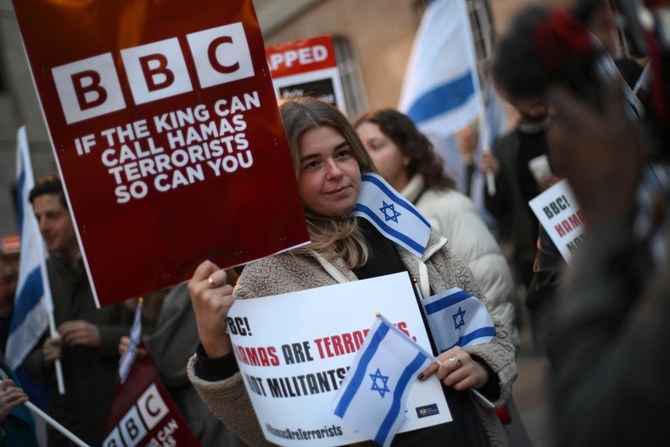
Israel threatens ban of BBC for its refusal to call Hamas terrorists

Karhi called the network “a propaganda mouthpiece” for Hamas and accused it of exposing Israeli soldiers to potential attack from Gaza. (AFP/File)
Short Url
Updated 20 October 2023
Follow

Israel threatens ban of BBC for its refusal to call Hamas terrorists

  • Israeli president calls BBC reporting ‘atrocious’ and accuses broadcaster of double standards

LONDON: The Israeli government has issued a stern warning to the BBC, suggesting that the network may be prohibited from reporting in the country due to its refusal to classify Hamas as a terrorist organization.

A senior Israeli official voiced the government’s concerns, emphasizing that the BBC might face repercussions if it continued to operate in a manner “inconsistent with our legal framework.”

In an interview with the Daily Mail on Thursday, Israeli President Isaac Herzog called the BBC’s stance “atrocious.”

“The fact that it does not recognize Hamas as a terror organization requires a complete legal battle and public battle,” Herzog said. “What other type of torture do they want before they decide it (is) a terrorist organization?”

Herzog also highlighted what he claimed was a double standard in the way the BBC has characterized similar acts of violence in the past, citing the London Bridge, Westminster, and Paris attacks as examples of events the BBC has reported as terrorist acts. 

Another Israeli official, discussing potential measures against broadcasters, told The Telegraph, “We’re a democratic country and we will use all the tools a democratic state has. If any broadcast channel uses terminology we think is crossing the line in accordance with our laws, we will (take action).”

Earlier this week, Israeli media reported that Shlomo Karhi, the communications minister, had been given the green light by the attorney general to set up regulations aimed at curbing Al Jazeera’s reporting on the ground in Israel.

Karhi called the network “a propaganda mouthpiece” for Hamas and accused it of exposing Israeli soldiers to potential attack from Gaza.

The reports triggered an international reaction, with media and press-freedom organizations urging Israel not to block the Qatari broadcaster, citing the importance of a “plurality of media voices.” Any move to ban the BBC from Israel is expected to further raise concerns about press freedom.

Since the beginning of the conflict, the BBC has faced numerous criticisms over its reporting. On Thursday, Israeli officials criticized the British broadcaster for its coverage of the explosion at Al-Ahli Arab Hospital in Gaza, describing suggestions it made in the immediate aftermath of the blast that Israel might have been responsible as a “modern blood libel.”

On Saturday, during a pro-Palestine march in London, activists splattered the BBC’s New Broadcasting House in Oxford Circus with red paint to protest what they called the network’s “biased” reporting of events in Israel and Gaza.


Paris exhibition marks 200 years of Le Figaro and the enduring power of the press

Updated 17 January 2026
Follow

Paris exhibition marks 200 years of Le Figaro and the enduring power of the press

  • The exhibition celebrated the bicentennial of Le Figaro, offering visitors a rare opportunity to step inside the newspaper’s vast historical archive

PARIS: One of France’s most influential newspapers marked a major milestone this month with a landmark exhibition beneath the soaring glass nave of the Grand Palais, tracing two centuries of journalism, literature and political debate.
Titled 1826–2026: 200 years of freedom, the exhibition celebrated the bicentennial of Le Figaro, offering visitors a rare opportunity to step inside the newspaper’s vast historical archive. Held over three days in mid-January, the free exhibition drew large crowds eager to explore how the title has both chronicled and shaped modern French history.
More than 300 original items were displayed, including historic front pages, photographs, illustrations and handwritten manuscripts. Together, they charted Le Figaro’s evolution from a 19th-century satirical publication into a leading national daily, reflecting eras of revolution, war, cultural change and technological disruption.
The exhibition unfolded across a series of thematic spaces, guiding visitors through defining moments in the paper’s past — from its literary golden age to its role in political debate and its transition into the digital era. Particular attention was paid to the newspaper’s long association with prominent writers and intellectuals, underscoring the close relationship between journalism and cultural life in France.
Beyond the displays, the program extended into live journalism. Public editorial meetings, panel discussions and film screenings invited audiences to engage directly with editors, writers and media figures, turning the exhibition into a forum for debate about the future of the press and freedom of expression.
Hosted at the Grand Palais, the setting itself reinforced the exhibition’s ambition: to place journalism firmly within the country’s cultural heritage. While the exhibition has now concluded, the bicentennial celebrations continue through special publications and broadcasts, reaffirming Le Figaro’s place in France’s public life — and the enduring relevance of a free and questioning press in an age of rapid change.