Meta to limit some Facebook comments on Israeli, Palestinian posts

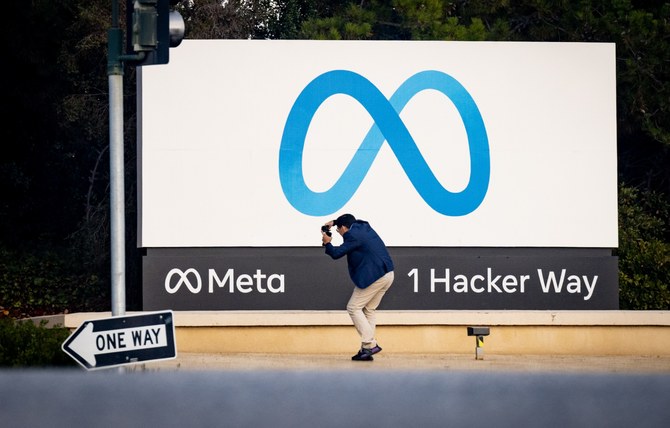
Meta designates Hamas as a “dangerous organization” and bans content praising the group. (AFP/File)
Short Url
Updated 19 October 2023
Follow

Meta to limit some Facebook comments on Israeli, Palestinian posts

  • Individuals can only comment posts created by users ‘in the region’ to only their friends and followers
  • Announcement comes as EU issued a one-week ultimatum to Meta and TikTok to detail anti-disinformation measures

LONDON: Facebook-owner Meta Platforms on Wednesday introduced temporary measures to limit “potentially unwelcome or unwanted comments” on posts about the conflict between Israel and Hamas.

Meta said it will change the default setting for people who can comment on new and public Facebook posts created by users “in the region” to only their friends and followers, Meta said in an updated blog post.

A Meta spokesperson declined to specify how the company defined the region. Users can opt-out and change the setting at any time, Meta said.

The social media company added it will disable the ability to see the first one or two comments on posts while scrolling the Facebook feed.

“Our policies are designed to keep people safe on our apps while giving everyone a voice.” Meta said.

“We apply these policies equally around the world and there is no truth to the suggestion that we are deliberately suppressing voice.”

Earlier this week, some users who posted in support for Palestine or Gaza citizens accused Meta of suppressing their content.

Meta designates Hamas as a “dangerous organization” and bans content praising the group.

Mondoweiss, a news website that covers Palestinian human rights, said on social media platform X on Oct. 10 that Instagram had twice suspended the profile of its video correspondent.

Other Instagram users reported their posts and stories about Palestine were not receiving views.

In a statement to Arab News, Meta denied allegations of censorship based on taking sides or silencing Palestinian voices.

They explained that the issue was caused by a now-fixed bug, which had been preventing re-posted content from appearing correctly in a user’s story.

“The suggestion that we’re trying to suppress a particular community or point of view is categorically untrue,” a spokesperson said.

“Our policies are designed to give everyone a voice while keeping people safe on our apps, and we apply these policies regardless of who is posting, or their personal beliefs.”

“This bug affected accounts equally around the globe – not only people trying to post about what’s happening in Israel and Gaza – and it had nothing to do with the subject matter of the content,” Meta added.

The decision coincides with the European Union giving Meta and TikTok a one-week ultimatum to furnish information about their efforts to combat the dissemination of terrorist, violent, and hate speech content on their platforms.

This ultimatum comes in light of the recently enacted Digital Services Act (DSA), which took effect in August.

According to the DSA, significant online platforms are now obligated to step up their efforts in removing unlawful and harmful content, or they could face fines of up to 6 percent of their global revenue.

With Reuters


MenaML hosts 2026 Winter School in Saudi Arabia to boost AI education, collaboration in region

Updated 16 January 2026
Follow

MenaML hosts 2026 Winter School in Saudi Arabia to boost AI education, collaboration in region

  • Second edition of Winter School will be hosted in partnership with KAUST

DUBAI: The Middle East and North Africa Machine Learning Winter School will host its second edition in Saudi Arabia this year, in partnership with the King Abdullah University of Science and Technology.

The non-profit held its inaugural edition in Doha last year in partnership with the Qatar Computing Research Institute.

The initiative began when like-minded individuals from Google DeepMind and QCRI came together to launch a platform connecting a “community of top-tier AI practitioners with a shared interest in shaping the future of the MENA region,” Sami Alabed, a research scientist at Google DeepMind and one of the co-founders of MenaML, told Arab News.

Along with Alabed, the core team includes Maria Abi Raad and Amal Rannen-Triki from Google DeepMind, as well as Safa Messaoud and Yazan Boshmaf from QCRI.

Maria Abi Raad

Messaoud said that the school has three goals: building local talent in artificial intelligence, enhancing employability and connection, and reversing brain drain while fostering regional opportunity.

AI has dominated boardrooms and courtrooms alike globally, but “AI research and education in MENA are currently in a nascent, yet booming, stage,” she added.

Launched at a pivotal moment for the region, the initiative was timed to ensure “regional representation in the global AI story while cultivating AI models that are culturally aligned,” said Rannen-Triki.

The school’s vision is to cultivate researchers capable of developing “sophisticated, culturally aligned AI models” that reflect the region’s values and linguistic and cultural diversity, said Messaoud.

This approach, she added, enables the region to contribute meaningfully to the global AI ecosystem while ensuring that AI technologies remain locally relevant and ethically grounded.

MenaML aims to host its annual program in a different city each year, partnering with reputable institutions in each host location.

“Innovation does not happen in silos; breakthroughs are born from collaboration that extends beyond borders and lab lines,” said Alabed.

“Bringing together frontier labs to share their knowledge echoes this message, where each partner brings a unique viewpoint,” he added.

This year, MenaML has partnered with KAUST, which “offers deep dives into specialized areas critical to the region, blending collaborative spaces with self-learning and placement programs,” said Abi Raad.

The program, developed in partnership with KAUST, brings together speakers from 16 institutions and focuses on four key areas: AI and society, AI and sciences, AI development, and regional initiatives.

“These themes align with the scientific priorities and research excellence pillars of KAUST as well as the needs of regional industries seeking to deploy AI safely and effectively,” said Bernard Ghanem, professor of electrical and computer engineering and computer science at KAUST and director of the Center of Excellence in Generative AI.

The program will also highlight efficiency in AI systems, with the overall goal of equipping “participants with the conceptual and practical understanding needed to contribute meaningfully to next-generation AI research and development,” he told Arab News.

For KAUST, hosting the MenaML Winter School aligns with Saudi Arabia’s ambition to become a global hub for AI research under Vision 2030.

By attracting top researchers, industry partners, and young talent to the Kingdom, it helps cement the Kingdom’s position as a center for AI excellence, Ghanem said.

It also aligns closely with Vision 2030’s “goals of building human capital, fostering innovation, and developing a knowledge-based economy” and “contributes to the long-term development of a world-leading AI ecosystem in Saudi Arabia,” he added.

Although the program accepts students from around the world, participants must demonstrate a connection to the MENA region, Abi Raad said.

The goal is to build bridges between those who may have left the region and those who remain, enabling them to start conversations and collaborate, she added.

A certain percentage of spots is reserved for participants from the host country, while a small percentage is allocated to fully international students with no regional ties, with the objective of offering them a glimpse into the regional AI ecosystem.

Looking ahead, MenaML envisions growing from an annual event into a sustainable, central pillar of the regional AI ecosystem, inspired by the growth trajectory of global movements like TED or the Deep Learning Indaba, a sister organization supporting AI research and education in Africa.

Boshmaf said MenaML’s long-term ambition is to evolve beyond its flagship event into a broader movement, anchored by local MenaMLx chapters across the region.

Over time, the initiative aims to play a central role in strengthening the regional AI ecosystem by working with governments and the private sector to support workforce development, AI governance and safety education, and collaborative research, while raising the region’s global visibility through its talent network and international partnerships.

He added: “If TED is the global stage for ‘ideas worth spreading,’ MenaML is to be the regional stage for ‘AI ideas worth building.’”

The MenaML Winter School will run from Jan. 24 to 29 at KAUST in Saudi Arabia.