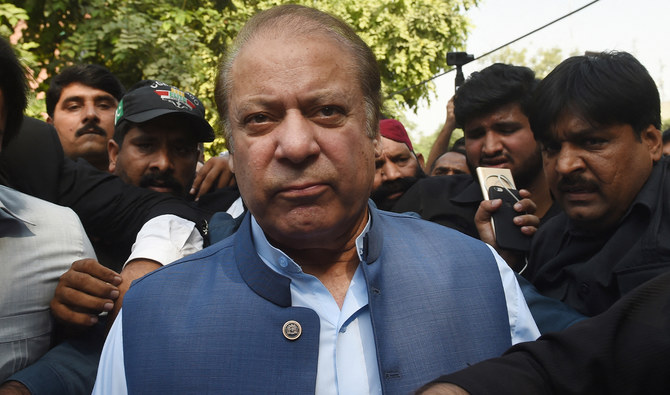

ISLAMABAD: The Pakistan Muslim League-Nawaz (PML-N) on Wednesday filed a protective bail plea in the Islamabad High Court (IHC) to restrain authorities from arresting the head of the party, three-time former Prime Minister Nawaz Sharif, when he returns to Pakistan this week after four years in self-imposed exile.
Sharif left Pakistan in November 2019 in an air ambulance to seek medical treatment in London, a month after he was released on bail from a seven-year prison sentence for corruption.
Sharif’s third term as prime minister ran from 2013 to 2017, when he was removed by the Supreme Court amid revelations over his personal wealth in the Panama Papers investigations, and subsequently convicted of corruption in a number of different cases. Sharif has consistently denied the accusations, claiming they were politically motivated and blaming the country’s generals for directing the judges to bring him down. The military denies interfering in politics.
Sharif was only allowed to leave for medical treatment on Nov 19, 2019, after agreeing to a series of conditions, including that he would return in four weeks if his doctors found him fit. He was also required to submit medical reports notarized by Pakistan’s embassy in London.
But Sharif did not return despite multiple court summons in at least two cases and was declared a proclaimed offender by the IHC, meaning he could face arrest upon his return to Pakistan on October 21.
“The petitioner [Sharif] submits to seek protective bail so as to surrender before the Honorable Court and to submit to due process of justice and avail the remedies permissible under the law,” said a copy of the protective bail petition filed by Sharif’s lawyers.
The application sought the IHC’s direction to stop authorities from arresting Sharif from the airport on his return to the country and to allow him to surrender before the court and let the law take its course.
The two cases in which Sharif fears arrest are the Avenfield case, which revolves around corrupt practices in the purchase of luxury apartments in London by the Sharif family, and the Al-Azizia reference, of owning assets beyond means, which pertains to the Sharifs being unable to justify the source of the funds provided to set up the Al-Azizia Steel Mills and Hill Metal Establishment (HME) in Saudi Arabia.
In 2018, Sharif was sentenced to seven years in jail in the Al-Azizia Steel Mills corruption reference and 10 years in prison on corruption charges related to the Avenfield flats.
His appeals against the convictions by accountability courts were dismissed by the IHC. Now, as Sharif returns to Pakistan after four years, there are fears he will be rearrested in the two cases.
He is scheduled to leave Dubai for Pakistan on October 21.
PML-N senior leader Ishaq Dar recently told media there was “no chance” of Sharif being arrested on his return to Pakistan, adding that he would obtain transit and protective bails.
“Nawaz Sharif will follow the standard legal procedures,” Dar, a former finance minister, said.
Sharif has been a central figure in Pakistan’s turbulent politics for three decades, repeatedly clashing with the powerful military.
In 1999, Sharif was overthrown by a military coup that brought army chief General Pervez Musharraf to power. Sharif subsequently went into exile in Saudi Arabia, before returning to Pakistan in 2007 as Musharraf’s grip on power began to slip.