

Saudi Arabia calls emergency OIC meeting to discuss Gaza escalation on Wednesday

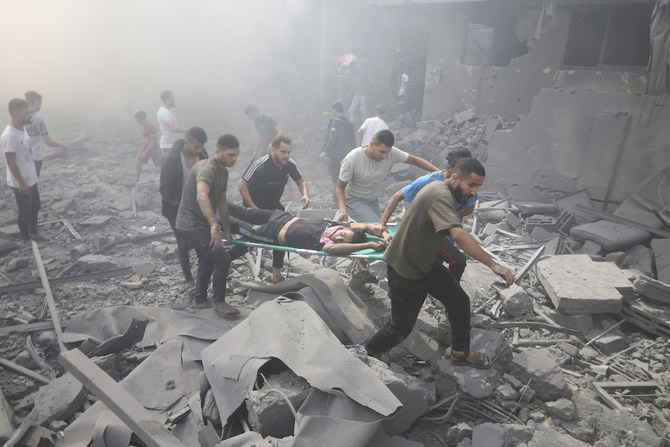
Palestinians evacuate wounded after an Israeli airstrike in Rafah refugee camp, southern Gaza Strip, Thursday, Oct. 12, 2023. (AP)
Short Url
Updated 15 October 2023
Follow

Saudi Arabia calls emergency OIC meeting to discuss Gaza escalation on Wednesday

JEDDAH: At the invitation of Saudi Arabia, the Organization of Islamic Cooperation will hold an emergency meeting in Jeddah on Wednesday to discuss the violence in Gaza, following an eight-day war that has left thousands dead and injured.

The Kingdom, which is chairman of the Islamic Summit at its current session and chairman of the OIC’s executive committee, called for the “open-ended” ministerial meeting to discuss the military escalation in Gaza and its surroundings, and the worsening situation that threatens civilians and regional security and stability.

Israel has intensified its war to destroy the Hamas group, relentlessly pounding the Gaza Strip, killing at least 2,215 people, and deploying tens of thousands of soldiers nearby ahead of an expected ground offensive.

It follows last Saturday’s attack by Hamas, which saw hundreds of its fighters cross the Israeli border to take hostages and kill more than 1,300 people.

(With AFP)


Japanese researchers hope to restore coral from Saudi-made structures

Updated 05 January 2026
Follow

Japanese researchers hope to restore coral from Saudi-made structures

  • Coral skeletons made for Saudi Pavilion at Japan expo last year
  • Results of Japanese study to be revealed at Riyadh Expo 2030

TOKYO: Japanese universities are seeking to restore coral reefs and marine ecosystems after receiving artificial structures that Saudi Arabia made and showcased at last year’s Osaka-Kansai Expo.

The coral skeletons were donated to the University of the Ryukyus in Okinawa and Kansai University in Osaka Prefecture, Kyodo News reported at the weekend.

The structures are made from calcium carbonate, a material on which corals are believed to grow more easily compared to artificial alternatives such as concrete or metal.

The skeletal structures were created using 3-D printers, with one piece produced a day during the expo, and displayed across an entire wall in the Saudi Arabia Pavilion, which had an area focusing on sustainable marine environments.

Coral reefs serve as habitats for much marine life, but over 40 percent of the world’s 892 species face possible extinction, according to the International Union for Conservation of Nature.

The University of the Ryukyus, which received about 150 of the artificial coral skeletons, will place them in waters off the eastern coast of Okinawa’s main island and then examine their impact on the ecosystem.

Kansai University has placed theirs in the sea around Kagoshima Prefecture’s Yoron Island to observe their growth after transplanting coral polyps onto the structures.

The results of the research are expected to be revealed at the Riyadh Expo in 2030.

“I had never imagined that Japan and Saudi Arabia would cooperate on coral research,” said Masato Ueda, a professor specializing in regenerative medicine at Kansai University.

Ueda said he wants to demonstrate to children that “humanity is attempting to restore the environment.”