

China drives away Philippines navy gunboat from Scarborough Shoal waters

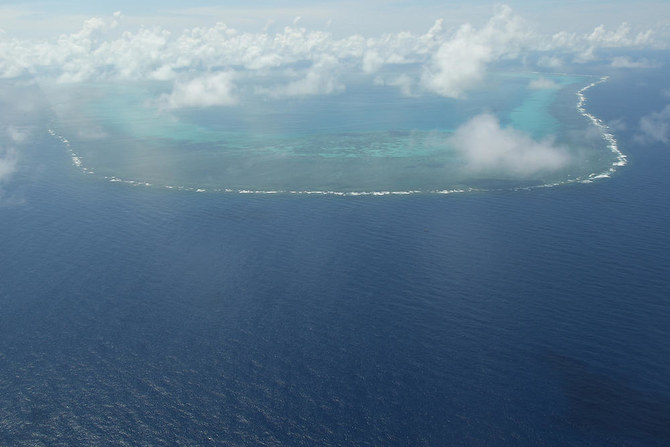
Above, an aerial view of the Scarborough Shoal in the South China Sea, which China claims ‘indisputable sovereignty’, including the adjacent waters. (AFP)
Short Url
Updated 10 October 2023
Follow

China drives away Philippines navy gunboat from Scarborough Shoal waters

  • Philippines’ military chief has denied its navy vessel was driven away by the Chinese coast guard

BEIJING: China’s coast guard took measures to drive away a Philippine navy gunboat on Tuesday after it intruded into waters around the Scarborough Shoal in the South China Sea, according to an official statement.

The coast guard said it took “necessary measures” such as forcing the gunboat out and controlling its route after repeated dissuasion and warnings from the Chinese side were ignored.

The Philippines’ military chief has denied its navy vessel was driven away by the Chinese coast guard in Scarborough shoal, saying it was part of China’s propaganda.

“We are having it verified, but nothing like that happened. In our view, it is Chinese propaganda,” Philippine armed forces chief Romeo Brawner said in an interview.

China claims it has “indisputable sovereignty” over the shoal, which it calls Huangyan Island, and the adjacent waters.

Last month, the Philippine coast guard week said it had cut a 300 meter (980 feet) floating barrier installed by China that blocked access to the hotly disputed area which Beijing has controlled for over a decade.

“We urge the Philippines to immediately stop its infringement,” coast guard spokesman Gan Yu said, saying the action was also a serious violation of international law.

The occurrence comes a day after China warned the Philippines against further “provocations” at an atoll in the South China Sea, saying such acts had violated Chinese territorial sovereignty, contravened international law and disrupted regional peace and stability.

Ties between the Philippines and China have deteriorated of late, in large part due to overtures from its president to deepen defense ties with Washington, including offering expanded access to its troops, ostensibly for training and humanitarian purposes.


Mali, Burkina say restricting entry for US nationals in reciprocal move

Updated 31 December 2025
Follow

Mali, Burkina say restricting entry for US nationals in reciprocal move

  • Both countries said they are applying the same measures on American nationals as imposed on them

ABIDJAN: Mali and Burkina Faso have announced travel restrictions on American nationals in a tit-for-tat move after the US included both African countries on a no-entry list.
In statements issued separately by both countries’ foreign ministries and seen Wednesday by AFP, they said they were imposing “equivalent measures” on US citizens, after President Donald Trump expanded a travel ban to nearly 40 countries this month, based solely on nationality.
That list included Syrian citizens, as well as Palestinian Authority passport holders, and nationals of some of Africa’s poorest countries including also Niger, Sierra Leone and South Sudan.
The White House said it was banning foreigners who “intend to threaten” Americans.
Burkina Faso’s foreign ministry said in the statement that it was applying “equivalent visa measures” on Americans, while Mali said it was, “with immediate effect,” applying “the same conditions and requirements on American nationals that the American authorities have imposed on Malian citizens entering the United States.”
It voiced its “regret” that the United States had made “such an important decision without the slightest prior consultation.”
The two sub-Saharan countries, both run by military juntas, are members of a confederation that also includes Niger.
Niger has not officially announced any counter-measures to the US travel ban, but the country’s news agency, citing a diplomatic source, said last week that such measures had been decided.
In his December 17 announcement, Trump also imposed partial travel restrictions on citizens of other African countries including the most populous, Nigeria, as well as Ivory Coast and Senegal, which qualified for the football World Cup to be played next year in the United States as well as Canada and Mexico.