

Army says five militants, major killed during gunbattle in southwestern Pakistan

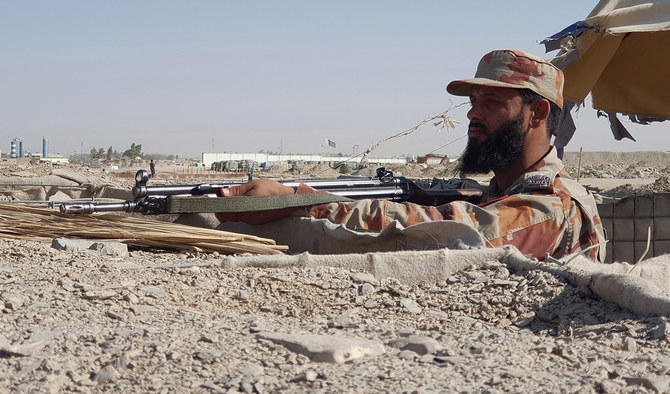
In this representational photo, Pakistani paramilitary soldier stands guard near the Pakistan-Afghanistan border crossing point in Chaman District in Balochistan, Pakistan on August 18, 2021. (AFP/File)
Short Url
Updated 09 October 2023
Follow

Army says five militants, major killed during gunbattle in southwestern Pakistan

  • Security forces, militants exchange fire in Balochistan’s Zhob district, says army’s media wing
  • Pakistan has seen a steep rise in militant attacks since Afghan Taliban took over Kabul in 2021

ISLAMABAD: Five militants and a Pakistan Army major were killed during a gunbattle between militants and security forces in the country’s southwestern Balochistan province, the Inter-Services Public Relations (ISPR) said in a statement on Monday. 

Pakistan’s restive Balochistan province has been the scene of a low-level insurgency by nationalist groups operating in the southwestern region, who claim to be fighting against what they view as the unfair exploitation of its mineral wealth by the federation.

The Pakistani state has consistently denied allegations made by armed separatist groups. On Sunday, a senior official of the Pakistan Mineral Development Corporation (PMDC) was killed in a targeted bomb attack in Balochistan’s capital Quetta, signifying a steep rise in militant activities across the province. 

According to a statement by the army’s media wing, security forces conducted an operation in Sambaza, Zhob district on the reported presence of militants on Sunday night. 

“During the conduct of the operation, terrorists were surrounded and after an intense exchange of fire, five terrorists were sent to hell,” the ISPR said. 

The army’s media wing said security forces also suffered casualties in the form of Major Syed Ali Raza Shah, 31, who was leading the operation. Havaldar Nisar Ahmed, 38, was also killed during the gunbattle. 

“Security forces of Pakistan are indebted & proud of our brave men and pay homage to their chivalry and sacrifices for the motherland,” the ISPR said.

The army said a sanitization operation was underway to eliminate any militants found in the surrounding areas. 

Pakistan’s western regions have seen a sharp rise in militant attacks since the Afghan Taliban captured Kabul in August 2021. The proscribed Tehreek-e-Taliban Pakistan (TTP), a separate entity from the Afghan Taliban who have pledged allegiance to them, have carried out some of the deadliest attacks against Pakistan’s security forces and civilians since 2007. 

Pakistan has called on Afghanistan to rein in TTP militants that it says are operating from Afghan soil. However, the Afghan government has rejected Pakistan’s accusations, leading to strained ties between Kabul and Islamabad. 

Last month, at least 60 people were killed and several injured when a suicide bomber targeted a gathering held in Balochistan’s Mastung city to mark the birthday of Prophet Muhammad (peace be upon him). 


Pakistan, China to sign multiple MoUs at major agriculture investment conference today

Updated 18 January 2026
Follow

Pakistan, China to sign multiple MoUs at major agriculture investment conference today

  • Hundreds of Chinese and Pakistani firms to attend Islamabad event
  • Conference seen as part of expanding CPEC ties into agriculture, trade

KARACHI: Islamabad and Beijing are set to sign multiple memorandums of understanding (MoUs) to boost agricultural investment and cooperation at a major conference taking place in the capital today, Monday, with hundreds of Chinese and Pakistani companies expected to participate.

The conference is being billed by Pakistan’s Ministry of National Food Security and Research as a platform for deepening bilateral agricultural ties and supporting broader economic engagement between the two countries.

“Multiple memorandums of understanding will be signed at the Pakistan–China Agricultural Conference,” the Ministry of National Food Security said in a statement. “115 Chinese and 165 Pakistani companies will participate.”

The conference reflects a growing emphasis on expanding Pakistan-China economic cooperation beyond the transport and energy foundations of the flagship China-Pakistan Economic Corridor (CPEC) into agriculture, industry and technology.

Under its first phase launched in 2015, CPEC, a core component of China’s Belt and Road Initiative, focused primarily on transportation infrastructure, energy generation and connectivity projects linking western China to the Arabian Sea via Pakistan. That phase included motorways, power plants and the development of the Gwadar Port in the country's southwest, aimed at helping Pakistan address chronic power shortages and enhance transport connectivity.

In recent years, both governments have formally moved toward a “CPEC 2.0” phase aimed at diversifying the corridor’s impact into areas such as special economic zones, innovation, digital cooperation and agriculture. Second-phase discussions have highlighted Pakistan’s goal of modernizing its agricultural sector, attracting Chinese technology and investment, and boosting export potential, with high-level talks taking place between planning officials and investors in Beijing.

Agri-sector cooperation has also seen practical collaboration, with joint initiatives examining technology transfer, export protocols and value-chain development, including partnerships in livestock, mechanization and horticulture.

Organizers say the Islamabad conference will bring together government policymakers, private sector investors, industry associations and multinational agribusiness firms from both nations. Discussions will center on investment opportunities, technology adoption, export expansion and building linkages with global buyers within the framework of Pakistan-China economic cooperation.