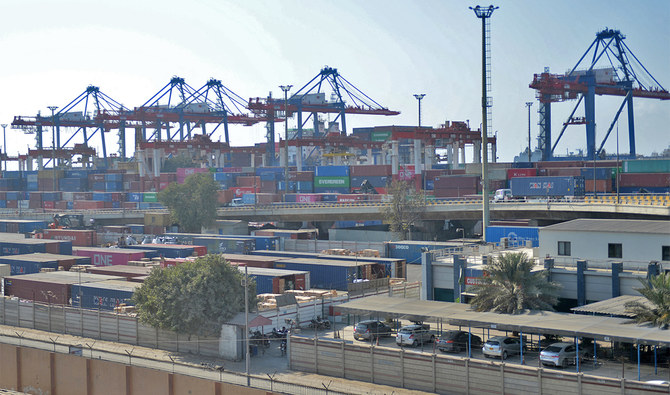
ISLAMABAD: Pakistani authorities have stopped hundreds of Afghanistan-bound containers under transit trade at Karachi port to curb smuggling and ensure proper taxation, causing losses of millions of dollars to Afghan traders, local businessmen said on Saturday.
The development comes days after the country imposed a 10 percent processing fee on several items under the Afghan transit trade agreement in a step that was viewed as an attempt to stop illegal entry of goods into the country from the neighboring state.
The commerce ministry in Islamabad subsequently banned the export of 212 items to Afghanistan under the transit trade agreement that included confectioneries, chocolates, footwear, machinery, blankets, tires, home textiles and garments.
“Hundreds of Afghanistan-bound containers are stuck at Karachi port after the authorities refused to clear the items banned by the commerce ministry,” Qazi Zahid Hussain, former president of Pakistan-Afghanistan Joint Chamber of Commerce and Industry, told Arab News.
“It is obvious the Afghan traders will have to bear millions of dollars of losses due to the change in Pakistan’s policy,” he continued, though he lauded the move and said it would curb smuggling that was taking place under the transit trade arrangement.
“The authorities will now allow Afghan traders to reexport their goods from Pakistani ports instead of clearing them for Afghanistan,” he added.
The Afghanistan-Pakistan Transit Trade Agreement aims to facilitate the transit of goods exported from and imported to Afghanistan using the Pakistani ports in Karachi and Gwadar. The pact also envisages the use of Afghan territory for trade between Pakistan and the Central Asian countries.
Hussain said the volume of Afghan transit trade swelled to around $8 billion from $4.5 billion in recent months, adding this alerted the authorities that many of the items destined for Afghanistan were secretly flowing into the Pakistani market.
“This means the volume of smuggling had increased significantly putting pressure on our currency, closure of local industry, loss of jobs and weakening of the economy,” he explained, adding that recent measures of the government against the smuggling through the Afghan transit trade had resulted in appreciation of rupee against the US dollar and stabilization of the economy.
Hussain, however, said that Pakistan being signatory of the World Trade Organization (WTO) was bound to allow the transit trade through its sea and land routes to landlocked Afghanistan.
“Pakistan cannot unilaterally shut the Afghan transit trade but can regulate it to some extent to stop the smuggling and boost its tax revenue,” he continued.
Afghan officials have objected to these developments while pointing out it is putting the commercial activities between the two countries under undue pressure.
“In addition to imposing 10 percent processing fee on some transit goods, the government of Pakistan has asked Afghan traders for 100 percent bank guarantee on transit cargo, which is beyond the ability of the traders,” Afghan embassy in Islamabad said this week.
The embassy added that its officials had tried to resolve trade-related issues by taking them up with the Pakistani authorities, but they had only exacerbated.
It urged the government in Islamabad “to remove these obstacles in the Afghan transit sector, so as not to have a negative impact on the commercial and bilateral relations of the two countries.”
Jawaid Bilwani, a member of the Pakistan-Afghanistan Joint Chamber of Commerce and Industry, said that Pakistan should revive the railway route to Afghanistan to boost its exports to the Central Asian states under the agreement.
“Our total export to the Central Asian countries at the moment is just $1 million per annum which can be significantly boosted through Afghanistan which is the shortest route to these nations,” he told Arab News.
“Pakistani authorities should work out viable plans to use the transit trade agreement in our favor,” he said, adding that Pakistan was earning millions of US dollars in taxation and fees for the utilization of its ports for transit trade.


Pakistan holds hundreds of Afghanistan-bound containers at Karachi port amid escalating trade row
https://arab.news/cxjev
Pakistan holds hundreds of Afghanistan-bound containers at Karachi port amid escalating trade row

- Afghan traders are likely to suffer financial losses due to the measures taken by the Pakistani authorities to curb smuggling
- Government imposed trade restrictions after transit trade items were sold into Pakistani markets, weakening the economy

Pakistan spin out Australia in second T20I to take series
- Salman Agha’s 76 and Usman Khan’s 53 lift Pakistan to 198-5, their highest T20I total against Australia
- Pakistan’s spinners take all 10 wickets as Australia are bowled out for 108, sealing an unbeatable 2-0 series lead
LAHORE: Skipper Salman Agha hit his highest score in the shortest format before Pakistan’s spinners routed Australia by 90 runs in the second Twenty20 international in Lahore on Saturday.
Agha hit a 40-ball 76 and Usman Khan smashed a 36-ball 53 as Pakistan made 198-5, their highest-ever T20I total against Australia.
This was enough for Pakistan’s spin quintet who shared all ten wickets between them with Abrar Ahmed returning the best figures of 3-14 and Shadab Khan finishing with 3-26.
Australia were routed for 108 in 15.4 overs, giving Pakistan their biggest T20I victory over Australia eclipsing the 66-run win in Abu Dhabi in 2018.
“It has to be a perfect game,” said Agha. “We batted well and then were outstanding with the ball. Fielding was outstanding.”
The victory gives Pakistan an unbeatable 2-0 lead after they won the first match by 22 runs, also in Lahore, on Friday.
“We want to play in the same way, forget the 2-0 scoreline and come again with the same intensity and go to the World Cup with the same energy,” said Agha of the event starting in India and Sri Lanka from February 7.
This is Pakistan’s first T20I series win over Australia since 2018. The final match is on Sunday, also in Lahore.
Despite skipper Mitchell Marsh coming back after resting on Friday, the visiting batters had little answer to Pakistan’s spin assault.
Ahmed dismissed Marsh for 18, Josh Inglis for five and Matthew Short for 27.
Cameroon Green top scored with a 20-ball 35 before spinner Usman Tariq dismissed him on his way to figures of 2-16.
Marsh admitted Pakistan were better.
“Pakistan outplayed us,” said Marsh. “Hopefully, we can improve and come back tomorrow. They put us under great pressure in batting; it was probably a 160-170 wicket so they scored a big total.”
Earlier, Agha and Usman led Pakistan to a fighting total after they won the toss and batted.
Agha built the innings with Saim Ayub (11-ball 23) during a second wicket stand of 55 as Pakistan scored 72 runs in the power-paly.
Agha’s previous highest in all T20 cricket was 68 not out.
After Babar Azam failed with a five-ball two, Usman helped Agha add another quickfire 49 for the fourth wicket before Sean Abbott broke the stand.
Agha smashed four sixes and eight fours in his sixth Twenty20 half century.
Pakistan added a good 61 runs in the last five overs with Usman knocking two sixes and four fours in his second T20I half century while Shadab’s knock had two sixes and a four.
The Usman-Shadab fifth-wicket stand yielded 63 runs off just 39 balls.
Shadab finished with an unbeaten 20-ball 28.
Pacer Xavier Bartlett and spinner Matthew Kuhnemann were expensive, conceding 92 runs between them in their eight overs.


