

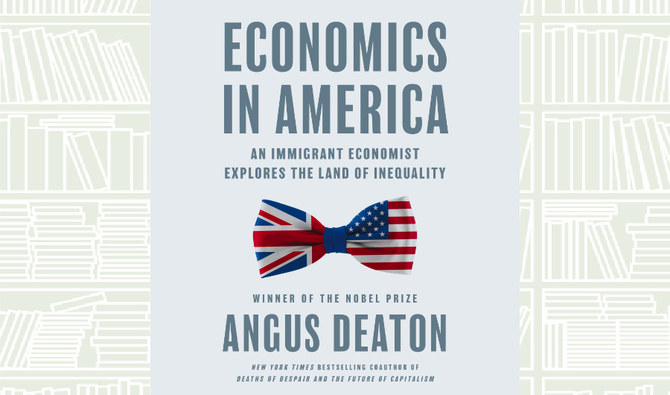
What We Are Reading Today: Economics in America

Short Url
Updated 06 October 2023
Follow

What We Are Reading Today: Economics in America

Author: Angus Deaton

When economist Angus Deaton immigrated to the US from Britain in the early 1980s, he was awed by America’s strengths and shocked by the extraordinary gaps he witnessed between people. 

“Economics in America” explains how the field of economics addresses the most pressing issues of our time — from poverty, retirement, and the minimum wage to the ravages of the nation’s uniquely disastrous healthcare system — and narrates Deaton’s account of his experiences as a naturalized US citizen and academic economist.

In this incisive, candid, and funny book, he describes the everyday lives of working economists, recounting the triumphs as well as the disasters, and tells the inside story of the Nobel Prize in economics and the journey that led him to Stockholm to receive one. 

He discusses the ongoing tensions between economics and politics and reflects on whether economists bear at least some responsibility for the growing despair and rising populism in America.


What We Are Reading Today: Shame: The Politics and Power of an Emotion

Updated 23 December 2025
Follow

What We Are Reading Today: Shame: The Politics and Power of an Emotion

Author: David Keen

Today, we are caught in a shame spiral—a vortex of mutual shaming that pervades everything from politics to social media. We are shamed for our looks, our culture, our ethnicity, our sexuality, our poverty, our wrongdoings, our politics. But what is the point of all this shaming and countershaming? Does it work? And if so, for whom?

In Shame, David Keen explores the function of modern shaming, paying particular attention to how shame is instrumentalized and weaponized. Keen points out that there is usually someone who offers an escape from shame—and that many of those who make this offer have been piling on shame in the first place. Self-interested manipulations of shame, Keen argues, are central to understanding phenomena as wide-ranging as consumerism, violent crime, populist politics, and even war and genocide. Shame is political as well as personal. To break out of our current cycle of shame and shaming, and to understand the harm that shame can do, we must recognize the ways that shame is being made to serve political and economic purposes.

Keen also traces the rise of leaders on both sides of the Atlantic who possess a dangerous shamelessness, and he asks how shame and shamelessness can both be damaging.