GRANADA, Spain: Europe’s quest to build a common geopolitical purpose suffered a new blow on Thursday when Turkiye and Azerbaijan skipped a major summit, as tensions mounted over the Nagorno-Karabakh conflict.
Four dozen European leaders — from European Union and NATO member states, as well as their neighbors — have gathered in Granada for the third summit of the European Political Community (EPC).
But two invitees, Turkiye’s President Recep Tayyip Erdogan and his ally, Azerbaijan’s leader Ilham Aliyev, failed to turn up, torpedoing efforts to address Europe’s latest security crisis.
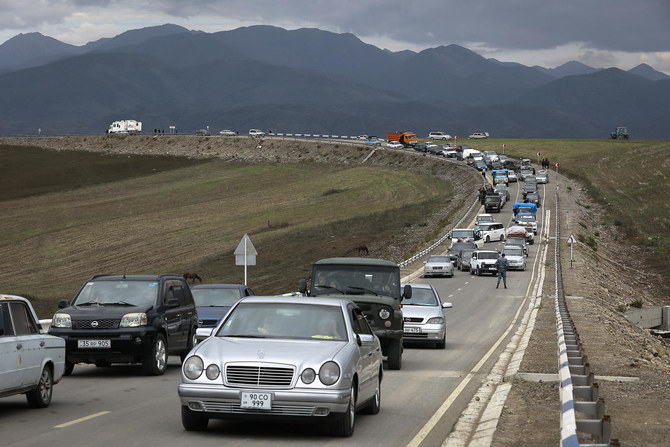
Leaders had hoped to host Aliyev’s first meeting with Armenian Prime Minister Nikol Pashinyan since Azerbaijan seized the breakaway region of Nagorno-Karabakh and triggered an exodus of ethnic Armenian civilians.
The two leaders were to have been joined by EU council president Charles Michel, France’s Emmanuel Macron and Germany’s Olaf Scholz — but Azerbaijan rejected the format, accusing Europe of bias.
The EU recognizes Azerbaijan’s sovereign claim on Nagorno-Karabakh but has criticized Baku’s use of force to resolve the dispute, which has led to a wave of refugees into Armenia.
France, in particular, has been outspoken, with Foreign Minister Catherine Colonna traveling to the Armenian capital, Yerevan, and promising to deliver weapons to Pashinyan’s government.
Azerbaijan is furious and wants Turkiye’s Erdogan to serve as a mediator.
But Erdogan was not invited to join Macron and Scholz in mediating the talks between Armenia and Azerbaijan, and decided to skip the entire EPC summit.
“It’s a shame that Azerbaijan isn’t here and it’s a shame that Turkiye — which is the main country supporting Azerbaijan — is not here either,” EU foreign policy chief Josep Borrell said.
“We are not going to be able to talk here about something as serious as the fact that more than 100,000 people have had to leave their homes in a hurry, running away from an act of military force.”
Arriving at the summit, Michel, who would have hosted the meeting, insisted: “The EU is a neutral mediator, with no agenda.”
But even as he spoke, the European Parliament adopted a resolution dubbing the exodus of ethnic Armenians “ethnic cleansing” and condemning “threats and violence committed by Azerbaijani troops.”
The resolution, paired with a call for sanctions, will have no practical effect but is bound to further alienate Baku at a time when Europe is seeking unity to confront other crises.
Armenia’s Pashinyan, who turned up to the summit and plans to hold bilateral talks with Macron and other EU leaders, expressed regret that he would not meet Aliyev and sign a “turning point document.”
In a social media post, Sinan Ulgen — a former Turkish diplomat turned think tank expert — said western Europeans should really not be surprised by Ankara and Baku’s response.
“It is really a bit odd for France to expect to play a mediating role in the Karabakh dispute after such a show of unmitigated support and solidarity with Armenia,” he said.
But the eastern boycott is also a blow to the EPC, a fledgling forum designed to form the basis of a common European geopolitical identity beyond the borders of the European Union.
“Without Turkiye and Azerbaijan, the political community becomes more narrowly European and seems more anti-Putin, give or take a few leaders,” said Sebastien Maillard of the Institut Jacques Delors think tank.
“Without a Karabakh meeting, the agenda could flip to the migration crisis,” he said.
Indeed, with the Caucasus conflict falling down the EPC agenda, UK Prime Minister Rishi Sunak and his Italian counterpart Giorgia Meloni will push a plan for tough action on “organized immigration crime.”


![]()

Turkiye and Azerbaijan snub Europe summit over Karabakh tensions
Short Url
https://arab.news/rn6jk
Turkiye and Azerbaijan snub Europe summit over Karabakh tensions
- Turkiye’s President Recep Tayyip Erdogan and his ally, Azerbaijan’s leader Ilham Aliyev, failed to turn up, torpedoing efforts to address Europe’s latest security crisis
- Leaders had hoped to host Aliyev’s first meeting with Armenian Prime Minister Nikol Pashinyan since Azerbaijan seized the breakaway region of Nagorno-Karabakh


Latest updates


© 2026 SAUDI RESEARCH & PUBLISHING COMPANY, All Rights Reserved And subject to Terms of Use Agreement.