

Nagorno-Karabakh exodus grows amid ‘ethnic cleansing’ fears

1 / 3
Refugees from Nagorno-Karabakh region arrive at a temporary accommodation center in the town of Goris, Armenia, on September 24, 2023. (Irakli Gedenidze/REUTERS)
2 / 3
An Armenian police officer watches as vehicles carrying refugees from Nagorno-Karabakh arrive near the border town of Kornidzor on September 24, 2023. (AFP)
3 / 3
Refugees from Nagorno-Karabakh region arrive at the town of Goris, Armenia, on September 24, 2023. (REUTERS)
Short Url
Updated 25 September 2023
Follow

Nagorno-Karabakh exodus grows amid ‘ethnic cleansing’ fears

  • PM Pashinyan signals major shift away from Russia
  • 120,000 Armenians ‘preparing to flee’

Fears of ethnic cleansing and repression will force more than 120,000 ethnic Armenians to flee Nagorno-Karabakh and head to Armenia, the leadership of the breakaway region said on Sunday.

“Our people do not want to live as part of Azerbaijan,” said David Babayan, an adviser to Samvel Shahramanyan, president of the self-styled Republic of Artsakh. He added that “99.9 percent prefer to leave our historic lands.”

Babayan’s remarks came as Armenian Prime Minister Nikol Pashinyan said the Karabakh Armenians were likely to leave the region, and that Armenia was ready to take them in following defeat last week at the hands of Azerbaijan.
“The fate of our poor people will go down in history as a disgrace, and a shame for the Armenian people and for the whole civilized world,” Babayan said. “Those responsible for our fate will one day have to answer for their sins.”

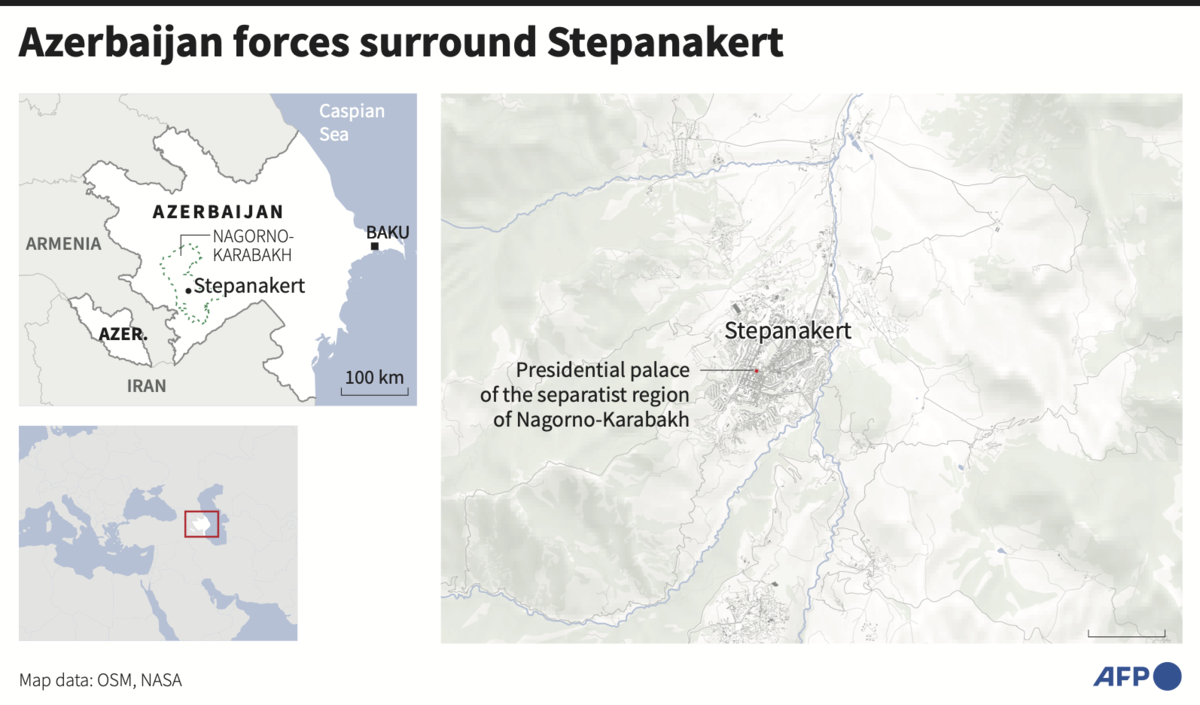
The Armenians of Karabakh — a territory internationally recognized as part of Azerbaijan, but previously beyond Baku’s control — were forced to declare a ceasefire on Sept. 20 after a lightning 24-hour military operation by the much larger Azerbaijani military.
Azerbaijan said it will guarantee their rights and integrate the region, but the Armenians say they fear repression.

BACKGROUND

This week’s lightning operation could mark a historic geopolitical shift, with Azerbaijan victorious over the separatists and Armenia publicly distancing itself from its traditional ally Russia.

Armenian Prime Minister Nikol Pashinyan said that his former Soviet republic’s current foreign security alliances were ‘ineffective’ and ‘insufficient.’

Russian Foreign Minister Sergei Lavrov has accused Armenia of ‘adding fuel to the fire’ with its public rhetoric.

Hundreds of refugees from Nagorno-Karabakh have begun arriving in Armenia, local officials said.

The Armenian leaders of Karabakh said in a statement that all those made homeless by the Azerbaijani military operation and wanting to leave will be escorted to Armenia by Russian peacekeepers.


READ MORE:

Azerbaijan-Armenia reconciliation possible if apology offered for past atrocities, Azerbaijan presidential adviser tells Arab News

Why Lebanese-Armenians feel the pull of the Nagorno-Karabakh war


Reporters near the village of Kornidzor on the Armenian border saw heavily laden cars pass into Armenia, with one of the drivers saying the vehicles were from Nagorno-Karabakh.

It was unclear when the bulk of the population will move down the Lachin corridor, which links the territory to Armenia.

Meanwhile, Armenia’s leader is facing calls to resign for failing to save Karabakh.

In an address to the nation on Sunday, Pashinyan said some humanitarian aid had arrived, but the Armenians of Karabakh still faced “the danger of ethnic cleansing.”

He added: “If proper conditions are not created for the Armenians of Nagorno-Karabakh to live in their homes and there are no effective protection mechanisms against ethnic cleansing, the likelihood is rising that the Armenians of Nagorno-Karabakh will see exile from their homeland as the only way to save their lives and identity.”

Pashinyan signaled a major foreign policy shift away from Russia, following Moscow’s refusal to enter the conflictHe said that the former Soviet republic’s current foreign security alliances were “ineffective” and “insufficient,” and added that Armenia could join the International Criminal Court.

Russian officials say Pashinyan is to blame for his own mishandling of the crisis, and have repeatedly said that Armenia, which borders Turkiye, Iran, Azerbaijan and Georgia, has few other friends in the region.


A humanitarian convoy for Nagorno-Karabakh moves along the Armenian side of the border near the town of Kornidzor. Tension was running high at the crossing on Sunday amid growing international concern. (AFP)

A mass exodus could change the delicate balance of power in the South Caucasus region.

Armenian authorities said that about 150 tons of humanitarian aid from Russia and another 65 tons of flour shipped by the International Committee of the Red Cross had arrived in the region.

With 2,000 peacekeepers in the region, Russia said that under the terms of the ceasefire six armored vehicles, more than 800 small arms, anti-tank weapons and portable air defense systems, as well as 22,000 ammunition rounds, had been handed in by Saturday.


Fossils of ‘Java Man,’ first known Homo erectus, return to Indonesia

Updated 6 sec ago
Follow

Fossils of ‘Java Man,’ first known Homo erectus, return to Indonesia

  • Netherlands to repatriate more than 28,000 items in Dubois collection in 2026
  • Fossils excavated in Indonesia were ‘removed against will of people’  

JAKARTA: Prehistoric bones belonging to “Java Man” — the first known fossil evidence of Homo erectus — went on display at Indonesia’s National Museum on Thursday, more than 130 years after they were taken to the Netherlands during Dutch colonial rule.

The parts of the skeleton — a skull fragment, molar and thigh bone — were uncovered along the Bengawan Solo River on Java island in the late 19th century by Dutch anatomist and geologist Eugene Dubois. 

The three items, and a related shell that was scratched by early Homo erectus, are the first in the planned repatriation of more than 28,000 fossils and natural history objects originating in Java and Sumatra that Dubois had removed. 

“Repatriation is a national priority,” Indonesian Culture Minister Fadli Zon said during an official handover ceremony in Jakarta. 

“We bear the responsibility to protect cultural heritage, restore historical narratives and ensure public access to the cultural and scientific heritage that belongs to Indonesia.” 

Fossils of the Java Man, which was hand-carried in a GPS-tracked, climate-controlled suitcase with a diplomatic seal, were some of the first pieces of evidence showing links between apes and humans. 

The fossils are part of the larger Dubois collection that was managed by Naturalis Biodiversity Center, a 200-year-old scientific institution in Leiden. 

The rest of the collection will be transferred to Indonesia in 2026, the Dutch Embassy in Jakarta said in a statement, adding that Indonesia’s National Research and Innovation Agency will take a lead role in preserving and managing the items. 

“This handover marks the beginning of the next phase. We intend to repatriate thousands of items excavated in Indonesia over 130 years ago,” said Marcel Beukeboom, general director of Naturalis Biodiversity Center. 

“This fossil bears witness to an important link in human evolution, while also representing part of Indonesian history and cultural heritage,” he said.

Jakarta started to campaign for the Dutch government to return stolen Indonesian artifacts after declaring independence in 1945, but the Netherlands started to return stolen items only in small numbers in the 1970s. 

Recent efforts by the Indonesian Repatriation Committee have brought back home hundreds of artifacts since 2023, bringing the number to more than 2,000 items so far. 

The repatriation of the Dubois collection was first announced in September, following recommendation by the Netherlands’ Colonial Collections Committee. 

“The Colonial Collections Committee has concluded … that the Dutch state never owned the Dubois collection,” the Dutch government said in a news release issued at the time. 

“The committee believes that the circumstances under which the fossils were obtained means it is likely they were removed against the will of the people, resulting in an act of injustice against them.

“Fossils held spiritual and economic value for local people, who were coerced into revealing fossil sites.” 

The returned fossils are now a centerpiece of “Early History,” a new permanent exhibit at the National Museum in Jakarta that opened to the public on Thursday. 

It explores the history of human civilization throughout Indonesia, with displays including a replica of one of the world’s oldest cave paintings from South Sulawesi and inscriptions from the 4th-century Hindu Kutai Martadipura Kingdom in East Kalimantan.