QUETTA: The Counter-Terrorism Department (CTD) of Pakistan’s southwestern Balochistan province has arrested eight suspects for allegedly being involved in and facilitating last week’s suicide blast in Mastung, a source in the department with direct knowledge of the development said on Wednesday.
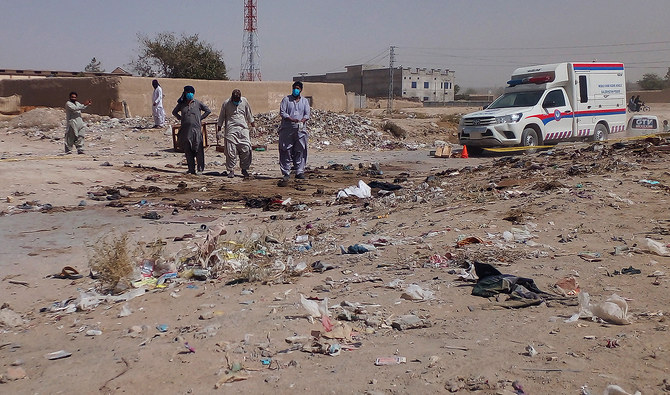
Sixty people were killed and scores were injured on Friday when a suicide blast targeted a gathering held to celebrate Prophet Muhammad’s (peace be upon him) birthday in Balochistan’s Mastung city. No group has yet claimed responsibility for the incident while banned outfit Tehreek-e-Taliban Pakistan (TTP) has distanced itself from the incident.
A spokesperson for the CTD Balochistan said the department has intensified its investigation into the Mastung suicide bombing. He added that the CTD and other law enforcement agencies were carrying out operations in Mastung and other districts of the province to arrest those involved in the bombing.
“Eight persons have been arrested on suspicion of being involved in the incident [Mastung bomb blast] and facilitating it,” a CTD source told Arab News. “Further action is being taken on the information extracted from those detained.”
Meanwhile, the CTD spokesperson said authorities have not received any data relating to the suicide bomber yet, adding that various methods are being used to identify him. “We have still not received the DNA and forensic reports,” the spokesperson said. “There is no negligence in the investigation of the incident, however, results will take time.”
Situated near the provincial capital of Quetta, Mastung is mostly mentioned in the news due to incidents of sectarian violence, insurgency, and militant attacks. The security situation in the area has been volatile for years and it is widely considered as one of the more sensitive districts in Balochistan from a security perspective.
Abdul Basit, a research fellow at the International Center for Political Violence and Terrorism Research in Singapore’s S. Rajaratnam School of International Studies, said the Daesh-Khorasan outfit was most likely behind the Mastung bomb blast.
The regional affiliate of Daesh is a key rival of the Taliban. The militant group has increased its attacks in Afghanistan since the Taliban takeover of the country in August 2021. Targets have included Taliban patrols and members of Afghanistan’s Shia population.
Basit said the militant group has been struggling to survive as it faces tough opposition in Afghanistan and Pakistan. “If we look at all the data points and substantial evidence, it will give us a clear picture of which group has a stronghold in Mastung and attacks soft targets,” Basit told Aran News over the phone.
He said Daesh has conducted lethal attacks in Pakistan’s northwestern Khyber Pakhtunkhwa (KP) province and Balochistan as both provinces share borders with Afghanistan, where it has a strong presence in some towns.
“Daesh has been struggling to show its relevance in Pakistan through more attacks and the militant group might attack soft targets in the next general elections.” Basit added.
Pakistan’s Caretaker Interior Minister Sarfraz Bugti vowed on Tuesday to take decisive action against militants in the country, adding that the state would maintain its monopoly on violence and would not succumb to pressure on gunpoint. He gave “illegal immigrants” in the country till November 1 to leave, threatening that after the deadline passes, the administration would deport them.
The move is likely to impact millions of Afghans living in Pakistan, with a sizable number not even registered as refugees in the country.
Balochistan’s Caretaker Information Minister Jan Achakzai told reporters on Wednesday that out of the 24 suicide bombings that have taken place in Pakistan since January, 14 were conducted by Afghan nationals.
“During the recent attacks on security forces’ camps in Zhob and Muslim Bagh, the majority of the attackers were Afghan citizens,” Achakzai said. He added that Balochistan was hosting 584,000 Afghans out of which 313,000 are registered as refugees and 274,000 are registered with Afghan citizen cards.
“In future, the Balochistan government will expel Afghan citizens living without visa here,” he said.


![]()

Balochistan police arrest 8 on suspicion of involvement in Mastung suicide blast
Short Url
https://arab.news/r2hfr
Balochistan police arrest 8 on suspicion of involvement in Mastung suicide blast
- 60 people were killed, scores injured when a suicide blast targeted a gathering in Mastung on Friday
- CTD Balochistan spokesperson says various methods are being used to identify the suicide bomber


Latest updates


Recommended


© 2026 SAUDI RESEARCH & PUBLISHING COMPANY, All Rights Reserved And subject to Terms of Use Agreement.