Pakistan’s Sindh calls for precautions after Nipah virus outbreak in India

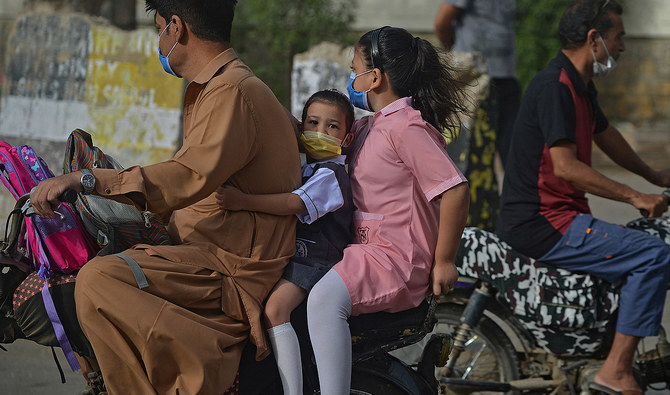
In this file photo, taken on June 21, 2021, children, wearing face masks, riding as a pillion on a motorcycle on their way to a school in Karachi. (AFP/File)
Short Url
Updated 03 October 2023
Follow

Pakistan’s Sindh calls for precautions after Nipah virus outbreak in India

  • Nipah virus is a highly contagious zoonotic disease that causes high fever, fatigue
  • In September, two people died after an outbreak of the disease in India

ISLAMABAD: The provincial government of Pakistan’s southern Sindh province on Tuesday issued an advisory warning citizens to take precautionary measures after an outbreak of the Nipah (NiV) virus in neighboring India last month killed two people. 

India’s Kerala state shut schools, offices, and public transport on September 13 after two people were killed by the contagious NiV. To prevent the further spread of the virus, Indian health authorities tested over 700 people on suspicion that they may have come into contact with persons infected with it. 

NiV is a highly contagious zoonotic disease that spreads from animals to humans and in some cases, humans to humans. Pakistan has not reported any cases of the infection so far. 

“While there is currently no outbreak of the Nipah virus in Pakistan, it is it is essential to stay informed and take precautions in view of the recent outbreak situation in India to prevent its spread,” an advisory issued by the Directorate General Health Services in Sindh said. 

The advisory said fruit bats are “natural reservoirs” of NiV and based on available data in South Asia, almost all NiV outbreaks have occurred in winter to spring seasons (December to May).

The disease can spread through direct contact between humans and infected animals such as bats and pigs or their bodily fluids, it said. It can also spread via direct contact with the bodily fluids of infected animals and close contact with a person infected with NiV or his/her bodily fluids.

“Symptoms may appear from 4 to 14 days,” the advisory said, adding that a person infected with NiV may experience high fever, muscle pain, headache, fatigue, nausea and vomiting, respiratory issues, and seizures. 

The advisory warned citizens against traveling to places where there is an outbreak of the disease and urged them to wash hands frequently with soap and water, and avoid meeting infected persons. 

“If you or someone you know exhibits symptoms of NiV infection, such as fever, headache, and respiratory issues, seek immediate medical attention,” the advisory said. 

“Early diagnosis and treatment are essential.”

The advisory said suspected or confirmed cases of NiV should be isolated and monitored, adding that it is essential for authorities to trace persons who may have potentially come into contact with the infected person. 

It also called on authorities to screen passengers at airports to know whether they carry the virus or not. 


Pakistan explores underground gas storage to manage supply swings, price shocks

Updated 7 sec ago
Follow

Pakistan explores underground gas storage to manage supply swings, price shocks

  • Pakistan seeks consultants to assess feasibility of underground gas storage
  • Industry officials say storage could ease shortages, cut cargo cancelations

KARACHI: Pakistan is exploring the construction of underground gas storage facilities, a long-discussed energy infrastructure project that officials and industry experts say could help manage supply shortages and cushion the country against global price volatility during periods of geopolitical disruption.

The initiative has resurfaced after a state-run gas infrastructure company this month issued a tender seeking consultants to assess the market need and technical feasibility of underground gas storage, potentially marking the first concrete step toward a project that could cost more than $1 billion.

Pakistan’s energy ministry, through Inter State Gas Systems (Private) Limited (ISGS), posted the tender on the Public Procurement Regulatory Authority (PPRA) portal, inviting local and international firms to conduct a pre-feasibility study for the project.

Asif Inam, chairman of Sui Southern Gas Company (SSGC), welcomed the move, confirming that the idea had been envisioned decades earlier but never implemented.

“If they make it, it will be very helpful because we are forced to close the field in summer and sell LNG cargoes on the spot,” Inam, whose state-owned utility is responsible for gas transmission in Sindh and Balochistan, told Arab News.

He said the ability to store up to one billion cubic feet of gas would ease operational pressures during periods of excess supply and reduce the need to offload imported cargoes.

According to official data, Pakistan imports about $5 billion worth of liquefied natural gas (LNG) and petroleum gas annually, accounting for roughly 30 percent of the country’s total energy imports.

The energy ministry’s spokesperson, Zafar Abbas, did not answer queries about why Pakistan wanted to carry out the project. However, building such storage facilities can help the country avoid costly cargo cancelations.

In November last year, the country scrapped 21 LNG shipments under a long-term contract with Italy’s Eni after excess imports flooded its gas network, while also negotiating the deferment or resale of cargoes with Qatar.

“These storages can also be helpful in war-like situations,” the SSGC official said. “At least we should have storage for a month.”

The tender issued this month by ISGS seeks consultants to assess market demand, identify potential underground storage sites and evaluate their technical and commercial viability.

Inam said if these facilities were built at Port Qasim, then the LNG could be stored right after its arrival.

Energy analyst Muhammad Saad Ali said Pakistan had previously missed opportunities to build strategic reserves during the COVID-19 pandemic when global prices were low due to the absence of storage infrastructure.

“At that time, we did not have storage facilities and lost that opportunity,” said Ali, head of research at Karachi-based Lucky Investments Ltd.

Asked about the expected project cost, he said it could go up to $1 billion.

Ali noted that Pakistan currently has surplus gas, though he said it was a wise move since such storage facilities would provide insurance against future shocks.

“Right now, we have a surplus, so we don’t really need it that much,” he said. “But obviously, in the future, if there is a geopolitical crisis, wars, there can be an energy price shock in all these things.”