

Lebanese security services arrest 2 Syrians involved in people smuggling from Libya

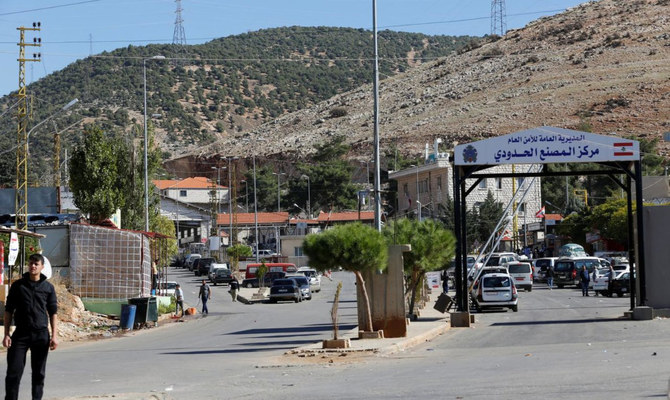
Vehicles are seen at Masnaa border crossing between Lebanon and Syria. Mafias and drug traffickers reportedly benefit from Hezbollah’s presence amid the spread of illegal weapons and the illegal crossings used for organized smuggling to and from Syria. (Reuters/File)
Short Url
Updated 02 October 2023
Follow

Lebanese security services arrest 2 Syrians involved in people smuggling from Libya

  • Report of ‘terrorist plot to blow up Baalbek columns’ raises concern

BEIRUT: Lebanon’s General Directorate of Internal Security Forces announced on Monday that they had arrested two Syrian nationals, aged 48 and 52, on suspicion of people smuggling.

The suspects had been accused of smuggling people of various nationalities from Libya to Europe via boats. Their names were not disclosed.

The suspects were operating in coordination with people of Lebanese nationality in the Wadi Khaled region in northern Lebanon, on the border with Syria.

The arrests come a few weeks after a boat sank off the coast of the city of Tobruk, Libya, resulting in the death of dozens of migrants.

The directorate said that the two detainees had fled from Libya to Syria after one of them was the target of a murder attempt by some of the victims’ families. 

The two then secretly entered Lebanon and took up residence in the towns of Lala and Bar Elias in the Bekaa.

The second person was kidnapped by unknown people in the Wadi Khaled area and held captive for four months.

During his captivity, he was compelled to pay $43,000 in compensation to the people he had attempted to smuggle to Europe through Libya, but had failed to do so after taking their money.

According to the directorate, detainees confessed during interrogation to receiving $3,500 for each person.

They also reportedly admitted that hundreds of people were smuggled by sea from Libya to Italy and Greece using boats.

The boats’ capacities ranged from 250 to 500 people of various nationalities.

The operation took place in collaboration with the brother of one of the detainees living in Libya and another person residing in Greece, they said.

Also on Monday, a news report about a terrorist plot to blow up the columns of the historical Baalbek citadel sparked reactions that ranged from surprise to fear to skepticism.

The story, published on Monday morning in An-Nahar newspaper, cited a security report.

The report alleged the existence of a plot by fundamentalist terrorist groups to blow up the columns of Baalbek citadel because it was a pagan symbol, and to send a message to Hezbollah in its stronghold.

Culture Minister Mohammad Mortada, who represents the Amal Movement — an ally of Hezbollah in Prime Minister Najib Mikati’s caretaker government — neither confirmed nor denied the news.

Mortada said: “Regardless of whether it is true or not, the Jupiter columns remain a beacon and a symbol of civilization, unparalleled anywhere on the planet.

“Therefore it is not unlikely that our enemies might entertain the idea of targeting them with their dark, ignorant tools,” the minister said.

He added: “In any case, we reassure the Lebanese that Baalbek and its citadel are protected, and will remain standing tall despite the hatred of our enemies and the clouds of evil passing through our region.”

The minister criticized the circulation of the terror threat claim as the historic citadel had received a large number of tourists this year.

Baalbek Gov. Bashir Khodr also denied the report.

Khodr considered it to be “a result of the resounding success of this year’s tourist season in Baalbek, and the large numbers of tourists, especially foreigners, whom they are trying to intimidate.”

He said: “Leave Baalbek in peace.”

The city of Baalbek and its region are considered a key stronghold for Hezbollah. The party coexists with the tribes that live in the region.

Mafias and drug traffickers reportedly benefit from Hezbollah’s presence amid the spread of illegal weapons and the illegal crossings used for organized smuggling to and from Syria.

News about extremist groups, especially Daesh, occasionally surfaces in Lebanon.

The Lebanese army has announced a series of security operations over the past two years that have resulted in the arrest of Daesh-affiliated armed cells preparing to implement terrorist plots inside Lebanon.

A security source told Arab News that it was likely that there were sleeper cells of terrorist organizations in Lebanon that could be activated by a political decision, and there were lone wolves as well.

The source said: “Whenever political solutions become more complicated in Lebanon, tension is relieved through a specific security event, and perhaps what happened in the Ain Al-Hilweh Palestinian refugee camp last month is one example.”

In this context, the Lebanese newspaper Al-Joumhouria quoted a security source on Monday as saying: “The situation in Lebanon is very dangerous, with suspicious movements and attempts to sabotage and disrupt security.”

According to the source, the situation required the highest level of vigilance.

“The security and military agencies are on high alert and are performing their duties to protect it, through coordination with each other to thwart any attempt to tamper with the country’s security and stability.”


Israel agrees to reopen Rafah crossing only for Gaza pedestrians

Updated 1 min 49 sec ago
Follow

Israel agrees to reopen Rafah crossing only for Gaza pedestrians

  • The announcement came after visiting US envoys reportedly pressed Israeli officials to reopen the crossing, a vital entry point for aid into Gaza

JERUSALEM: Israel said Monday it would only allow pedestrians to travel through the Rafah crossing between Gaza and Egypt as part of its “limited reopening” once it has recovered the remains of the last hostage in the Palestinian territory.
Reopening Rafah, a vital entry point for aid into Gaza, forms part of a truce framework announced by US President Donald Trump in October, but the crossing has remained closed since Israeli forces took control of it during the war in the Palestinian territory.
Visiting US envoys had reportedly pressed Israeli officials to reopen the crossing during talks in Jerusalem over the weekend.
World leaders and aid agencies have repeatedly pushed for more humanitarian convoys to be able to access Gaza, which has been left devastated by more than two years of war and depends on the inflow of essential medical equipment, food and other supplies.
Prime Minister Benjamin Netanyahu’s office said on Monday that Israel had agreed to a reopening “for pedestrian passage only, subject to a full Israeli inspection mechanism.”
The move would depend on “the return of all living hostages and a 100 percent effort by Hamas to locate and return all deceased hostages,” it said on X.
It remained unclear whether the reopening would allow medical patients to leave Gaza for treatment in Egypt or other countries.
The Israeli military said it was searching a cemetery in the Gaza Strip on Sunday for the remains of the last hostage, Ran Gvili.
“Upon completion of this operation, and in accordance with what has been agreed upon with the US, Israel will open the Rafah Crossing,” said Netanyahu’s office.
The announcement came after Gaza’s newly appointed administrator, Ali Shaath, said the crossing would open “in both directions” this week.
“For Palestinians in Gaza, Rafah is more than a gate, it is a lifeline and a symbol of opportunity,” Shaath said at the World Economic Forum in Davos on Thursday.
Israeli media had also reported that US envoys Steve Witkoff and Jared Kushner had urged Netanyahu to reopen Rafah during their Jerusalem talks.
Before the war erupted in October 2023, Rafah had been the only gateway connecting Gazans to the outside world and enabling international humanitarian aid to enter the territory, home to 2.2 million people living under Israeli blockade.

Last hostage

A spokesman for Hamas’s Ezzedine Al-Qassam Brigades, Abu Obeida, said on Sunday that the group had “provided mediators with all the details and information in our possession regarding the location of the captive’s body,” referring to Gvili.
Obeida added that “the enemy (Israel) is currently searching one of the sites based on information transmitted by the Al-Qassam Brigades.”
Except for Gvili, all of the 251 people taken hostage during Hamas’s October 7, 2023 attack on Israel have since been returned, whether living or dead.
A non-commissioned officer in the Israeli police’s elite Yassam unit, Gvili was killed in action on the day of the attack and his body was taken to Gaza.
The first phase of the US-backed ceasefire deal had stipulated that Hamas hand over all the hostages in Gaza.
Gvili’s family has expressed strong opposition to launching the second phase of the plan, which includes reopening Rafah, before they have received his remains.
“First and foremost, Ran must be brought home,” his family said in a statement on Sunday.
The Gaza war was sparked by Hamas’s October 7, 2023 attack on Israel, which resulted in the deaths of 1,221 people, according to an AFP tally based on official Israeli figures.
The Israeli retaliation flattened much of Gaza, a territory that was already suffering severely from previous rounds of fighting and from an Israeli blockade imposed since 2007.
The two-year war between Israel and Hamas has left at least 71,657 people dead in Gaza, according to the territory’s health ministry, figures considered reliable by the United Nations.