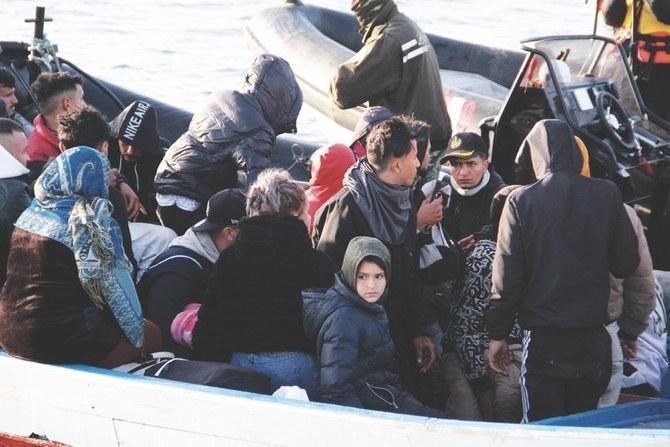
DUBAI: European Commission President Ursula von der Leyen and the premiers of two EU member states will travel to Tunisia on Sunday to finalize a deal worth more than €1 billion ($1.12 billion) that aims to combat people smuggling and human trafficking, and help boost the country’s ailing economy.
Citing unnamed sources, The Guardian newspaper reported on Friday that the prime ministers of Italy and the Netherlands will join the head of the commission to sign off on a memorandum of understanding with the Mediterranean country.
The trip comes a month after the three European leaders reportedly flew to Tunisia to propose a €900m package of financial assistance, with a further €150 million to support reforms ordered by the International Monetary Fund.
The follow-up trip will come shortly after a number of European parliamentarians warned against handing Tunisia the deal on a “silver plate” amid growing fears of a “breakdown” in the country’s democracy.
As part of the package, a further €105m would be allocated as part of a new partnership to fight people-smuggling and human trafficking, and prevents the tragedies of migrants who drown while trying to reach other countries in the hope of a better life.
After the Tunisian president Kais Saied’s announcement that his country would not be Europe’s “border guard,” the EU has been eager to stress the wider economic benefits of the package in a bid to end an impasse in negotiations.
The Guardian said the EU was eager to sign the memorandum to show member states in which migration has become a major political issue that it is working to reduce numbers of people crossing borders.
This month, Mark Rutte, prime minister of the Netherlands, said he would quit politics after upcoming elections because the Dutch government had collapsed in a disagreement over migration.
The agreement with Tunisia has been heavily criticized by some members of European parliaments.
“It was not right that Tunisia should be given €1 billion on a silver plate. That cannot happen,” said French MEP Mounir Satouri.
Matjaz Nemec, a Slovenian MEP for the Progressive Alliance of Socialists and Democrats, said: “The European Union cannot be part of, or complicit in, the breakdown of Tunisian democracy by President Saied. We need all European institutions united in our call that the money released needs to be conditioned on full respect for human rights, democracy and, of course, rule of law.”
The EU package includes a comprehensive air-transport agreement that could help boost tourism and a €150 million digital cable link to Europe to support research and education.
Under a compromise deal worked out last month, new legislation on processes for asylum seekers will allow individual countries to decide whether Tunisia should be considered a safe country for migrants.


![]()

Tunisia to receive €1bn from EU to combat people smuggling and bolster economy
Short Url
https://arab.news/6mrme
Tunisia to receive €1bn from EU to combat people smuggling and bolster economy
- European Commission’s president and the prime ministers of Italy and the Netherlands will travel to Tunisia on Sunday to sign off on a memorandum of understanding, newspaper says
- The EU is eager to sign the agreement to show authorities in member states in which migration is a major political issue it is working to reduce number of people crossing borders


Latest updates


© 2026 SAUDI RESEARCH & PUBLISHING COMPANY, All Rights Reserved And subject to Terms of Use Agreement.