

UK festival celebrates creativity of Arab, Muslim refugees

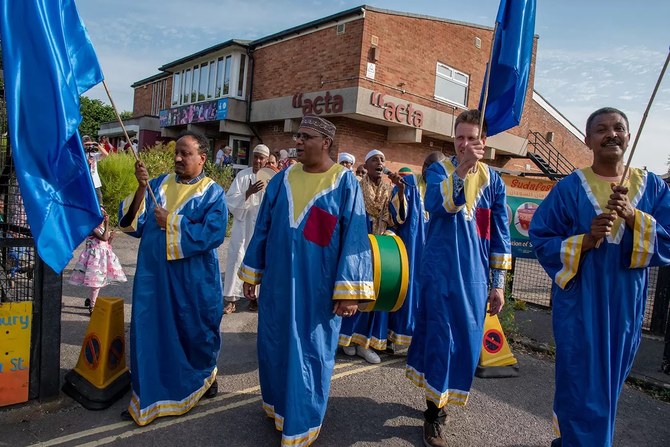
Noba Sufi parade at Bristol-based Sudafest. (Hassan Abuzaid)
Short Url
Updated 01 October 2023
Follow

UK festival celebrates creativity of Arab, Muslim refugees

  • Platforma seeks to highlight migrants’ contributions to British society
  • Event promises heady mix of art, comedy, music and theater

LONDON: An arts festival showcasing the works of Middle Eastern and Muslim refugees is touring the southwest of England.

The Platforma festival, which opened on Saturday, aims to tackle perceptions of refugees in the UK. It is managed by Counterpoints Arts, a London-based organization that seeks to promote the artistic contributions of migrants and refugees to British society.

This year marks the seventh edition of the event and will feature a variety of visual arts, drama, music and comedy inspired by people from refugee backgrounds. It runs until Nov. 5.

The festival hit the ground running in Bristol on Sunday with a session on Arabic calligraphy and poetry. Among the events planned for the coming weeks are performances by comedians Alaa Shehada, Hanna Shammas and Diana Sweity who will dive deep into the intricacies of Palestinian identities with engaging stand-up comedy routines in Bristol on Oct. 10.

On Oct. 21, Devon will witness “Crown,” a performance blending classical Persian dance, contemporary dance and Sufi movements.

Back in Bristol, the comedic duo Mohand and Peter will deliver a unique theatrical experience, melding humor with evocative narratives rooted in Sudan.

From Oct. 28-29, “Dear Laila,” an art installation by Basel Zaraa, will be on show at Bristol’s Palestine Museum. The work brings to life the Palestinian narrative of displacement, as told through the experiences of one family.

Another highlight of the festival will be “Sudafest: Hope and Healing” on Oct. 22, which celebrates Sudanese art and culture.

Its founder, Hiba Elhindi, told the BBC: “I am from Sudan and I came to the UK in 2014. I have lived in Bristol pretty much that whole time. I have been engaging in many activities in the Sudanese community.

“I would say around 90 percent of the Sudanese population in Bristol are refugees.”

Elhindi believes art has the power to break linguistic and cultural barriers.

“We have been working really hard in using art and culture as a platform for Sudanese current issues,” she said.

“I don’t think there is enough media coverage of the war in Sudan in the UK, and people may not be aware of the issue. We have been using Sudafest as a platform to raise awareness about what is happening there.”

The Platforma festival was founded by Almir Koldzic, who moved to the UK from Yugoslavia in 1995 to escape the war in his homeland, the BBC reported.

The event, which is held every two years in a different part of England, aims to highlight the healing and unifying abilities of art and cultural expression.


Two high-speed trains derail in Spain, police sources say 21 people killed

Updated 19 January 2026
Follow

Two high-speed trains derail in Spain, police sources say 21 people killed

  • The accident happened near Adamuz, in Cordoba province. So far, 21 people ​have been confirmed dead by police

MADRID: A high-speed train derailed and smashed into another oncoming train in southern Spain on Sunday, pushing the second train off the tracks in a collision that police sources confirmed to Reuters had killed at least 21 people.
The accident happened near Adamuz, in Cordoba province. So far, 21 people ​have been confirmed dead by police, with state broadcaster Television Espanola adding that 100 people had been injured, 25 seriously. The driver of one of the trains, which was traveling from Madrid to Huelva, was among those who died, the TV station added.
“The Iryo 6189 Malaga — (to Madrid) train has derailed from the track at Adamuz, crashing onto the adjacent track. The (Madrid) to Huelva train which was traveling on the adjacent track has also derailed,” said Adif, which runs the rail network, in a social media post.
Adif said the accident happened at 6:40 p.m. (1740 GMT), about 10 minutes after the Iryo train left Cordoba heading toward Madrid.
Iryo is a private rail operator, majority-owned by Italian state-controlled railway group Ferrovie dello Stato. The train involved was a Freccia 1000 train which was traveling between ‌Malaga and Madrid, ‌a spokesperson for Ferrovie dello Stato said.
The company said in a statement that it ‌deeply ⁠regretted what ​had happened ‌and had activated all emergency protocols to work closely with the relevant authorities to manage the situation.
The second train was operated by Renfe, which also did not respond to a request for comment.
Adif has suspended all rail services between Madrid and Andalusia.

HORRIFIC SCENE
The Iryo train had more than 300 passengers on board, while the Renfe train had around 100.
Paco Carmona, Cordoba fire chief, told TVE the first train heading to Madrid from Malaga had been evacuated.
The other train’s carriages were badly damaged, he said, with twisted metal and seats. “There are still people trapped. We don’t know how many people have died and the operation is concentrating on getting people out of areas which are very narrow,” he ⁠said. “We have to remove the bodies to reach anyone who is still alive. It is proving to be a complicated task.”
Transport Minister Oscar Puente said he was following events ‌from rail operator Adif’s headquarters in Madrid.
“The latest information is very serious,” ‍he posted on X. “The impact was terrible, causing the first two ‍carriages of the Renfe train to be thrown off the track. The number of victims cannot be confirmed at this time. ‍The most important thing now is to help the victims.”
The mayor of Adamuz, Rafael Moreno, told El Pais newspaper that he had been among the first to arrive at the scene of the accident alongside the local police and saw what he believed to be a badly lacerated body several meters from the accident site.
“The scene is horrific,” he said. “I don’t think they were on the same track, but it’s not clear. Now ​the mayors and residents of the area are focused on helping the passengers.”

CALLS FOR MEDICS
Images on local television showed a reception center set up for passengers in the town of Adamuz, population 5,000, with locals coming ⁠and going with food and blankets amid nighttime temperatures of around 42 degrees Fahrenheit (6 degrees Celsius).
A woman named Carmen posted on X that she had been on board the Iryo train to Madrid. “Ten minutes after departing (from Cordoba) the train started to shake a lot, and it derailed from coach 6 behind us. The lights went out.”
Footage posted by another Iryo train passenger, also on X, showed an Iryo staffer in a fluorescent jacket instructing passengers to remain in their seats in the darkened carriages, and those with first aid training to keep watch over fellow passengers. He also urged people to maintain mobile phone batteries to be able to use their torches when they disembarked.
Salvador Jimenez, a journalist for RTVE who was on board the Iryo train, shared images showing the nose of the rear carriage of the train lying on its side, with evacuated passengers sitting on the side of the carriage facing upwards.
Jimenez told TVE by phone from beside the stricken trains that passengers had used emergency hammers to smash the windows and climb out, and they had seen two people taken ‌out of the overturned carriages on stretchers.
“There’s a certain uncertainty about when we’ll get to Madrid, where we’ll spend the night, we’ve had no message from the train company yet,” he said. “It’s very cold but here we are.”