

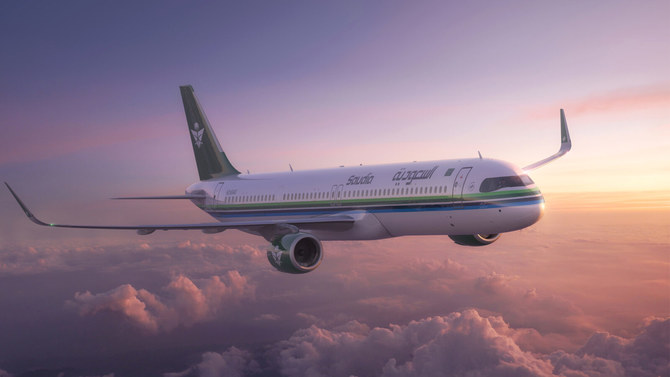

RIYADH: The unveiling of a new brand identity for Saudi Arabian Airlines is more than a change in its appearance, as according to a top official it is but a part of a huge transformation in the company’s approach in line with the ongoing digital transformation.
Khaled Tash, group chief marketing officer at Saudia, told Arab News on Sunday the new look represented the airline’s commitment to digital advancement and an array of new services and products in the pipeline.
He said the rebranding signifies the company’s embrace of the developing tech industry, reflecting the Kingdom’s broader ambitions.
The official said: “This is not about changing our logo or changing our colors.” It is, he added, more about improving our services and introducing new products.
“We are very keen to accelerate the transition…the overall reaction from the market” has been overwhelming, Tash said.
Elaborating on how the update reinforces the airline’s digital transformation, Tash noted that Saudia stands out as one of the pioneering airlines in Europe, the Middle East, and Africa to integrate artificial intelligence into its customer experience.
“The Travel Companion is an AI-driven personal aide. When users access the Saudia app, it intuitively recognizes them without requiring manual data input and promptly aids with all travel-related queries,” elaborated Tash.
Highlighting its capabilities, he mentioned that users can ask Saudia’s travel companion bot for holiday recommendations, which will engage in an interactive dialogue to understand preferences before offering tailored suggestions.
Additionally, users can seamlessly book their flights directly within the chat interface when conversing with the travel companion, eliminating the need to navigate away from the conversation.
The AI-driven bot is slated for launch by the end of this year, coinciding with an enhanced version of the airline’s application.
“Digital transformation is not just a buzzword that we use, we aim to improve the customer experience using new innovations,” Tash stated.
He elaborated that, guided by that motto, the company has pinpointed 260 features and services for introduction or enhancement if they already exist.
The airline has also launched a VIP meet-and-greet service. Tash expects this addition to boost revenue from booking services by 10 percent.
In alignment with Arab culture, the airline has introduced an option for female passengers to request seating next to other female passengers on specific, long-duration flights.
Tash said the unprecedented growth in the Kingdom’s tourism sector is also proving to be fruitful for the airline and it is part of the ongoing transformation. He specifically mentioned the fact that Saudia is the first airline to begin operations to and from the Red Sea International Airport.
The marketing head also revealed that the airline has ambitious goals to more than triple its passenger count over the next seven years.
Clarifying the shift in Saudia’s vision, Tash mentioned that historically, the airline’s objective was to connect the Kingdom’s citizens to the world. However, the current goal emphasizes bringing the world to Saudi Arabia.


