
OUAGADOUGOU: Elections in Burkina Faso are “not a priority” compared to “security,” the country’s military leader Capt. Ibrahim Traore said on state TV, almost a year to the day after coming to power in a coup.
Capt. Traore, who had promised a return to democracy with presidential elections by July 2024, also announced planned changes to the constitution to make it more representative of the “masses.”
“It’s not a priority, I’ll tell you that clearly, it’s security that’s the priority” in a country plagued by extremist violence, he said, referring to elections.
Even so, the goal was still to organize a ballot, he said, without specifying a date.
“There won’t be an election that is only concentrated in Ouagadougou and Bobo-Dioulasso and other nearby towns,” he said, referring to two cities that have been mainly spared frequent terror attacks.
“It has to be that all Burkinabe people choose their president.”
At 34, Traore was the world’s youngest leader when he was sworn in as interim president, vowing to win back territory and support a transition leading to elections in July 2024.
Traore on Friday went on to say he was planning a “partial change” to the country’s constitution, saying the present text reflected “the opinion of a handful of enlightened people” to the detriment of the “popular masses.”
“The current texts don’t allow us to evolve peacefully,” he said.
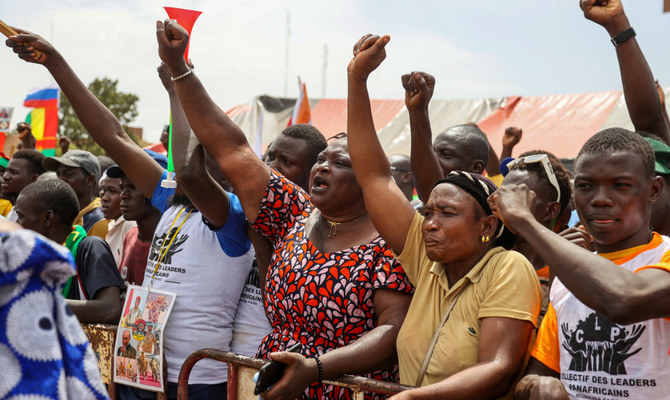
Several thousand people demonstrated on Friday in Ouagadougou and other cities in support of the military regime, calling for adopting a new constitution.
When Traore seized power, he gave himself “two to three months” to improve security in Burkina Faso, but one year on, jihadist violence still blights the West African nation.
At the time, he cited the country’s spiraling security situation as justification for the putsch.
Since then, the regime has focused on responding to attacks by affiliates of Al-Qaeda and Daesh and has undertaken a massive recruitment drive for the Volunteers for the Defense of the Fatherland or VDP, a civilian force that supports the military.
However, despite hopes that Traore’s efforts to regain territory and improve security would yield results, “the situation has deteriorated considerably,” said Lassina Diarra, a specialist on safety in the Sahel.
More than 17,000 people have died in attacks since 2015 — more than 6,000 of them just this year, according to a count by NGO monitor the Armed Conflict Location and Event Data Project or ACLED.
Still, the government claimed at the end of last month that more than 190,000 people had returned to their homes after it chased jihadists from the areas, and regime supporters welcome what they call vital decisions by Traore.
“We are at war,” Traore said Friday, blaming “certain actors” for refusing to sell the army equipment.
“Most of our equipment is Russian,” he added, and there is “not much” French equipment.
Under Traore, relations with France broke down, with French forces helping the Burkinabe army leave the country at the junta’s request in February.
Burkina has since moved closer to Russia and allied with neighboring Mali and Niger, two countries also led by military regimes.
Concerns about the erosion of personal freedoms in the country have recently been raised, and some have condemned alleged abuses by the VDP or armed forces.
French media outlets RFI, France 24, and Jeune Afrique have been suspended in the country, and correspondents from newspapers Liberation and Le Monde have been expelled in the last 12 months.
Traore on Friday said that “individual freedoms must not take precedence over collective freedoms.”
Authorities announced on Thursday that four officers had been detained a day after the military government said it had thwarted a coup attempt.
The junta said late on Wednesday that the intelligence and security services had foiled the attempt the previous day.
Asked about the attempted coup, Traore alluded to “manipulated individuals” and insisted there was “no malaise” in the army.