

My book, the first in Arabic, is a step forward in deepening Saudi-Japan relations

1 / 2
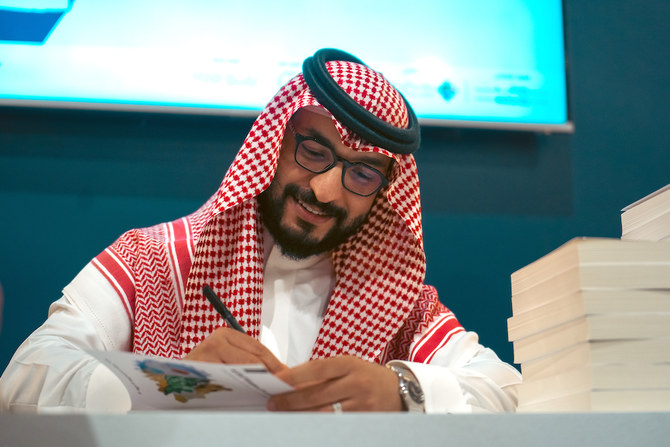
Dr. Khalid Alrashoud signs copies of his book at ongoing Riyadh International Book Fair. (Abdulrahman Shulhub)
2 / 2
Fumio Iwai, the Japanese ambassador to Saudi Arabia, at the book signing by author of Saudi-Japanese relations Dr. Khalid Alrashoud. (Abdulrahman Shulhub)
Short Url
Updated 01 October 2023
Follow

My book, the first in Arabic, is a step forward in deepening Saudi-Japan relations

  • Khalid Alrashoud lived in Japan for 13 years and studied the historic ties between the two countries
  • Japanese envoy attends author’s signing event at Riyadh International Book Fair

RIYADH: The history of Saudi-Japan relations can be traced back to the early 20th century, but it was not well documented, and the few books written on the subject were available only in Japanese and English.

This prompted Khalid Alrashoud, who pursued a Ph.D. in transformation management and development engineering in Japan, to write a book on the growing relationship between the two countries — the first publication to appear in Arabic.

While signing copies of his book, “Saudi Japanese Relations,” at the Riyadh International Book Fair, Alrashoud spoke exclusively to Arab News, sharing the story of his connection to Japan, and what readers can expect from the publication.

Iwai Fumio, Japanese ambassador to Saudi Arabia, also attended the book signing on Friday.

“It’s all about the Saudi-Japanese diplomatic relations. The book covers the relations between Japan and Saudi Arabia from the beginning, even before the establishment of the modern Kingdom in 1932, from 1920 all the way to 2022,” Alrashoud said.

“The first chapter touches on the early connections between Japanese and Muslims, which took place in China, and how this relationship developed over time to where it is today.

“What’s really special about this book is that it covers not only the political and diplomatic aspects, but also all the prominent engagements, whether social, cultural or trade relations,” he added.

Alrashoud began writing the book during his stay in Japan. He lived there for 13 years while completing an undergraduate program, and pursuing a master’s and Ph.D. He also has the highest-level qualification in Japanese language proficiency, the Japanese-Language Proficiency Test, which covers language knowledge, and reading and listening ability.

“This helped me dig deep in literature written in Japanese,” he said.

“When I first started writing about the subject, I was shocked at how little was available. When it comes to looking for literature on bilateral relations, it was available only in English or Japanese, and wasn’t quite accurate. So, I took on this mission to write the book in Arabic, the first and only book in Arabic documenting Saudi-Japan relations. It took me about three years,” Alrashoud told Arab News.

Referring to his connection with Japan, Alrashoud said: “I worked there as a university professor and as a consultant in international relations. I also worked there for a number of years as a project manager for a Japanese company that is basically focusing on development partnerships with Middle Eastern countries.”

On what readers can expect from the book, especially on Saudi-Japan relations, he said: “If you are looking for a well-documented and well-written book that provides all the resources, whether in Arabic, Japanese or English, this is the book to read. And all the names mentioned are in Japanese and in English for researchers who want to take a step further and search even more on this topic.

“I worked very hard to make it easily understandable for anyone who is reading this book to be enlightened about the numbers and data. I remember when I first reached out to the Ministry of Economy and Planning in Saudi Arabia and asked for the data on bilateral trade. All this information they had was from around the 1980s. Then I reached out to the Japanese government and they had information documented from the 1970 and 1960s.

“So, I combined the two and I made graphs. In this book you will find information that you will not find in another book.”

Alrashoud also bought rare historic photos of Japanese officials who visited Saudi Arabia in the 1950s and earlier, and incorporated these in the book.

The book also deals with Saudi students studying in Japan.

“Yes, I was one of them. I was honored to be a part of the King Abdullah Foreign Scholarship Program, and that’s where I completed my bachelor’s, master’s and Ph.D. It covers the numbers of students studying in Japan, and how the numbers increase and decrease.”

Alrashoud completed his Ph.D. in transformation management and development engineering at the Tokyo Institute of Technology (Tokyo Tech).


Human development program helping to expand pathways for Saudi students into elite global universities

Updated 6 sec ago
Follow

Human development program helping to expand pathways for Saudi students into elite global universities

  • HCDP takes a comprehensive approach, supporting citizens throughout their lives from early childhood education through to lifelong learning

DAVOS: Saudi Arabia is accelerating efforts to equip its young population with the skills and global exposure needed to compete on the world stage, as part of the Kingdom’s Vision 2030 agenda, the CEO of the Human Capability Development Program told Arab News.

Speaking on the sidelines of the World Economic Forum in Davos, Anas Al-Mudaifer said the program, one of Vision 2030’s realization initiatives, is enhancing the competitiveness of Saudi citizens by investing in their skills, knowledge and long-term development.

“Our mandate is to improve and enhance the competitiveness of the Saudi citizen,” he said. “We want to make sure they have the opportunity to compete locally and globally,” he added.

The HCDP takes a comprehensive approach, supporting citizens throughout their lives from early childhood education through to lifelong learning, while aligning education and training with the evolving needs of the labor market, he said.

Al-Mudaifer added that reforms are underway across the education system, including expanded access to early childhood education, new school curricula and teaching methods, and stronger alignment between higher education, vocational training and future labor market demands.

A key pillar of the strategy is preparing Saudi youth for global competition, a push that is already delivering tangible results.

“We have seen Saudis competing in admission to Ivy League schools,” he said. “More than 1,000 Saudi students are now enrolled in top 30 universities every year.”

He added that Saudi Arabia now ranks as the second-largest source of international students at the Massachusetts Institute of Technology, behind only China, a milestone he described as “a great achievement and a great footstep for Saudi students.”

Beyond academia, Saudi graduates are increasingly securing roles in leading international institutions and companies. Al-Mudaifer pointed to Saudi professionals working in prestigious US hospitals such as the Mayo Clinic and Cleveland Clinic, as well as global technology firms including Tesla and Meta.

To support continuous upskilling, the program is also investing heavily in lifelong learning. More than 2 million Saudi citizens now receive training each year, both domestically and overseas, as rapid technological change reshapes the global labor market.

“With the emergence of intelligent technologies, especially artificial intelligence, we need to make sure the Saudi workforce is always up to date with the requirements of local and global employers,” he said.

Among recent initiatives is the launch of a platform which offers short, six-to seven-week micro and nano degrees in fields relevant to the Saudi labor market.

The courses are accredited by employers and international training bodies, providing fast-track pathways into employment.

Entrepreneurship is another priority area, particularly in technology. In partnership with the Ministry of Communications and Information Technology, the program has launched initiatives that send Saudi tech founders to global innovation hubs such as Silicon Valley and Berlin for intensive boot camps and growth programs.

Al-Mudaifer said that Saudi Arabia’s progress is rooted in global collaboration rather than isolation.

“There is no leader alone,” he added, highlighting that the Kingdom works closely with international partners and convenes global experts annually at the Human Capability Initiative Conference in Riyadh to shape the future of human development.