

Saudi Arabia announces inaugural Riyadh School for Tourism and Hospitality

1 / 2
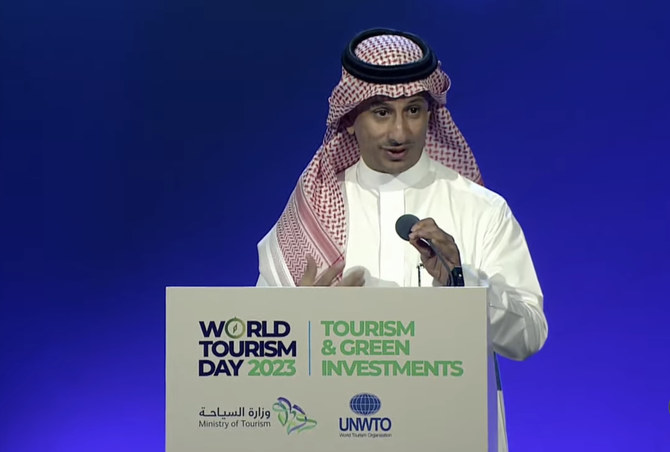
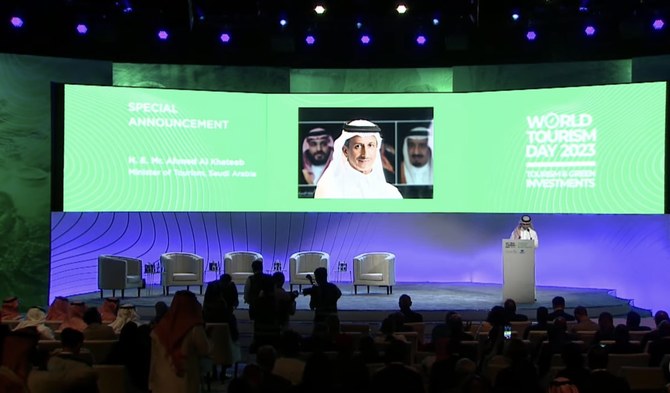
Saudi Minister of Tourism Ahmed Al-Khateeb announced the inauguration of the Riyadh School for Tourism and Hospitality at the UN World Tourism Organization’s World Tourism Day 2023 in Riyadh. (Supplied)
2 / 2
Saudi Minister of Tourism Ahmed Al-Khateeb announced the inauguration of the Riyadh School for Tourism and Hospitality at the UN World Tourism Organization’s World Tourism Day 2023 in Riyadh. (Supplied)
Short Url
Updated 30 September 2023
Follow

Saudi Arabia announces inaugural Riyadh School for Tourism and Hospitality

  • The facilities will then move to a larger campus in Qiddiyah in 2027
  • The project will cost over $1 billion to build

RIYADH: The Saudi Arabian Minister of Tourism, Ahmed Al-Khateeb, announced the inauguration of the Riyadh School for Tourism and Hospitality At the 2023 United Nations World Tourism Organization’s (UNWTO) World Tourism Day celebrations in Riyadh.
“Yesterday I was so touched with the Secretary General (of UNWTO Zurab Pololikashvili) to visit the schools and meet with the students… This school is a gift from the Kingdom of Saudi Arabia to the world because it will be open to everyone to enjoy the best training in tourism and hospitality,” Al-Khateeb said during the announcement.
The facilities will then move to a larger campus in Qiddiyah in 2027. The project will cost over $1 billion to build.
The school initiative hopes to shape the future of industry education by attracting the brightest minds and employing cutting-edge technologies in an innovative facility.
It will offer a lead vocational and academic study program that places students at the heart of its curriculum, and provide a rich, diverse, and global learning experience through real-world practice.
Last year, the Ministry revealed alongside Pololikashvili, that they will be sending 100,000 Saudi talent every year for training across the globe throughout a five-year period, equipping them with the skills to work in the tourism and sustainability sector. “We will extend it to the next 10 years,” Al-Khateeb said.
“We are committing $100 million every year to train them…Those who come back will work in the private sector and I’m encouraging them and other groups of investors to also join the government in investing in talent,” Al-Khateeb said.
While the industry lost over 60 million jobs worldwide due to the pandemic, the Kingdom is investing over $800 billion in the sector and working to create 1 million jobs across the next 10 years, and is expecting international arrivals to double by 2032.
Al-Kateeb said: “It’s easy to put policies and procedures and systems (into place), but the most difficult thing that you need to have is the people…We need to have enough young people to join our industry today and I believe we need to double them in the future.
“We’re trying to make our sector, work in travel and tourism, as attractive and we need to make it a career for life for people to come and stay, and progress, and prosper throughout their life.”
The Kingdom continues its ambitious journey to become a global tourism hub by 2030 by investing in human capital, and the school is one of its latest initiatives to achieve the goal.
The 2023 WTD, held from Sept. 27-28, will explore potential avenues of collaboration between world tourism leaders by placing people, sustainability, and prosperity at the forefront of its discussions under the theme “Tourism and Green Investments.”


Automatic defense systems ‘hugely important’ in dealing with threats

Updated 9 sec ago
Follow

Automatic defense systems ‘hugely important’ in dealing with threats

RIYADH: Automatic defensive systems that respond to threats in real time without human intervention are “hugely important” in modern air defense, a senior executive at Lockheed Martin told Arab News at the World Defense Show in Riyadh on Thursday.

Joseph Rank, chief executive and vice president at Lockheed Martin Saudi Arabia and Africa, said the ability to connect detection systems directly to interceptors without delay is critical when responding to fast-moving threats such as missiles and drones.

“Integration is hugely important today. There’s so many threats, and the way you deal with threats in a real-time basis is by having everything integrated,” Rank said.

He described systems in which sensors identify incoming projectiles and automatically communicate with defensive assets.

“Your sensors or your radars have to see the incoming missiles or drones, but you don’t want to wait and have a human in loop … The sensors communicate automatically to the missiles that are going to knock those out of the air,” he said.

Rank said latency must be minimal to ensure an effective response.

“The latency has to be almost like nothing there, like a nanosecond, so that immediately, when you pick up that incoming missile or drone, it’s automatically communicated, no human in the loop that’s there,” he said.

He spoke about how the company uses a system called Command IQ to support this interconnectivity, linking sensors and interceptors in real time and incorporating artificial intelligence to assess response options.

The system works by “connecting everything together, sensors to shooters in real time, and it also integrates artificial intelligence. So, it gives you the best options.

“You might have three or four options to shoot or eliminate that drone. It gives you what’s the most cost-effective, what has the most probability of kill. And so, it helps you protect your citizens here, the citizens of the Kingdom.”

Beyond system integration, Rank also addressed the company’s operations in Saudi Arabia, describing a shift from supplying equipment to carrying out manufacturing and maintenance activities locally.

“We used to sell things to the Kingdom. Now we actually make things here in the Kingdom,” he said.

The company is meeting or exceeding the country’s 60 percent localization requirement and is investing in workforce development, he added.

Rank said that the company, which has operated in Saudi Arabia for 60 years, intends to continue expanding its role, including through future co-development of systems in Saudi Arabia.

“We’re going to build new things here in the Kingdom that will be for the Kingdom’s use, and we will export abroad.”

The company also announced in a statement on Thursday that it signed a memorandum of understanding with the Arabian International Co. for Steel Structures to expand localized production of components for the advanced Terminal High Altitude Area Defense weapon system.