ISLAMABAD: The United States has pledged ongoing support for Pakistan’s fight against cross-border infiltration and militancy in the northwestern Khyber Pakhtunkhwa (KP) province, with a $250,000 program to boost Frontier Corps’ nighttime capabilities and $350,000 in safety equipment for counterterrorism efforts, a US diplomatic mission statement confirmed on Wednesday.
Pakistan has seen a surge in militancy, particularly in the KP region bordering Afghanistan, after the Afghan Taliban got back into power in August 2021. The violence further escalated after a fragile truce between the Tehreek-i-Taliban Pakistan (TTP), an ally of the Afghan Taliban, and Islamabad collapsed in November last year.
Officials in Islamabad have consistently expressed concern over the militant network using Afghan soil to launch attacks in their country, citing safe havens in the neighboring state. The administration in Kabul, however, denies these claims.
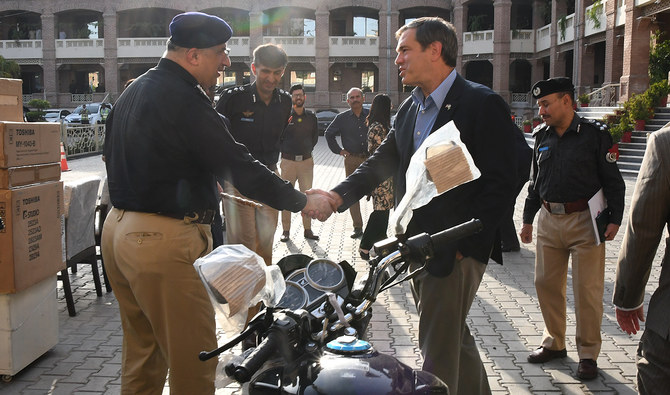
“US Deputy Chief of Mission, Andrew Schofer, visited Peshawar on September 25-26 to reaffirm US commitment to border security and continued support for Pakistan in its fight against cross-border infiltration and militancy in Khyber Pakhtunkhwa,” the statement said.
“During the visit, Schofer visited the Inspector General of Frontier Corps at the historic Fort Balahisar where he announced a new $250,000 program to enhance the Frontier Corps’ nighttime operational capabilities.”
The statement added that the US diplomat also held a meeting with Peshawar’s Inspector General of Police, Akhtar Hayat, and delivered $350,000 worth of safety and security equipment to enhance the safety and effectiveness of police forces conducting perilous counter-terrorism operations.
Earlier this year, the US said it was ready to “assist” Pakistan broadly against terrorism challenges while also acknowledging that the country had taken some important steps to counter militant groups in line with the completion of its Financial Action Task Force action plans.
At the same time, however, the US reiterated the importance of Pakistan continuing to take steps to permanently disband all militant groups, including Lashkar-e-Taiba, Jaish-e-Mohammed, and their various front organizations, assuring that it would raise this issue regularly with Pakistani officials and work together to counter mutual terrorist threats.


![]()

US commits $250,000 worth of aid, additional equipment for counterterrorism efforts in Pakistan’s northwest
Short Url
https://arab.news/8eerq
US commits $250,000 worth of aid, additional equipment for counterterrorism efforts in Pakistan’s northwest
- US announces new $250,000 program to enhance Frontier Corps’ nighttime operational capabilities in Khyber Pakhtunkhwa
- It also provided $350,000 in security equipment for safer and more effective counter-terrorism operations in province
Latest updates






© 2026 SAUDI RESEARCH & PUBLISHING COMPANY, All Rights Reserved And subject to Terms of Use Agreement.