

Pakistani cabbies struggle to stay on the road as fuel costs hack pay

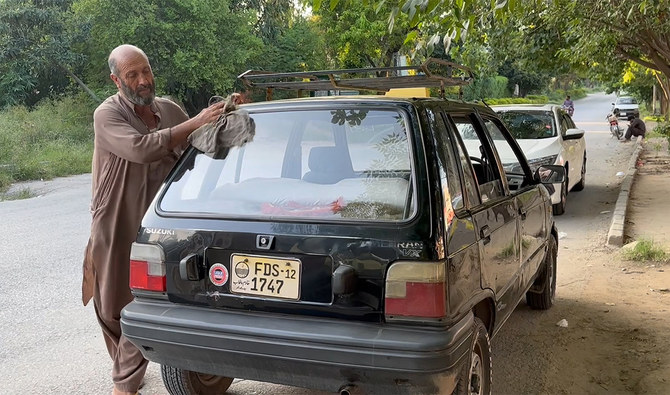
Khairullah Khan, a 50-year-old taxi driver, cleans his taxi as he waits for customers in Islamabad, Pakistan on September 19, 2023. (AN photo)
Short Url
Updated 27 September 2023
Follow

Pakistani cabbies struggle to stay on the road as fuel costs hack pay

  • On Sept. 15, Pakistan announced a record rise in petrol and diesel prices, second big increase in two weeks
  • Spiraling fuel costs and inflation have left Islamabad cab drivers with reduced incomes, no alternative means of livelihood

ISLAMABAD: Khairullah Khan, a 50-year-old taxi driver, remembers a time when he could fill his tank with cheap fuel to drive passengers across the Pakistani capital and take home enough money for food, drink and a decent life for his wife and nine children. 

Today, spiraling fuel costs and soaring inflation mean he is left at the end of a busy day with less than a few dollars in earnings. 

Last week, parked under a tree near a bustling market in Islamabad, Khan waited for customers but said rising fuel costs had driven most of his clients away.

On Sept. 15, Pakistan announced a record rise in petrol and diesel prices — by 26.02 rupees to 331.38 rupees a liter and by 17.34 rupees to 329.18 rupees a liter, respectively — the second big increase in two weeks for the South Asian nation already struggling with high inflation. A $3 billion loan program, approved by the International Monetary Fund (IMF) in July, averted a sovereign debt default in Pakistan but reforms linked to the bailout have fueled annual inflation running at 27.4 percent.

“We have no work, no income, we are ready to kill ourselves,” Khan, who has been plying the streets of Islamabad since 1991, told Arab News. “It has become very difficult to make ends meet now.” 
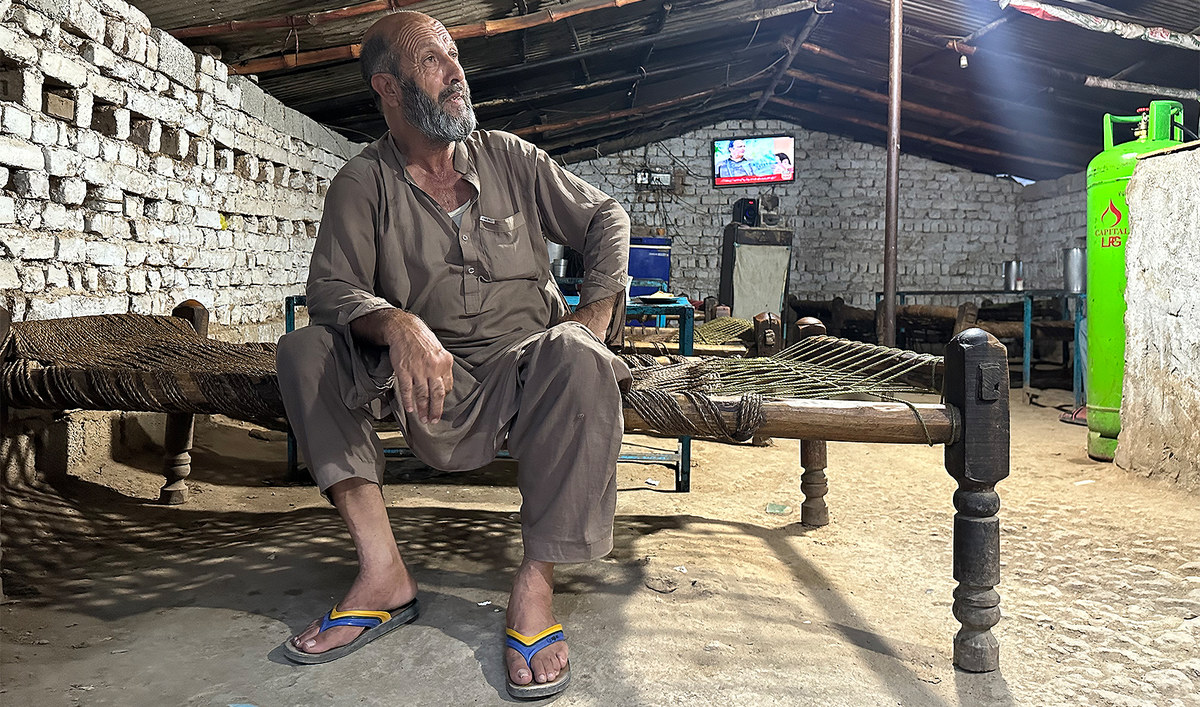


Khairullah Khan, a 50-year-old taxi driver, is pictured sitting in a roadside cafe in Islamabad, Pakistan on September 19, 2023. (AN photo)

Khan complained that customers were now unwilling to pay the high cost of rides that drivers were forced to charge due to new fuel prices.

“When we raise the fares, people argue that they are not responsible for the fuel prices so why should they pay higher costs,” the cabbie said.

Yellow cab driver Talib Hussain, 47, said now even “middle class people” could not afford taxi rides.

“I have not had any customers since morning, neither have any other cabbies standing here,” he said, pointing to a line of cabs behind his car.

Hussain said he used to make almost Rs25,000 ($85.6) per month last year but now took home barely Rs 8-10,000 ($27-34) monthly.

“If we [family] were eating thrice a day [last year], now we can only afford to eat one meal per day. Earlier my kids used to go to school by a van but now they have to walk to school every day. I have enrolled them in a government school because I could not afford to pay for private schools.”
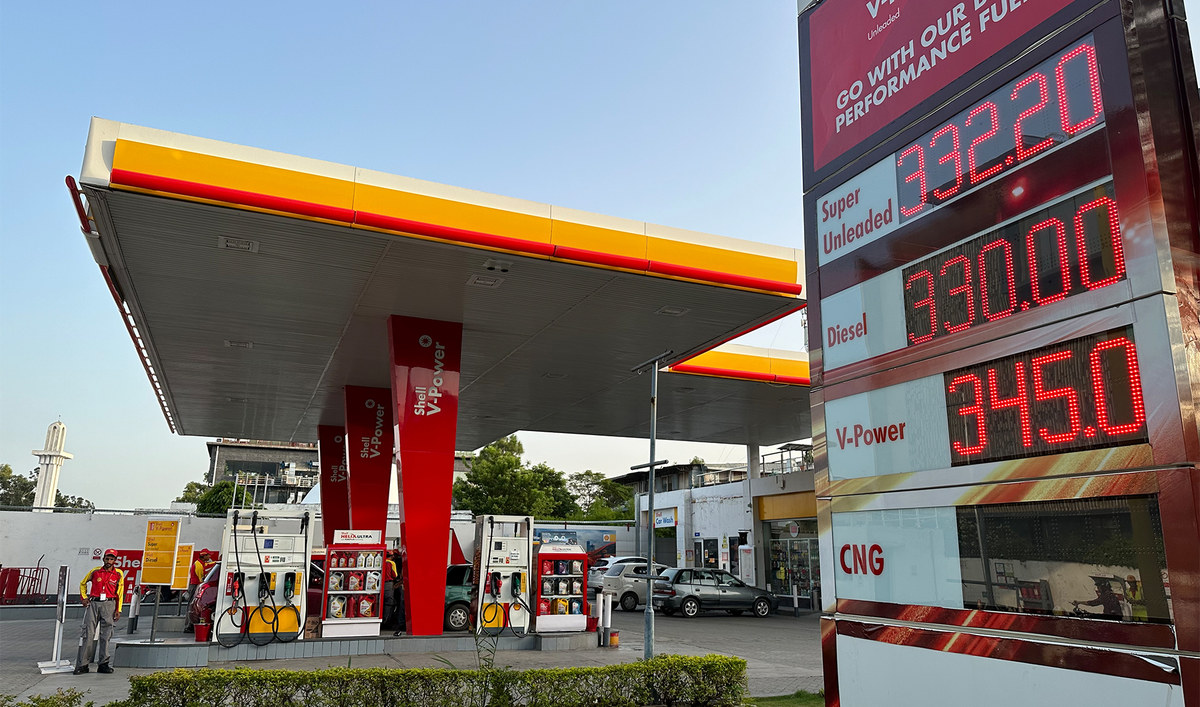


An employee waits for customers at a fuel station in Islamabad, Pakistan on September 25, 2023. (AN photo)

Many drivers who work with ride hailing apps like Uber, Careem, Bykea and InDrive reported a 50-60 percent decrease in average income compared to last year.

“The way fuel prices have increased, the rates per kilometer have not been increased the same way [by the ride-hailing company] which has resulted in a 50-60 percent drop in our incomes,” part time cabbie Naveed Alam said.

“If I was saving Rs 1,000 ($3.42) per day from this work last year, now I can barely save Rs600 ($2) … Customers have decreased, and fuel prices have doubled, which has reduced our income manifold.”

An InDrive bike rider who only identified himself by his first name, Usman, said he earned Rs1,000 ($3.42) per ride last year while burning Rs200 ($0.68) on fuel.

“Now for the same job, the fuel costs us around Rs 500-600 ($2),” he said, adding that maintenance costs for his bike had also doubled. “The fuel costs have almost doubled, and inflation has also increased so much, which has made our lives very difficult.”

Many cab drivers said the price hikes were forcing them to seek alternative means of livelihood, an uphil task, or get a second job.

“We toil for over 18 hours a day, yet we are unable to cover our expenses,” said Vilayat Khan, a cab driver in Islamabad who has been associated with the profession for the last 28 years. “But to start any other work we need investment, but we don’t have any money to invest, we don’t even own the cars we are driving.”

Bykea motorcycle driver Haider Ali Bykea said he saw no silver lining in the clouds:

“People like us will be forced to end our lives … what else can we do? I have five kids, how do I feed them? How is a poor man supposed to survive?”


IMF warns against policy slippage amid weak recovery as it clears $1.2 billion for Pakistan

Updated 11 December 2025
Follow

IMF warns against policy slippage amid weak recovery as it clears $1.2 billion for Pakistan

  • Pakistan rebuilt reserves, cut its deficit and slowed inflation sharply over the past one year
  • Fund says climate shocks, energy debt, stalled reforms threaten stability despite recent gains

ISLAMABAD: Pakistan’s economic recovery remains fragile despite a year of painful stabilization measures that helped pull the country back from the brink of default, the International Monetary Fund (IMF) warned on Thursday, after it approved a fresh $1.2 billion disbursement under its ongoing loan program.

The approval covers the second review of Pakistan’s Extended Fund Facility (EFF) and the first review of its climate-focused Resilience and Sustainability Facility (RSF), bringing total disbursements since last year to about $3.3 billion.

Pakistan entered the IMF program in September 2024 after years of weak revenues, soaring fiscal deficits, import controls, currency depletion and repeated climate shocks left the economy close to external default. A smaller stopgap arrangement earlier that year helped avert immediate default, but the current 37-month program was designed to restore macroeconomic stability through strict monetary tightening, currency adjustments, subsidy rationalization and aggressive revenue measures.

The IMF’s new review shows that Pakistan has delivered significant gains since then. Growth recovered to 3 percent last year after shrinking the year before. Inflation fell from over 23 percent to low single digits before rising again after this year’s floods. The current account posted its first surplus in 14 years, helped by stronger remittances and a sharp reduction in imports. And the government delivered a primary budget surplus of 1.3 percent of GDP, a key program requirement. Foreign exchange reserves, which had dropped dangerously low in 2023, rose from US$9.4 billion to US$14.5 billion by June.

“Pakistan’s reform implementation under the EFF arrangement has helped preserve macroeconomic stability in the face of several recent shocks,” IMF Deputy Managing Director Nigel Clarke said in a statement after the Board meeting.

But he warned that Islamabad must “maintain prudent policies” and accelerate reforms needed for private-sector-led and sustainable growth.

The Fund noted that the 2025 monsoon floods, affecting nearly seven million people, damaging housing, livestock and key crops, and displacing more than four million, have set back the recovery. The IMF now expects GDP growth in FY26 to be slightly lower and forecasts inflation to rise to 8–10 percent in the coming months as food prices adjust.

The review warns Pakistan against relaxing monetary or fiscal discipline prematurely. It urges the State Bank to keep policy “appropriately tight,” allow exchange-rate flexibility and improve communication. Islamabad must also continue raising revenues, broadening the tax base and protecting social spending, the Fund said.

Despite the progress, Pakistan’s structural weaknesses remain severe.

Power-sector circular debt stands at about $5.7 billion, and gas-sector arrears have climbed to $11.3 billion despite tariff adjustments. Reform of state-owned enterprises has slowed, including delays in privatizing loss-making electricity distributors and Pakistan International Airlines. Key governance and anti-corruption reforms have also been pushed back.

The IMF welcomed Pakistan’s expansion of its flagship Benazir Income Support Program, which raises cash transfers for low-income families and expands coverage, saying social protection is essential as climate shocks intensify. But it warned that high public debt, about 72 percent of GDP, thin external buffers and climate exposure leave the country vulnerable if reform momentum weakens.

The Fund said Pakistan’s challenge now is to convert short-term stabilization into sustained recovery after years of economic volatility, with its ability to maintain discipline, rather than the size of external financing alone, determining the durability of its gains.