Polish minister must tone down criticism of migration film, court says

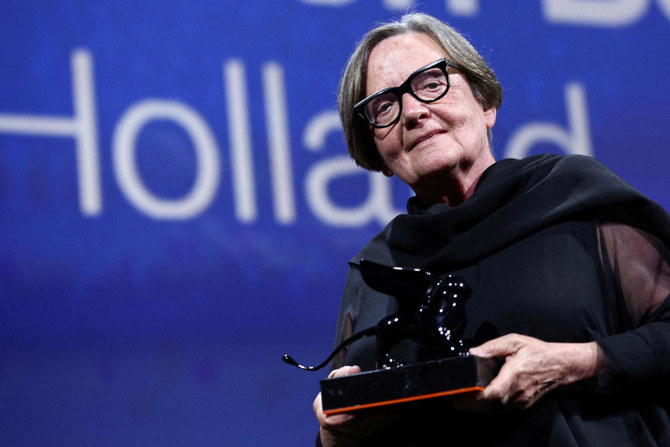
Poland’s justice minister must not compare film director Agnieszka Holland or her work to authoritarian regimes, a Warsaw court said on Tuesday. (Reuters/File)
Short Url
Updated 26 September 2023
Follow

Polish minister must tone down criticism of migration film, court says

  • The black-and-white film shows a family from Syria and a woman from Afghanistan thrown backwards and forward across the border by brutal guards indifferent to their suffering
  • The movie drew a furious response from conservatives in Poland even before its release in Polish cinemas on Friday

WARSAW: Poland’s justice minister must not compare film director Agnieszka Holland or her work to authoritarian regimes, a Warsaw court said on Tuesday, after the minister likened Holland’s film depicting the Belarus border migrant crisis to Nazi propaganda.
With migration a key issue ahead of Oct. 15 elections, the ruling nationalists Law and Justice (PiS) have pushed Holland’s award-winning film ‘Green Border’ to center stage in the campaign, condemning its portrayal of the treatment of migrants at the border and accusing Holland of insulting people who were protecting their country.
Justice Minister Zbigniew Ziobro compared the film to Nazi German propaganda, spurring Holland to demand an apology and threatening court action in the absence of one.
In his post on social media network X, Ziobro said: “In the Third Reich, the Germans produced propaganda films showing Poles as bandits and murderers. Today they have Agnieszka Holland for that.”
The black-and-white film shows a family from Syria and a woman from Afghanistan thrown backwards and forward across the border by brutal guards indifferent to their suffering, as activists struggled to try to bring them to safety.
After the court’s ruling on Tuesday, Holland’s lawyers Sylwia Gregorczyk-Abram and Michal Wawrykiewicz wrote on X: “As Agnieszka Holland’s representatives, we would like to inform you that the District Court in Warsaw has issued an order prohibiting Zbigniew Ziobro from speaking about Ms. Holland and her works, comparing them to criminal authoritarian regimes.”
The movie drew a furious response from conservatives in Poland even before its release in Polish cinemas on Friday.
Holland hit back at the criticism in an interview with private broadcaster TVN24 on Monday, labelling the government “a disgrace to Poland” and their actions against her work “unprecedented.”
Deputy Justice Minister Sebastian Kaleta said Holland and her legal team were in effect blocking Ziobro’s right to free speech.
“Minister Ziobro and every citizen has a right to present their views and opinions,” he told Reuters. “Ms Holland wants to refuse him this right.”
Migrants, largely from North African and the Middle East, started flocking to the border in 2021 after Belarus, a Russian ally, opened travel agencies in the Middle East offering an unofficial route into Europe, a move Brussels said was designed to create a crisis. Poland has refused to let them cross.


At top UN court, Myanmar denies deadly Rohingya campaign amounts to genocide

Updated 2 sec ago
Follow

At top UN court, Myanmar denies deadly Rohingya campaign amounts to genocide

  • The country defended itself Friday at the United Nations top court against allegations of breaching the genocide convention
  • Myanmar launched the campaign in Rakhine state in 2017 after an attack by a Rohingya insurgent group
THE HAGUE: Myanmar insisted Friday that its deadly military campaign against the Rohingya ethnic minority was a legitimate counter-terrorism operation and did not amount to genocide, as it defended itself at the top United Nations court against an allegation of breaching the genocide convention.
Myanmar launched the campaign in Rakhine state in 2017 after an attack by a Rohingya insurgent group. Security forces were accused of mass rapes, killings and torching thousands of homes as more than 700,000 Rohingya fled into neighboring Bangladesh.
“Myanmar was not obliged to remain idle and allow terrorists to have free reign of northern Rakhine state,” the country’s representative Ko Ko Hlaing told black-robed judges at the International Court of Justice.
Gambia filed genocide case in 2019
African nation Gambia brought a case at the court in 2019 alleging that Myanmar’s military actions amount to a breach of the Genocide Convention that was drawn up in the aftermath of World War II and the Holocaust.
Some 1.2 million members of the Rohingya minority are still languishing in chaotic, overcrowded camps in Bangladesh, where armed groups recruit children and girls as young as 12 are forced into prostitution. The sudden and severe foreign aid cuts imposed last year by US President Donald Trump shuttered thousands of the camps’ schools and have caused children to starve to death.
Buddhist-majority Myanmar has long considered the Rohingya Muslim minority to be “Bengalis” from Bangladesh even though their families have lived in the country for generations. Nearly all have been denied citizenship since 1982.
Myanmar denies Gambia claims of ‘genocidal intent’
As hearings opened Monday, Gambian Justice Minister Dawda Jallow said his nation filed the case after the Rohingya “endured decades of appalling persecution, and years of dehumanizing propaganda. This culminated in the savage, genocidal ‘clearance operations’ of 2016 and 2017, which were followed by continued genocidal policies meant to erase their existence in Myanmar.”
Hlaing disputed the evidence Gambia cited in its case, including the findings of an international fact-finding mission set up by the UN’s Human Rights Council.
“Myanmar’s position is that the Gambia has failed to meet its burden of proof,” he said. “This case will be decided on the basis of proven facts, not unsubstantiated allegations. Emotional anguish and blurry factual pictures are not a substitute for rigorous presentation of facts.”
Aung San Suu Kyi represented Myanmar at court in 2019. Now she’s imprisoned
Nobel Peace Prize winner Aung San Suu Kyi represented her country at jurisdiction hearings in the case in 2019, denying that Myanmar armed forces committed genocide and instead casting the mass exodus of Rohingya people from the country she led as an unfortunate result of a battle with insurgents.
The pro-democracy icon is now in prison after being convicted of what her supporters call trumped-up charges after a military takeover of power.
Myanmar contested the court’s jurisdiction, saying Gambia was not directly involved in the conflict and therefore could not initiate a case. Both countries are signatories to the genocide convention, and in 2022, judges rejected the argument, allowing the case to move forward.
Gambia rejects Myanmar’s claims that it was combating terrorism, with Jallow telling judges on Monday that “genocidal intent is the only reasonable inference that can be drawn from Myanmar’s pattern of conduct.”
In late 2024, prosecutors at another Hague-based tribunal, the International Criminal Court, requested an arrest warrant for the head of Myanmar’s military regime for crimes committed against the country’s Rohingya Muslim minority. Senior Gen. Min Aung Hlaing, who seized power from Suu Kyi in 2021, is accused of crimes against humanity for the persecution of the Rohingya. The request is still pending.