

Pakistani leaders, Saudi envoy laud Kingdom’s efforts to ‘shape’ the future

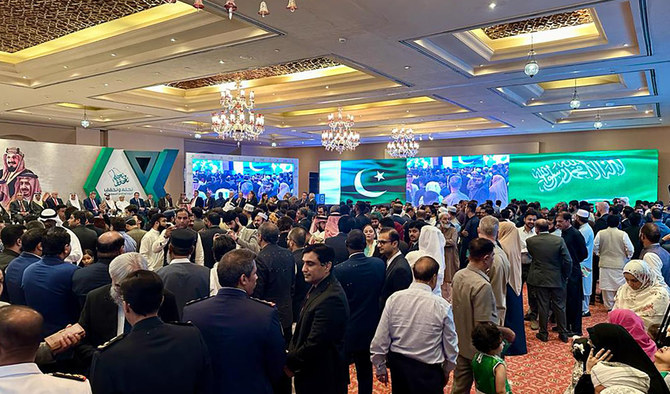
Pakistani officials, diplomats and dignitaries attend the Saudi National Day event in Islamabad, Pakistan on September 25, 2023. (AN photo)
Short Url
Updated 26 September 2023
Follow

Pakistani leaders, Saudi envoy laud Kingdom’s efforts to ‘shape’ the future

  • Glittering ceremony held in Islamabad to celebrate Saudi Arabia’s 93rd National Day
  • Senate chairman praises Saudi efforts to promote peace, stability in Middle East and beyond

ISLAMABAD: At celebrations to commemorate Saudi Arabia’s 93rd National Day in Islamabad on Monday, Pakistani leaders as well as the Kingdom’s envoy to Pakistan praised the leadership in Riyadh for its efforts to realign Middle East dynamics and open up the Saudi economy and society.

The Saudi government, in an effort led by Crown Prince Mohammed Bin Salman, has made remarkable changes in recent years under a vast economic transformation plan, the Vision 2030, to diversify away from oil and open the Kingdom to business and tourism amid rising regional competition. The Kingdom has also gone into diplomatic overdrive, restoring relations with Iran and agreeing to a rapprochement with Syria in its quest to rebuild regional alliances, instead of leaning entirely on the United States, its long-time big power ally. It has also recently joined the Shanghai Cooperation Organization as parts of Riyadh’s attempts to build a long-term partnership with China.

“Under the ideal leadership, Saudi Arabia is not just addressing the future, it is actively shaping it,” Chairman Senate Muhammad Sadiq Sanjrani said at a ceremony to celebrate Saudi National Day, which the Kingdom is marking this year with the slogan, “We dream and we achieve.”

The Senate chairman lauded steps taken by Saudi Arabia to promote peace and stability in the region.

“Dialogue and mutual respect are the bedrock on which lasting peace is made,” he said. “We are confident that Saudi efforts will open doors to various opportunities, including trade, the sharing of initiatives, and collaboration between leaders and their followers, not only for the region but for the entire world.”

Pakistan and Saudi Arabia are close allies and share strong economic, security and cultural ties. Saudi Arabia is also home to more than two million Pakistani expatriates, making it the largest contributor to remittance inflows.

This year, Pakistan received $2 billion in financial support from Saudi Arabia in July, a day before the International Monetary Fund’s board gave the final approval for a $3 billion bailout deal. Saudi Arabia’s continued economic and investment support is key for Pakistan, as economic stabilization is a major challenge, with the $350 billion economy on a narrow recovery path after the IMF bailout averted a sovereign debt default. Economic reforms have already fueled historic inflation and interest rates.

“Pakistan is grateful for all the support extended by the Kingdom in the difficult times,” Sanjrani said, adding that Pakistan had also provided “unwavering and never-ending” support to the Kingdom on the diplomatic and security fronts.

Speaking at the ceremony, which was organized by the Saudi embassy, Ambassador Nawaf bin Said Al-Malki called on Pakistan and the world to “support all development plans and initiatives taken for the progress and prosperity of the Kingdom.”

“At the forefront of these successful initiatives is the Kingdom’s Vision 2030,” the ambassador said, “which represents a new stage leading the country to a bright future.”


IMF hails Pakistan privatization drive, calls PIA sale a ‘milestone’

Updated 10 January 2026
Follow

IMF hails Pakistan privatization drive, calls PIA sale a ‘milestone’

  • Fund backs sale of national airline as key step in divesting loss-making state firms
  • IMF has long urged Islamabad to reduce fiscal burden posed by state-owned entities

KARACHI: The International Monetary Fund (IMF) on Saturday welcomed Pakistan’s privatization efforts, describing the sale of the country’s national airline to a private consortium last month as a milestone that could help advance the divestment of loss-making state-owned enterprises (SOEs).

The comments follow the government’s sale of a 75 percent stake in Pakistan International Airlines (PIA) to a consortium led by the Arif Habib Group for Rs 135 billion ($486 million) after several rounds of bidding in a competitive process, marking Islamabad’s second attempt to privatize the carrier after a failed effort a year earlier.

Between the two privatization attempts, PIA resumed flight operations to several international destinations after aviation authorities in the European Union and Britain lifted restrictions nearly five years after the airline was grounded following a deadly Airbus A320 crash in Karachi in 2020 that killed 97 people.

“We welcome the authorities’ privatization efforts and the completion of the PIA privatization process, which was a commitment under the EFF,” Mahir Binici, the IMF’s resident representative in Pakistan, said in response to an Arab News query, referring to the $7 billion Extended Fund Facility.

“This privatization represents a milestone within the authorities’ reform agenda, aimed at decreasing governmental involvement in commercial sectors and attracting investments to promote economic growth in Pakistan,” he added.

The IMF has long urged Islamabad to reduce the fiscal burden posed by loss-making state firms, which have weighed public finances for years and required repeated government bailouts. Beyond PIA, the government has signaled plans to restructure or sell stakes in additional SOEs as part of broader reforms under the IMF program.

Privatization also remains politically sensitive in Pakistan, with critics warning of job losses and concerns over national assets, while supporters argue private sector management could improve efficiency and service delivery in chronically underperforming entities.

Pakistan’s Cabinet Committee on State-Owned Enterprises said on Friday that SOEs recorded a net loss of Rs 122.9 billion ($442 million) in the 2024–25 fiscal year, compared with a net loss of Rs 30.6 billion ($110 million) in the previous year.