

Pakistan’s foreign minister reaffirms support for an independent Palestinian state

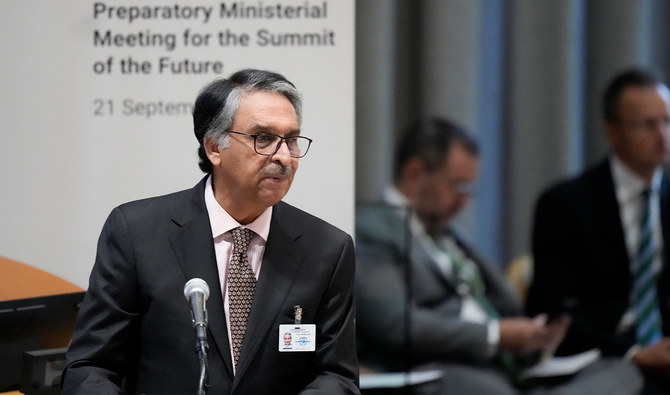
Pakistan Foreign Minister Jalil Abbas Jilani speaks during the Summit of the Future at United Nations headquarters on September 21, 2023. (Photo courtesy: AP/File)
Short Url
Updated 25 September 2023
Follow

Pakistan’s foreign minister reaffirms support for an independent Palestinian state

  • Caretaker Foreign Minister Jalil Abbas Jilani says independent Palestinian state is Pakistan’s ‘national interest’
  • Israeli Foreign Minister Eli Cohen said last week ‘six or seven’ Islamic nations were likely to ‘make peace’ with Israel

ISLAMABAD: Pakistan’s Caretaker Foreign Minister Jalil Abbas Jilani on Monday reaffirmed support for an independent Palestinian state, saying that it was in the South Asian country’s “national interest.”

Jilani’s comment came a day after Geo News reported he had said any decision to establish bilateral relations with Israel would hinge on the nation’s own interests and the well-being of the Palestinian people. His statement also follows Israeli Foreign Affairs Minister Eli Cohen’s remarks from last week in which Cohen indicated he had met leaders of several Islamic nations in recent days who were likely to forge diplomatic ties with Israel soon.

Pakistan does not recognize the state of Israel and has repeatedly called for an independent Palestinian state based on “internationally agreed parameters” and the pre-1967 borders with Al-Quds Al-Sharif as its capital. 

“In my statement at UNGA, I renewed Pakistan’s call for an independent State of Palestine, based on pre-67 borders, with Al-Quds Al-Sharif as capital,” Jilani wrote on social media platform X. The foreign minister was responding to a comment by a journalist who sought clarification on whether Pakistan was considering recognizing the state of Israel. 

“This is in our national interest.”

On Sunday, Pakistan’s Caretaker Information Minister Murtaza Solangi said Islamabad has taken a “traditional and principled stand” on not recognizing Israel, adding that the state and its institutions stand by it. 

“Pakistan’s position on Israel is related to the future of the people of Palestine,” Solangi told GTV News. “As long as Palestinians do not get their free country and their right to self-determination, which is recognized in the United Nations resolutions, Pakistan will not abandon its Palestinian brothers.”

Prime Minister Anwaar-ul-Haq Kakar also advocated for a two-state solution as a path to enduring peace in Palestine during his United Nations General Assembly speech on Friday.

He reiterated Pakistan’s position on the matter, calling for the “establishment of a viable and contiguous Palestinian state within the pre-June 1967 borders with Al-Quds as its capital.”

Kakar also criticized Israeli military raids against Palestinians and its expansion of settlements in the Occupied Territories.


IMF hails Pakistan privatization drive, calls PIA sale a ‘milestone’

Updated 10 January 2026
Follow

IMF hails Pakistan privatization drive, calls PIA sale a ‘milestone’

  • Fund backs sale of national airline as key step in divesting loss-making state firms
  • IMF has long urged Islamabad to reduce fiscal burden posed by state-owned entities

KARACHI: The International Monetary Fund (IMF) on Saturday welcomed Pakistan’s privatization efforts, describing the sale of the country’s national airline to a private consortium last month as a milestone that could help advance the divestment of loss-making state-owned enterprises (SOEs).

The comments follow the government’s sale of a 75 percent stake in Pakistan International Airlines (PIA) to a consortium led by the Arif Habib Group for Rs 135 billion ($486 million) after several rounds of bidding in a competitive process, marking Islamabad’s second attempt to privatize the carrier after a failed effort a year earlier.

Between the two privatization attempts, PIA resumed flight operations to several international destinations after aviation authorities in the European Union and Britain lifted restrictions nearly five years after the airline was grounded following a deadly Airbus A320 crash in Karachi in 2020 that killed 97 people.

“We welcome the authorities’ privatization efforts and the completion of the PIA privatization process, which was a commitment under the EFF,” Mahir Binici, the IMF’s resident representative in Pakistan, said in response to an Arab News query, referring to the $7 billion Extended Fund Facility.

“This privatization represents a milestone within the authorities’ reform agenda, aimed at decreasing governmental involvement in commercial sectors and attracting investments to promote economic growth in Pakistan,” he added.

The IMF has long urged Islamabad to reduce the fiscal burden posed by loss-making state firms, which have weighed public finances for years and required repeated government bailouts. Beyond PIA, the government has signaled plans to restructure or sell stakes in additional SOEs as part of broader reforms under the IMF program.

Privatization also remains politically sensitive in Pakistan, with critics warning of job losses and concerns over national assets, while supporters argue private sector management could improve efficiency and service delivery in chronically underperforming entities.

Pakistan’s Cabinet Committee on State-Owned Enterprises said on Friday that SOEs recorded a net loss of Rs 122.9 billion ($442 million) in the 2024–25 fiscal year, compared with a net loss of Rs 30.6 billion ($110 million) in the previous year.