

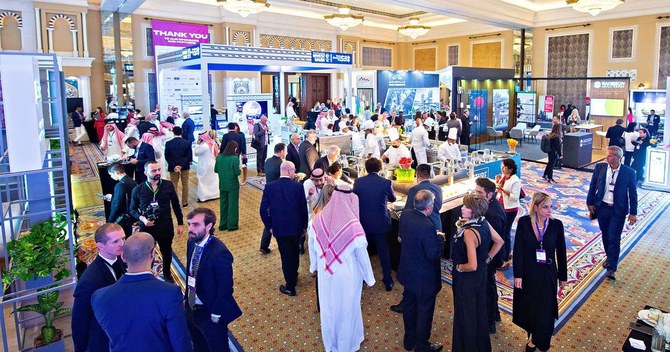
Sustainability tops agenda as summit set to begin in Abu Dhabi

From increased calls on climate action in the tourism and hospitality sector to Dubai hosting the COP28 this winter, most of the discussions at this year’s event are expected to be centered around measures to reduce the industry’s carbon footprint. File
Short Url
Updated 24 September 2023
Follow

Sustainability tops agenda as summit set to begin in Abu Dhabi

RIYADH: Principles related to environmental, social, and governance are top of the agenda as top names in the hospitality sector meet in Abu Dhabi for the Future Hospitality Summit on Sept. 26.

From increased calls on climate action in the tourism and hospitality sector to Dubai hosting the COP28 this winter, most of the discussions at this year’s event are expected to be centered around measures to reduce the industry’s carbon footprint.

According to the World Travel and Tourism Council, the sector contributes up to 11 percent of the total emissions in the world, and this figure is predicted to double by 2050.

With this in mind, industry leaders and most of the key players in the sector have already taken measures to ensure a greener future

Sustainability factor

Haitham Mattar, managing director of India, Middle East and Africa at IHG Hotels and Resorts, believes the tourism and hospitality sectors play a pivotal role in working toward a sustainable future.

“At IHG, we embrace our responsibility and opportunity to make a positive difference and (are) helping to shape the future of responsible travel,” said Mattar.

He added: “We are determined to contribute toward positive social and economic change, to stand up for key issues such as diversity, equity and inclusion, and human rights, and to make more responsible environmental choices.”

Mattar said IHG is working toward reducing carbon emissions, along with eliminating single-use items and moving to reusable and recyclable alternatives, as well as reducing the food waste from its hotel chain.

Jonathan Brown, chief portfolio officer of Miral Group, the host sponsor of FHS, believes the path to sustainability across the UAE’s leisure, entertainment, and tourism industry has been emboldened by a national strategy accentuating clean energy sources together with net-zero objectives.

Brown said: “Our ambition to accelerate the realization of the Emirate’s tourism growth and contribute to the industry’s ecosystem underpinned by a commitment to creating value for our customers, partners, and society, and positively impacting the communities in which we operate.”

He added: “Ultimately, the key to balancing growth with sustainable development lies in collective action, strategic partnerships, and long-standing investments.”

Richard Williamson, chief operating officer of Considerate Group, said the interest and investments surrounding ESG principles in the hospitality sector have picked up pace in recent years, and are a significant part of the agenda at events such as FHS.

“In 2023, we more often find a chief sustainability officer owning the agenda, with a dedicated ESG budget. Our role has evolved so that we now habitually provide advice and support to the CSO,” said Williamson.

He added: “This reflects the change in ESG engagement moving from a warm, slightly ‘wooly’ industry, to a more quantitative, data-led stage.”

Williamson believes the ESG evolution in the hospitality sector is being driven by four crucial factors: tightening regulations, stakeholder reporting requirements, asset-level carbon footprint analysis, and climate risk and resilience.

Fahad Abdulrahim Kazim, CEO of Millennium Hotels & Resorts, echoed those views and noted the hospitality industry’s investment in ESG and sustainability is becoming increasingly robust and essential.

“We are witnessing a significant shift as more hotels and resorts recognize the long-term benefits of incorporating environmental, social, and governance considerations into their business strategies,” said Kazim.

The executive added that industry leaders in the hospitality sector are steadily adopting energy efficient technologies, waste reduction initiatives, community engagement programs, and responsible sourcing practices.

“As consumer preferences align more with sustainable choices, the hospitality sector’s commitment to ESG is not just a trend but a necessary path to secure a greener and more resilient future,” Kazim noted.

Millennium Hotels & Resorts aims to reduce environmental impact through sustainable practices, including a reduction in single-use plastics, Kazim added.

“We seek to establish and nurture long-term relationships with residents and organizations by supporting local small and medium-sized enterprises. At Millennium Hotels & Resorts, we remain dedicated to leading this charge and setting a strong example for sustainable hospitality practices,” he said.

Kazim further pointed out that the biggest priority in the hospitality sector is striking the right balance between exceptional guest experiences and minimizing the environmental footprint.

Radisson Hotel Group’s Vice President of Business Development Elie Milky noted that the hospitality sector is witnessing a paradigm shift from sustainability being a “nice-to-have” to a fundamental core value.

“Investments in ESG reflect our ethical responsibilities and become vital for business resilience and long-term success,” said Milky.

He added: “As an industry that primarily revolves around physical locations, buildings, and transportation, we have a significant role in driving forward green building practices, efficient energy consumption, and sustainable transportation solutions for our guests.”

Paul Stevens, chief operating officer of the premium, midscale and economy division for Middle East, Africa and Turkiye at Accor, said the company has been a pioneer in bringing sustainable development to the hospitality industry for more than 30 years.

 “We drive transformation by collaborating closely with our hotel owners, partners and stakeholders to embed sustainability across all activities, making a positive impact on people and nature, which are two fundamentals at the core of our practices,” added Stevens.

According to the executive, the sustainable transition is not only just a strategic priority but is a fundamental necessity.

“ESG practices are no longer optional; they have evolved into essential requirements for staying competitive, attracting guests, and maintaining long-term viability,” he said.

Possible challenges

Talking about the challenges faced by the hospitality sector while reducing sustainability, IHG Hotels’ Mattar noted the most crucial to tackle is the lack of standardization.

He said: “For governments to set ESG targets, industry level standards are pivotal to mandate across different areas of sustainability. As an industry, standardization is a recurring topic of importance that appears in virtually every conversation, as well as across customer forums.

Mattar added: “It is the need of the hour for governments, businesses and trade bodies to harmonize efforts and as a result, maintain effective tourism and hospitality ESG standards.”

Stevens believes the hospitality sector faces intricate challenges when it comes to the development and execution of ESG strategies and deviating from traditional ways of doing things.

“The strategies are not one-size-fits-all solutions, each destination possesses its own unique challenges and opportunities, demanding a customized approach,” added Stevens.


World must prioritize resilience over disruption, economic experts warn

Saudi Arabia’s Finance Minister Mohammed Al-Jadaan urged policymakers and investors to “mute the noise” and focus on resilience.
Updated 23 January 2026
Follow

World must prioritize resilience over disruption, economic experts warn

  • Al-Jadaan said that much of the anxiety dominating markets reflected a world that had already been shifting for years
  • Pointing to Asia and the Gulf, Al-Jadaan said that some countries had already built models based on diversification and resilience

DAVOS: Saudi Arabia’s Finance Minister Mohammed Al-Jadaan urged policymakers and investors to “mute the noise” and focus on resilience, as global leaders gathered in Davos on Friday against a backdrop of trade tensions, geopolitical uncertainty and rapid technological change.

Speaking on the final day of the World Economic Forum in Davos, Al-Jadaan said that much of the anxiety dominating markets reflected a world that had already been shifting for years.

“We need to define who ‘we’ are in this so-called new world order,” he said, arguing that many emerging economies had been adapting to a more fragmented global system for decades.

Pointing to Asia and the Gulf, Al-Jadaan said that some countries had already built models based on diversification and resilience. In energy markets, he pointed out that the focus should remain on balancing supply and demand in a way that incentivized investment without harming the global economy.

“Our role in OPEC is to stabilize the market,” he said.

His remarks were echoed by Saudi Arabia’s Minister of Economy and Planning Faisal Alibrahim, who said that uncertainty had weighed heavily on growth, investment and geopolitical risk, but that reality had proven more resilient.

“The economy has adjusted and continues to move forward,” Alibrahim said.

Alibrahim warned that pragmatism had become scarce, trust increasingly transactional, and collaboration more fragile. “Stability cannot be quickly built or bought,” he said.

Alibrahim called for a shift away from preserving the status quo towards the practical ingredients that made cooperation work, stressing discipline and long-term thinking even when views diverged.

Quoting Saudi Arabia’s founding King Abdulaziz Al-Saud, he added: “Facing challenges requires strength and confidence, there is no virtue in weakness. We cannot sit idle.”

President of the European Central Bank Christine Lagarde stressed the importance of distinguishing meaningful data from headline noise, saying: “Our duty as central bankers is to separate the signal from the noise. The real numbers are growth numbers not nominal ones.”

Managing Director of the IMF Kristalina Georgieva echoed Lagarde’s sentiments, saying that the world had entered a more “shock prone” environment shaped by technology and geopolitics.

Director General of the World Trade Organization Ngozi Okonjo-Iweala said that the global trade systems currently in place were remarkably resilient, pointing out that 72 percent of global trade continued despite disruptions.

She urged governments and businesses, however, to avoid overreacting.

Okonjo Iweala said that a return to the old order was unlikely, but trade would remain essential. Georgieva agreed, saying global trade would continue, albeit in a different form.

Georgieva warned that AI would accelerate economic transformation at an unprecedented speed. The IMF expects 60 percent of jobs to be affected by AI, either enhanced or displaced, with entry-level roles and middle-class workers facing the greatest pressure.

Lagarde warned that without cooperation, capital and data flows would suffer, undermining productivity and growth.

Al-Jadaan said that power dynamics had always shaped global relations, but dialogue remained essential. “The fact that thousands of leaders came here says something,” he said. “Some things cannot be done alone.”

In another session titled Geopolitical Risks Outlook for 2026, former US Democratic representative Jane Harman said that because of AI, the world was safer in some ways but worse off in others.

“I think AI can make the world riskier if it gets in the wrong hands and is used without guardrails to kill all of us. But AI also has enormous promise. AI may be a development tool that moves the third world ahead faster than our world, which has pretty messy politics,” she said.

American economist Eswar Prasad said that currently the world was in a “doom loop.”

Prasad said that the global economy was stuck in a negative-feedback loop and economics, domestic politics and geopolitics were only bringing out the worst in each other.

“Technology could lead to shared prosperity but what we are seeing is much more concentration of economic and financial power within and between countries, potentially making it a destabilizing force,” he said.

Prasad predicted that AI and tech development would impact growing economies the most. But he said that there was uncertainty about whether these developments would create job opportunities and growth in developing countries.

Professor of international political economy at the University of New South Wales in Australia, Elizabeth Thurbon, said that China was driving a Green Energy transition in a way that should be modeled by the rest of the world.

“The Chinese government is using the Green Energy Transition to boost energy security and is manufacturing its own energy to reduce reliance on fossil fuel imports,” she explained.

Thurbon said that China was using this transition to boost economic security, social security and geostrategic security. She viewed this as a huge security-enhancing opportunity and every country had the ability to use the energy transition as a national security multiplier. 

“We are seeing an enormous dynamism across emerging market economies driven by China. This boom loop is being driven by enormous investments in green energy. Two-thirds of global investment flowing into renewable energy is driven largely by China,” she said.

Thurbon said that China was taking an interesting approach to building relationships with countries by putting economic engagement on the forefront of what they had to offer.

“China is doing all it can to ensure economic partnership with emerging economies are productive. It’s important to approach alliances as not just political alliances but investment in economy, future and the flourishment of a state,” she said.

The panel criticized global economic treaties and laws, and expressed the need for immediate reforms in economic governing bodies.

“If you are a developing economy, the rules of the WTO, for example, are not helpful for you to develop. A lot of the rules make it difficult to pursue an economic development agenda. These regulations are not allowing the economies to grow,” Thurbon said.

“Serious reform must be made in international trade agreements, economic bodies and rules and guidelines,” she added.

Prasad echoed this sentiment and said there was a need for national and international reform in global economic institutions.

“These institutions are not working very well so we can reconfigure them or rebuild them from scratch. But unfortunately the task of rebuilding falls into the hands of those who are shredding them,” he said.

WEF attendees were invited to join the Global Collaboration and Growth meeting to be held in Saudi Arabia in April 2026 to continue addressing the complex global challenges and engage in dialogue.