

UN has ‘moral duty’ to solve Palestine question: Omani FM

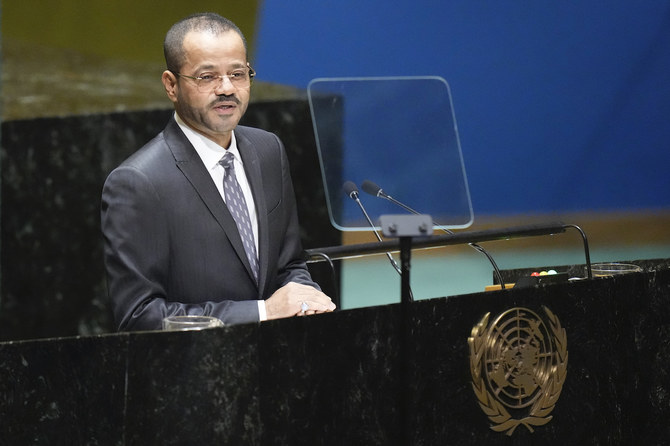
Oman's Foreign Minister Sayyid Badr bin Hamad bin Hamood Albusaidi addresses the 78th session of the United Nations General Assembly, Saturday, Sept. 23, 2023, at United Nations headquarters. (AP)
Short Url
Updated 24 September 2023
Follow

UN has ‘moral duty’ to solve Palestine question: Omani FM

  • ‘Like all peaceful nations,’ Gulf country believes in two-state solution, Sayyid Badr Al-Busaidi tells UN
  • Minister says incitement of violence, hatred poses national security risk and requires criminalization

NEW YORK CITY: The UN has a “moral duty” to resolve the Palestine question through a two-state solution, Oman’s foreign minister has told the UN.

Sayyid Badr Al-Busaidi was speaking at the 78th UN General Assembly in New York City on Saturday.

The minister described the Palestinian issue as “an injustice which has lasted more than 70 years.”

He added: “The Palestinian people, however, stand firm in their conviction and determination vis-a-vis the brutal Israeli occupation, the embargo and abuses and violation of international law, and Security Council resolutions.”

Oman’s belief in justice, equity and respect of the UN Charter means that “like all peaceful nations,” the country sees no other solution to the Palestine question than the two-state solution, Al-Busaidi said.

He appealed to all countries to “stay attached” to the UN system in settling disputes and resolving conflict, adding that the UN has a duty “to put an end to the painful suffering of the Palestinian people.”

This can only happen through Israel’s withdrawal to the June 1967 borders and the creation of an independent Palestinian state with East Jerusalem as its capital, Al-Busaidi said.

The Russia-Ukraine conflict has also caused “painful humanitarian consequences,” the Omani minister said.

The war has presented a “significant challenge to international peace and challenge to the proper functioning of supply systems worldwide,” Al-Busaidi said.

He appealed for dialogue and peace negotiations between the two sides “on the basis of the principle of harming no one” as well as state sovereignty and good neighborliness.

The foreign minister outlined the sultanate’s green targets that are part of the Oman 2040 Vision.

The country is aiming for net-zero by 2050, and will take part in the UAE-hosted COP28 later this year as part of a “national approach to promote sustainable development.”

Oman’s Vision 2040 also views modernization of education systems as “key,” Al-Busaidi said.

The minister highlighted the sultanate’s hosting of a global ministerial meeting on health preparedness as part of a post-pandemic strategy.

“One of the most important lessons drawn (from the pandemic) was that which relates to early preparation,” he said.

“The goal is to reduce increasing danger to public health,” Al-Busaidi added, inviting other states to take part in joint research to develop anti-pandemic measures.

Oman has “serious aspirations” to bolster and “promote the instruments” of human rights in order to promote an international community that respects human dignity, the minister said.

He condemned the incitement of violence and hatred as a breach of that principle and called for the adoption of “clear and categorical legislation” that criminalizes such behavior.

Discrimination based on religion, creed or race poses a threat to social peace and security, and even the “national security of states and societies,” Al-Busaidi said.

The Omani foreign minister ended his address by calling on the “family of nations” to “uphold peace and justice.”

He said: “We are grappling with complex challenges worldwide. These global challenges include climate change, the spread of epidemics, and trafficking of drugs and human beings. And to that list, we should add conflicts of various types.

“As a result, we would invite the family of nations to uphold the principles of peace and justice, and to implement the principles of international law without any double standards, so that confidence can prevail, and build trust between states and so that there will be prosperous partnerships between peoples.”


Sudan defense minister dismisses ‘intelligence document’ as fabrication after convoy strike

Updated 12 February 2026
Follow

Sudan defense minister dismisses ‘intelligence document’ as fabrication after convoy strike

  • Gen. Hassan Kabroun tells Arab News claims that army hid weapons in aid convoy are “completely false”

RIYADH: Sudan’s defense minister has firmly denied reports attributed to Sudanese intelligence alleging that a convoy targeted in North Kordofan was secretly transporting weapons under the cover of humanitarian aid.

Gen. Hassan Kabroun described the claims as “false” and an attempt to distract from what he called a militia crime.

The controversy erupted after news reports emerged that a document attributed to Sudan’s General Intelligence Service claimed the convoy struck in Al-Rahad on Friday was not a purely humanitarian mission, but was instead carrying “high-quality weapons and ammunition” destined for Sudanese Armed Forces units operating in the state.

The report further alleged that the convoy had been outwardly classified as humanitarian in order to secure safe passage through conflict zones, and that the Rapid Support Forces had destroyed it after gathering intelligence on its route and cargo.

Kabroun categorically rejected the narrative.

“First of all, we would like to stress the fact that this news is false,” he told Arab News. “Even the headline that talks about the security of the regions, such as Al-Dabbah, is not a headline the army would use.”

He described the document as fabricated and politically motivated, saying it was designed to “cover up the heinous crime they committed.”

The minister affirmed that the area targeted by drones is under full control of the Sudanese Armed Forces and does not require any covert military transport.

“Second, we confirm that the region that was targeted by drones is controlled by the army and very safe,” Kabroun said. “It does not require transporting any military equipment using aid convoys as decoys because it is a safe area controlled by the army, which has significant capabilities to transport humanitarian aid.”

According to the minister, the Sudanese military has both the logistical capacity and secure routes necessary to move equipment openly when needed.

“The army is professional and does not need to deliver anything to Kadugli or Dalang on board aid convoys,” he said. “The road between Dalang and Kadugli is open. The Sudanese forces used that road to enter and take control of the region. The road is open and whenever military trucks need to deliver anything, they can do so without resorting to any form of camouflage.”

Kabroun further rejected any suggestion that the military uses humanitarian operations as cover.

“Aid is transported by dedicated relief vehicles to the areas in need of this assistance,” he said. “Aid is not transported by the army. The army and security apparatus do not interfere with relief efforts at all, and do not even accompany the convoys.”

He stressed that the Sudanese Armed Forces maintains a clear institutional separation between military operations and humanitarian work, particularly amid the country’s crisis.

“These are false claims,” he said. “This fake news wanted to cover up the heinous crime they committed.”

Sudan has been gripped by conflict since April 2023, when fighting broke out between the Sudanese Armed Forces and the Rapid Support Forces, plunging the country into what the United Nations has described as one of the world’s worst humanitarian disasters.

The latest dispute over the convoy comes amid intensified fighting in South Kordofan, a strategically sensitive region linking central Sudan with the contested areas of Darfur and Blue Nile.

The false report suggested that intelligence monitoring had enabled the RSF to strike what it described as a military convoy disguised as humanitarian aid. But Kabroun dismissed that version outright.

“The intelligence agency is well aware of its duties,” he said. “The Sudanese Army has enough weapons and equipment to use in the areas of operations. These claims are completely false.”

He argued that the narrative being circulated seeks to shift blame for attacks on civilian infrastructure and humanitarian movements.

“This shows that they are trying to cover up the atrocities,” he added, referring to the militia.

Kabroun maintained that the army has regained momentum on multiple fronts and remains fully capable of sustaining its operations without resorting to deception.

“The region is secure, the roads are open, and the army does not need camouflage,” he said. “We are operating professionally and transparently.”

“These claims are completely false,” Kabroun said. “The Sudanese Army does not use humanitarian convoys for military purposes.”