

Soldier killed during gunbattle with militants in northwestern Pakistan— army 

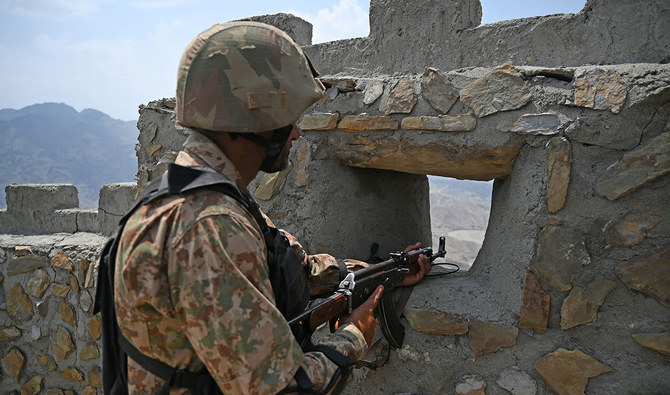
A Pakistani army soldier mans a position at the Pakistan-Afghanistan border near Big Ben post in Khyber district in Khyber Pakhtunkhwa province August 3, 2021. (AFP/File)
Short Url
Updated 24 September 2023
Follow

Soldier killed during gunbattle with militants in northwestern Pakistan— army 

  • Security forces, militants trade fire in northwestern tribal area bordering Afghanistan, says army 
  • Pakistan’s security forces determined to eliminate ‘menace of terrorism,’ says army’s media wing

ISLAMABAD: A Pakistan Army soldier was killed on Saturday when security forces traded fire with militants during an intelligence-based operation in northwestern Pakistan, the army’s media wing said. 

Pakistan’s restive northwestern Khyber Pakhtunkhwa (KP) province has seen multiple clashes between security forces and militants during September. On Sept. 6, the army said 12 militants and four soldiers were killed in an operation in the Lower Chitral area bordering Afghanistan. 

On Sept. 10, seven militants were killed while six were critically wounded during another encounter between security forces and militants in Chitral district. On Sept. 11, a paramilitary soldier was killed while seven others were critically wounded when a blast targeted a security forces convoy in KP’s Peshawar city. 

Saturday’s gunbattle took place in the tribal area of North Waziristan bordering Afghanistan, according to the Inter-Services Public Relations (ISPR). “However, during the operation, Sepoy Shakeel Shafqat (age 21 years, resident of District Khanewal), having fought gallantly, embraced Shahadat [martyrdom],” the army’s media wing said. 

“Security forces of Pakistan are determined to eliminate the menace of terrorism and such sacrifices of our brave soldiers further strengthen our resolve.”

The Tehreek-e-Taliban Pakistan (TTP) or the Pakistani Taliban have mounted attacks on the country’s western regions ever since the takeover of Kabul by the Afghan Taliban in August 2021. Pakistan has also seen an uptick in violence, particularly in KP, since a fragile truce between the state and the banned outfit broke down in November 2022. 

The TTP, which seeks to impose its strict version of Islam in the South Asian country, has carried out some of the deadliest attacks against Pakistani civilians and security forces since 2007 before the army conducted multiple operations to drive them out of the tribal areas. 


Pakistan FM discusses regional situation with Saudi counterpart, urges restraint and dialogue

Updated 5 sec ago
Follow

Pakistan FM discusses regional situation with Saudi counterpart, urges restraint and dialogue

  • This is the second time the two foreign ministers have spoken since the Arab Coalition targeted weapon shipments on Yemen’s Mukalla port
  • Saudi Arabia’s foreign ministry has invited factions in south Yemen to hold a dialogue in Riyadh to ‘discuss just solutions to southern cause’

ISLAMABAD: Pakistan’s foreign minister, Ishaq Dar, discussed the regional situation with his Saudi counterpart, Prince Faisal bin Farhan, and called for restraint and dialogue to resolve issues, the Pakistani foreign office said late Friday, amid tensions prevailing over Yemen.

This is the second time the two foreign ministers have spoken this week since the Saudi Arabia-led Coalition to Support Legitimacy in Yemen carried out a “limited” airstrike on Dec. 30, targeting two shipments of smuggled weapons and military equipment sent from the Emirati port of Fujairah to Mukalla in southern Yemen.

A coalition forces spokesperson said the weapons were meant to support the Southern Transitional Council (STC) forces, backed by the United Arab Emirates (UAE), in Yemen’s Hadramaut and Al-Mahra “with the aim of fueling the conflict.” The UAE has since announced withdrawal of its remaining troops from Yemen, rejecting any actions that could threaten the Kingdom or undermine regional stability.

In their telephonic conversation late Friday, the Pakistani and Saudi foreign ministers discussed the latest situation in the region, according to the Pakistani foreign office.

“FM [Dar] stressed that all concerned in the region must avoid any escalatory move and advised to resolve the issues through dialogue and diplomacy for the sake of regional peace and stability,” it added.

Separately, Saudi Arabia’s foreign ministry invited factions in south Yemen to hold a dialogue in Riyadh to “discuss just solutions to the southern cause.”

The ministry statement said the conference in the Saudi capital had been requested by Rashad Al-Alimi, President of the Yemeni Presidential Leadership Council, and the Kingdom urged all factions to participate “to develop a comprehensive vision” that would fulfill the aspirations of the southern people.

Disregarding previous agreements with the Arab Coalition, the STC separatist group launched a sweeping military campaign early in December, seizing the governorates of Hadramaut along the Saudi border and the eastern governorate of Al-Mahra in Yemen’s border with Oman. It also took control of the strategic PetroMasila oilfields, which account for a massive portion of Yemen’s remaining oil wealth.

The advance has raised the spectre of the return of South Yemen, a separate state from 1967 to 1990, while dealing a hammer-blow to slow-moving peace negotiations with Iran-backed Houthi rebels.

Saudi Arabia said the STC action poses a direct threat to the Kingdom’s national security, and regional stability. The Kingdom has reiterated the only way to bring the southern cause to a resolution is through dialogue.

On Thursday, Pakistan’s foreign office expressed solidarity with Saudi Arabia and reaffirmed Islamabad’s commitment to the Kingdom’s security, amid rising tensions in Yemen.

“Pakistan expresses complete solidarity with the Kingdom of Saudi Arabia and reaffirms its commitment to security of the Kingdom,” Pakistani foreign office spokesperson Tahir Andrabi told reporters at a weekly news briefing.

“Pakistan maintains its firm support for the resolution of Yemen issue through dialogue and diplomacy and hopes that Yemen’s people and regional powers work together toward inclusive and enduring settlement of the issue, safeguarding regional stability.”

Pakistan and Saudi Arabia signed a landmark defense pact in September last year, according to which aggression against one country will be treated as an attack against both. The pact signaled a push by both governments to formalize long-standing military ties into a binding security commitment.