

Mideast faces prospect of ‘environmental catastrophe’: Iraqi PM

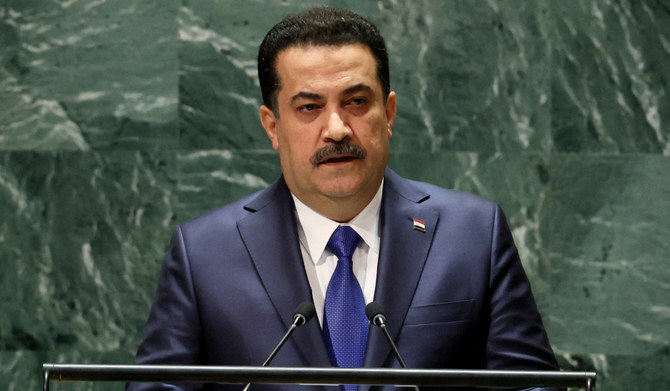
Prime Minister of Iraq Mohammed Shia Al Sudani addresses the 78th Session of the UN General Assembly in New York City, US, September 22, 2023. (REUTERS)
Short Url
Updated 23 September 2023
Follow

Mideast faces prospect of ‘environmental catastrophe’: Iraqi PM

  • Mohammed Shia Al-Sudani highlights Iraqi efforts to create regional group to tackle climate change
  • Report by Ministry of Water Resources warns Tigris, Euphrates rivers could dry out completely by 2040

NEW YORK: The Middle East will be at the forefront of “environmental catastrophe” if the international community fails to get back on track with its efforts to curb climate change, Iraq’s prime minister said on Friday.

Mohammed Shia Al-Sudani told the UN General Assembly in New York that his country is already experiencing the detrimental effects of temperature rises, with low waters on the Tigris-Euphrates river system.

“The environmental catastrophe will be more severe for Iraq and the countries of the region, with an unprecedented rise in temperatures, which render normal forms of life extremely difficult, approaching impossible,” he said.

“Our two rivers are exposed to the brunt of the effects of drought resulting from climate change. We have an urgent need to preserve rights to water resources and international river basins.”

A report by Iraq’s Ministry of Water Resources in 2021 warned that the Tigris and Euphrates rivers would dry out completely by 2040 due to the persistence of droughts and declining water levels that are being driven by climate change.

Al-Sudani highlighted Iraq’s efforts to engage with neighboring states to create a regional coordination mechanism for the management of transboundary water systems, and to tackle drought, dust storms and heatwaves.

“We call for the establishment of a regional grouping, which includes the countries of the Gulf shores, from Iraq and Iran, and the member states of the Gulf Cooperation Council — those countries most exposed to rising temperatures,” he said.

“At the national level, we’ve taken necessary steps to reduce emissions and stop burning associated gases and polluting the environment.

“We’ve also initiated several projects in the field of waste recycling and encouraging the trend towards clean energy.”


Yemen’s STC leader Al-Zubaidi has fled to unknown location, did not board plane to Riyadh: Coalition

Updated 27 min 31 sec ago
Follow

Yemen’s STC leader Al-Zubaidi has fled to unknown location, did not board plane to Riyadh: Coalition

RIYADH: Aidarous Al-Zubaidi, the leader of Yemen’s Southern Transitional Council, has fled to an unknown location and did not board a plane to the Saudi capital Riyadh, where talks with other southern-based factions are set to take place, the coalition to support the legitimate government of Yemen said.

Saudi Arabia offered to mediate between the factions to resolve tensions in the south of the country and both Al-Zubaidi and Yemen’s presidential council leader Rashad Al-Alimi agreed to attend.

A large delegation of STC members did board the flight to Riyadh, the Coalition to Support Legitimacy in Yemen said early on Wednesday. 

Al-Zubaidi was due to arrive in the Kingdom on Tuesday but during a 3-hour flight delay, the coalition said that “unjustified field movements” were observed in Aden. 

The coalition said it had been provided with information that Al-Zubaidi has moved a large number of forces toward Dhala.

Last week, the coalition carried a out a “limited” airstrike targeting two shipments of smuggled weapons and other military hardware into Mukalla in southern Yemen.

It said the two vessels entered the port without authorization from either the Yemeni government or the coalition, prompting the port’s closure.

The large quantity of “weapons and combat vehicles to support the Southern Transitional Council forces in the eastern governorates of Yemen” aimed to fuel the conflict, the coalition said.

More to follow...